


A predictive score for early in-patient tuberculosis mortality: A case-control study
- PMID: 39512650
- PMCID: PMC11541418
- DOI: 10.1016/j.jctube.2024.100487
A predictive score for early in-patient tuberculosis mortality: A case-control study
Abstract
Introduction: In-hospital mortality rates for tuberculosis (TB) patients are high within the first seven days of admission. This study sought to identify predictors of early inpatient mortality and assess the performance of a predictive score for early mortality in a Ugandan tertiary hospital.
Materials and methods: A case-control study was conducted at Kiruddu National Referral Hospital in Kampala, Uganda. Cases included patients admitted with TB who died within seven days of admission, while controls survived beyond this period. Logistic regression was utilized to identify early mortality predictors. The performance of an adapted predictive score (PROS score) was evaluated, assigning scores based on the following criteria: Pulse rate >100 beats/min (1 point), Respiratory rate >20 breaths/min (2 points), Oxygen saturation <92 % (4 points), and Systolic blood pressure <90 mmHg (2 points).
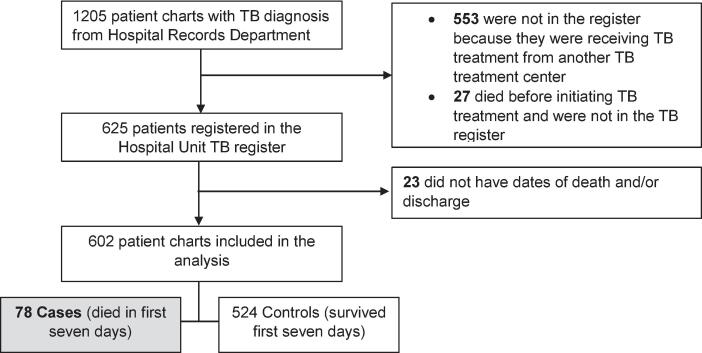
Results: Of 602 hospitalized TB patients, 187 (31.0 %) died during admission. Among these, 78 (41.7 %) died within seven days. Wasting (adjusted odds ratio [aOR] = 5.76, 95 % confidence interval [CI] 2.12-15.63, p = 0.001) and respiratory rate >20 breaths/min (aOR = 2.89, 95 % CI 1.19-7.00, p = 0.019) predicted early mortality. PROS score of ≥1 demonstrated a sensitivity of 87.8 % and negative predictive value of 90.0 %. The ultimate TB treatment success rate of all hospitalized patients (n = 599) was 47.4 % with 275 (45.9 %) dying during TB treatment.
Conclusion: Early and long term mortality rates among hospitalized TB patients are high. Wasting and tachypnea predict early inpatient mortality. The PROS score could be useful in ruling out low-risk patients in low-resource settings.
Keywords: HIV; Hospitalization; Mortality; PROS; Prognostic; Score; Tuberculosis.
© 2024 The Author(s).
Conflict of interest statement
The authors declare that they have no known competing financial interests or personal relationships that could have appeared to influence the work reported in this paper.
References
-
- World Health Organisation . World Health Organization; Geneva, Switzerland: 2021. Global tuberculosis report 2021.
-
- Uplekar M., Weil D., Lonnroth K., Jaramillo E., Lienhardt C., Dias H.M., et al. WHO’s new end TB strategy. Lancet. 2015;385:1799–1801. - PubMed
LinkOut - more resources
Full Text Sources
Miscellaneous
