. 2024 Oct 24:77:102886.
doi: 10.1016/j.eclinm.2024.102886. eCollection 2024 Nov.

The effect of prescription and over-the-counter medications on core temperature in adults during heat stress: a systematic review and meta-analysis

Affiliations

The effect of prescription and over-the-counter medications on core temperature in adults during heat stress: a systematic review and meta-analysis

Lily Hospers et al. EClinicalMedicine. .

Abstract

Background: Heat stress impacts are an escalating global health concern. Public health bodies such as the World Health Organization (WHO) warn that certain medications impair thermoregulation, with limited supporting evidence. Our aim was to investigate whether medications listed by the WHO increase core temperature responses during heat stress.

Methods: For this systematic review and meta-analysis, MEDLINE, PubMed, Scopus, CINAHL, Web of Science, and EMBASE were searched up to Jan.30, 2024. Randomised studies exposing humans to exertional and/or passive heat stress that investigated a drug identified by WHO compared to no drug/placebo were eligible. The primary outcome was core temperature (e.g., rectal, oesophageal, aural, tympanic). We assessed risk of bias (Cochrane's Risk of Bias 2) and certainty of evidence (GRADE). The study was pre-registered on PROSPERO (CRD42020170684).

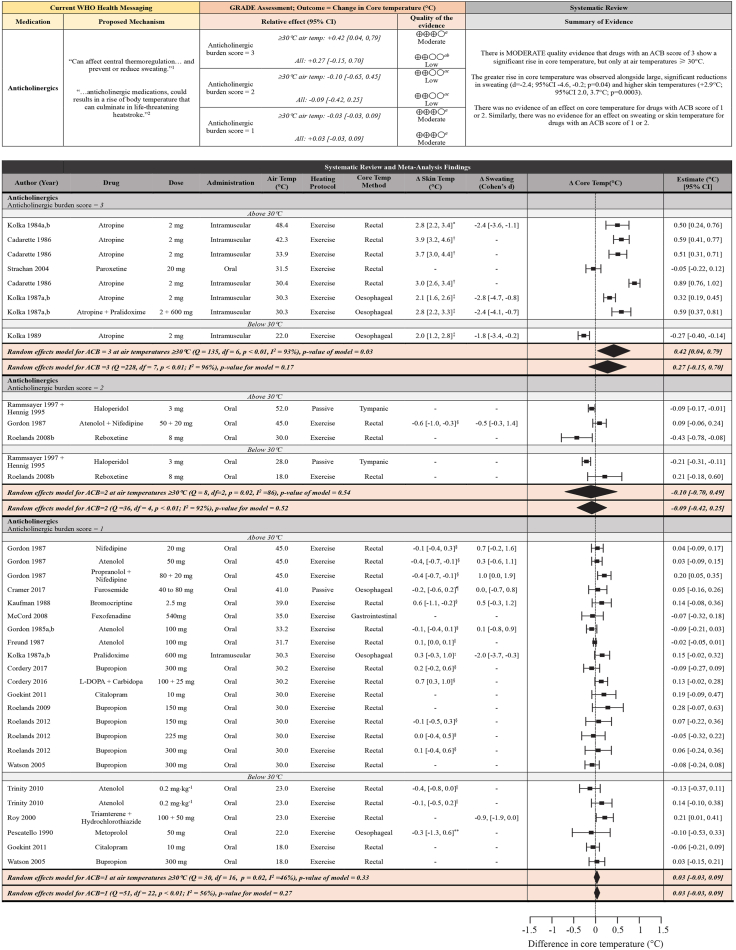
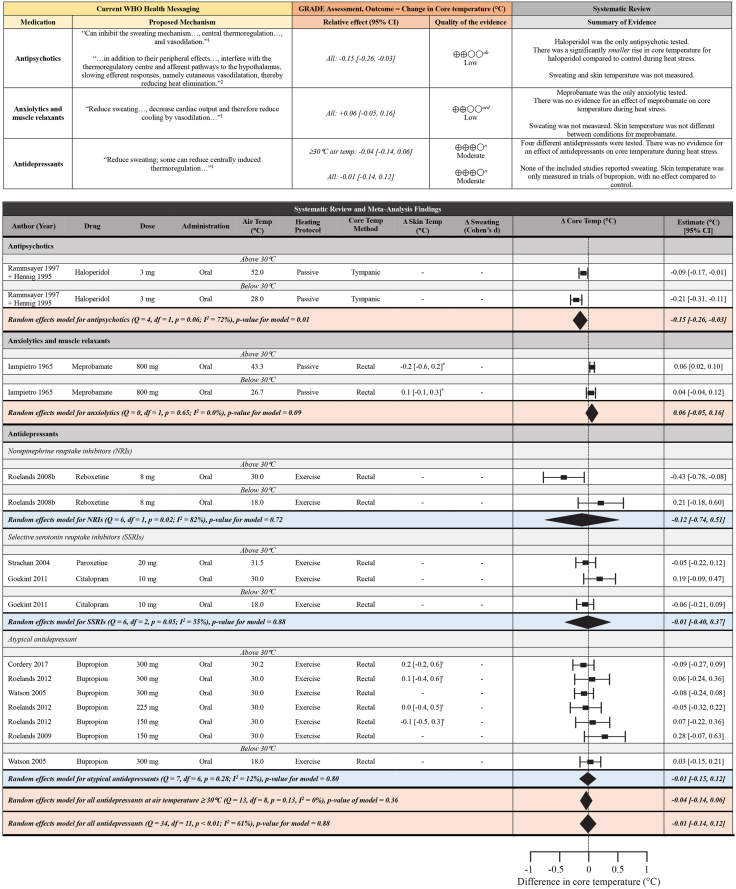
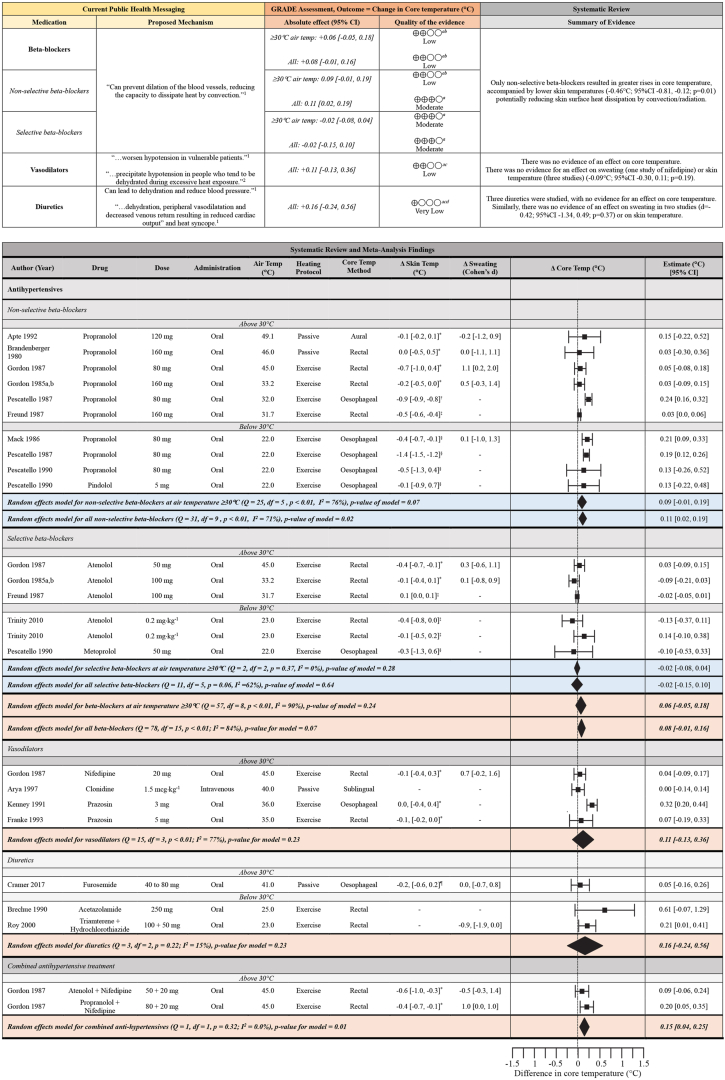
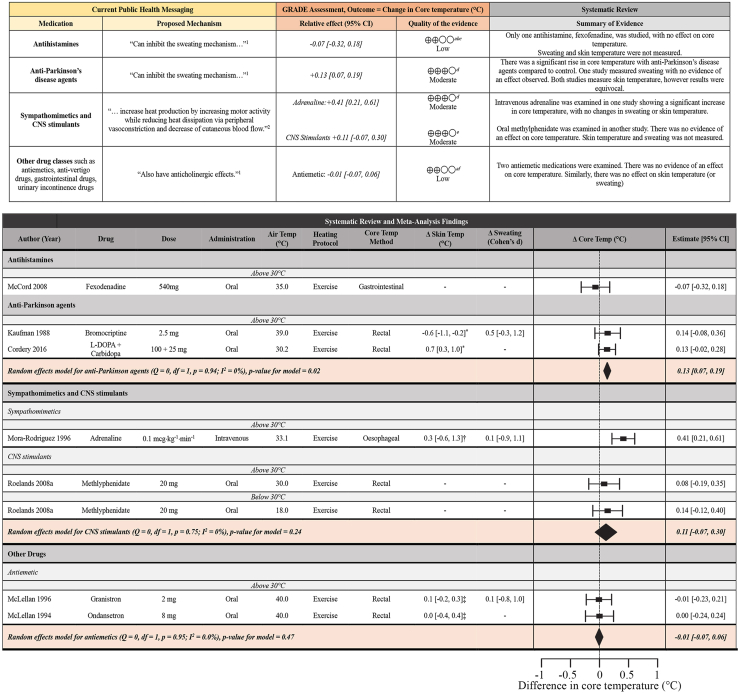
Findings: Thirty-five studies were included enrolling 353 individuals (16 women; 4.5%). Twenty-seven unique medications were tested. The average age of participants across studies was <30 years, and only one study included a clinical population. Under heat stress, there was moderate quality evidence that drugs with high anticholinergic properties increased core temperature at air temperatures ≥30°C (+0.42°C; 95% CI 0.04, 0.79°C; p = 0.03) alongside reduced sweating, although evidence is limited to the drug atropine. Similarly, non-selective beta-blockers (+0.11°C; 95% CI 0.02, 0.19°C; p = 0.02), adrenaline (+0.41°C; 95% CI 0.21, 0.61°C) and anti-Parkinson's agents (+0.13°C; 95% CI 0.07, 0.19°C; p = 0.02) elevated core temperature. Antidepressants, diuretics, or drugs with weak anticholinergic effects did not alter core temperature responses.

Interpretation: Current evidence supports strong anticholinergics, non-selective beta-blockers, adrenaline, and anti-Parkinson's agents impairing thermoregulation during heat stress. No evidence indicated thermoregulation is impacted by other WHO-listed medications. Evidence is predominantly limited to healthy young men, with short heat stress exposures. Studies over longer durations, in women, older adults and those with chronic diseases are required to better inform the pharmaceutical management of patients during hot weather.

Funding: This study was supported by a National Health and Medical Research Council (NHMRC) Investigator Grant (2021/GNT2009507; Holder: O. Jay).

Keywords: Drugs; Heat illness; Medications; Thermoregulation.


Conflict of interest statement

KLB reports grants from the NIH, Wellcome Trust, honoraria for keynote talks and travel support from the World Health Organization to attend meetings, conferences and give keynote talks. KLB is also the Chair of the US National Academy of Sciences Board on Environmental Change and Society. All of KLBs declarations are outside the scope of the submitted work. LK acknowledges funding from the National Institutes of Health (NIH; AG067471) outside of the submitted work. OJ acknowledges funding from the National Health and Medical Research Council (NHMRC 2021/GNT2009507) for the submitted work. OJ also reports grants from the Wellcome Trust and Resilience NSW, consulting fees from a National Institutes of Health grant, expert testimony for the National Rugby League, support for attending meetings and travel from the Global Heat and Health Information Network and Minderoo Foundation – all of which are outside the scope of the submitted work.

Figures
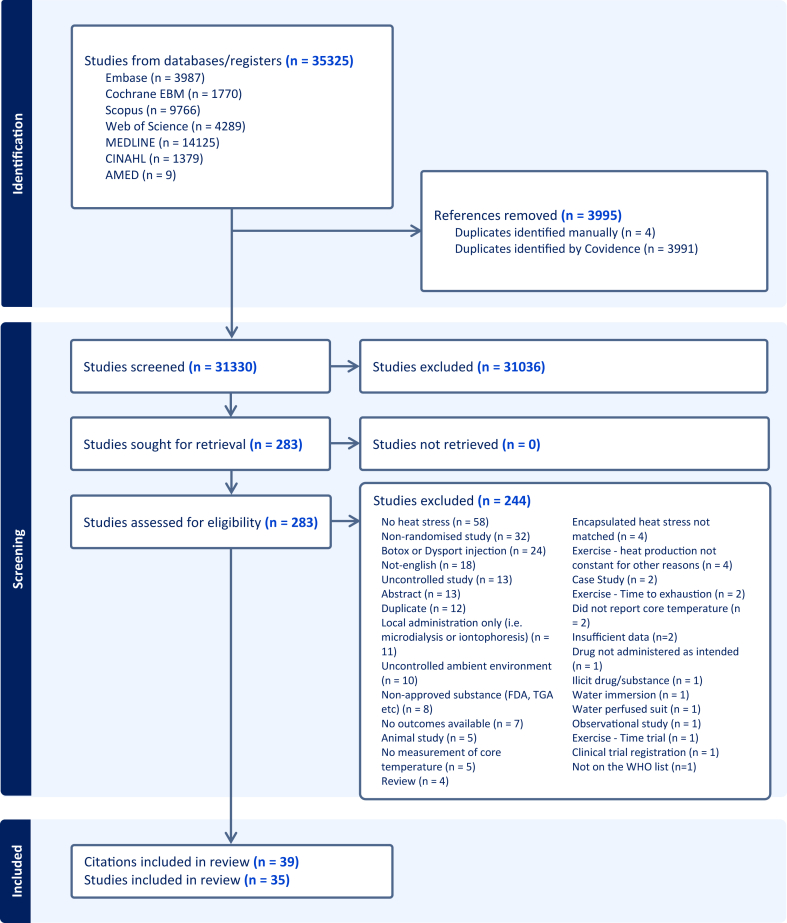
Fig. 1
Fig. 1
PRISMA flow diagram.
Fig. 2
Fig. 2
Effect of anticholinergic medications on core temperature. Temp = temperature. 1World Health Organization. Regional Office for E. Public health advice on preventing health effects of heat: new and updated information for different audiences. Copenhagen: WHO Regional Office for Europe; 2011. 2World Health Organization. Regional Office for E, European C. Improving public health responses to extreme weather/heat-waves: EuroHEAT: technical summary. Copenhagen: WHO Regional Office for Europe; 2009. aThe population sampled does not reflect the population that would usually take this medication. The effects of this medication may be different in the target population. bWhile the point estimate reflects the potential for harm (greater rise in core temperature), the 95% CIs indicate a range of values that include the potential for significant harm through to benefit. cWhile the point estimate indicates the potential for benefit (a lower rise in core temperature), the 95% CIs ranges from a significant benefit through to significant harm. Skin temperature measured using; ∗ 3-site average of arm, calf and chest; † 3-site average of calf, chest and forearm; ‡ 8-site average of back, calf, chest, forearm, hand, head, thigh and arm; § 4-site average of calf, chest, shoulder and thigh; ¶ 6-site average of abdomen, calf, chest, lower back, shoulder and thigh; || 6-site average of arm, back, calf, chest, forearm and thigh; ∗∗ 8-site average of chest, posterior flank, forehead, anterior flank, upper arm, forearm, thigh and calf.
Fig. 3
Fig. 3
Effect of antipsychotic, anxiolytics and antidepressants on core temperature. Temp = temperature. 1World Health Organization. Regional Office for E. Public health advice on preventing health effects of heat: new and updated information for different audiences. Copenhagen: WHO Regional Office for Europe; 2011. 2World Health Organization. Regional Office for E, European C. Improving public health responses to extreme weather/heat-waves: EuroHEAT: technical summary. Copenhagen: WHO Regional Office for Europe; 2009. aThe population sampled does not reflect all groups that could potentially take this medication. The effects of this medication may be different in older individuals for example, or those with other chronic illnesses. bOnly one study has been conducted with antipsychotic medication. While a significant benefit (lower rise in core temperature) was observed, we cannot say with confidence that this result is reflective of all other antipsychotic medications. cWhile the point estimate indicates the potential for harm (a greater rise in core temperature), the 95% CIs ranges from a significant benefit through to significant harm. dOnly one study has been conducted with anxiolytic medications. We cannot say with confidence that this result is reflective of all other anxiolytics. Skin temperature measured using; ∗ 17-site average (sites not reported); † 4-site average of calf, chest, shoulder and thigh.
Fig. 4
Fig. 4
Effect of betablockers, vasodilators and diuretics on core temperature. Temp = temperature. 1World Health Organization. Regional Office for E. Public health advice on preventing health effects of heat: new and updated information for different audiences. Copenhagen: WHO Regional Office for Europe; 2011. 2World Health Organization. Regional Office for E, European C. Improving public health responses to extreme weather/heat-waves: EuroHEAT: technical summary. Copenhagen: WHO Regional Office for Europe; 2009. aThe population sampled does not reflect the population that would usually take this medication. The effects of this medication may be different in the target population. bWhile the point estimate reflects the potential for harm (greater rise in core temperature), the 95% CIs include the null. cWhile the point estimate reflects the potential for harm (greater rise in core temperature), the 95% CIs indicate a range of values that include the potential for significant harm through to benefit. dThe proportion of information from studies at high risk of bias is sufficient to affect interpretation of results. Skin temperature measured using; ∗4-site average of calf, chest, shoulder and thigh; †8-site average of chest, posterior flank, forehead, anterior flank, upper arm, forearm, thigh and calf; ‡6-site average of arm, back, calf, chest, forearm and thigh; § 8-site average of chest, posterior flank, forehead, anterior flank, upper arm, forearm, thigh and calf; ¶ 6-site average of abdomen, calf, chest, lower back, shoulder and thigh.
Fig. 5
Fig. 5
Effect of anti Parkinson’s agents, sympathomimetics, CNS stimulants and antiemetics on core temperature. Temp = temperature. 1World Health Organization. Regional Office for E. Public health advice on preventing health effects of heat: new and updated information for different audiences. Copenhagen: WHO Regional Office for Europe; 2011. 2World Health Organization. Regional Office for E, European C. Improving public health responses to extreme weather/heat-waves: EuroHEAT: technical summary. Copenhagen: WHO Regional Office for Europe; 2009. aThe population sampled does not reflect all groups that could potentially take this medication. The effects of this medication may be different in older individuals for example, or those with other chronic illnesses. bWhile the point estimate indicates the potential for benefit (a lower rise in core temperature), the 95% CIs ranges from a significant benefit through to significant harm. cOnly one study has been conducted with antihistamine medication. We cannot say with confidence that this result is reflective of all other antihistamine medications. dThe population sampled does not reflect the population that would usually take this medication. The effects of this medication may be different in the target population. eWhile the point estimate indicates the potential for harm (a greater rise in core temperature), the 95% CIs ranges from a small benefit through to significant harm. fWhile the point estimate does not suggest any effect of anti-emetic medication, the confidence intervals range from significantly lower to significantly greater core temperatures. gWhile the point estimate suggests harm (greater rise in core temperature), the 95% confidence intervals include a negligible effect. Skin temperature measured using; ∗4-site average of calf, chest, shoulder and thigh; † 5-site average of calf, chest, forearm, shoulder and thigh; ‡ 12-site average of abdomen, calf, chest, forehead, anterior thigh, foot, forearm, lower back, posterior thigh, shin, upper back and wrist.

References

    1. National Center for Health Statistics . 2019. Health, United States, 2019: Table 039 Prescription drug use in the past 30 days, by sex, race and Hispanic origin, and age: United States, selected years 1988-1994 through 2015-2018. Hyattsville, MD.https://www.cdc.gov/nchs/hus/data-finder.htm Last updated June 26, 2023.
    1. World Health Organization. Regional Office for Europe . World Health Organization. Regional Office for Europe; Copenhagen: 2011. Public health advice on preventing health effects of heat: new and updated information for different audiences.
    1. World Health Organization. Regional Office for Europe . WHO Regional Office for Europe; Copenhagen: 2009. Improving public health responses to extreme weather/heat-waves : EuroHEAT : technical summary.
    1. Centers for Disease Control and Prevention . 2022. Tips for preventing heat-related illness.https://www.cdc.gov/disasters/extremeheat/heattips.html
    1. Health Canada . Health Canada; Ottawa, ON, Canada: 2011. Extreme heat events guidelines: technical guide for health care workers.

LinkOut - more resources