


Magnetic Resonance Elastography Combined With PI-RADS v2.1 for the Identification of Clinically Significant Prostate Cancer
- PMID: 39513399
- PMCID: PMC11991885
- DOI: 10.1002/jmri.29653
Magnetic Resonance Elastography Combined With PI-RADS v2.1 for the Identification of Clinically Significant Prostate Cancer
Abstract
Background: Multiparametric MRI may cause overdiagnosis of clinically significant prostate cancer (csPCa) with the Prostate Imaging Reporting and Data System version 2.1 (PI-RADS v2.1).
Objectives: To investigate the diagnostic performance of stiffness as a standalone and complementary marker to PI-RADS v2.1 for diagnosing csPCa.
Study type: Prospective.
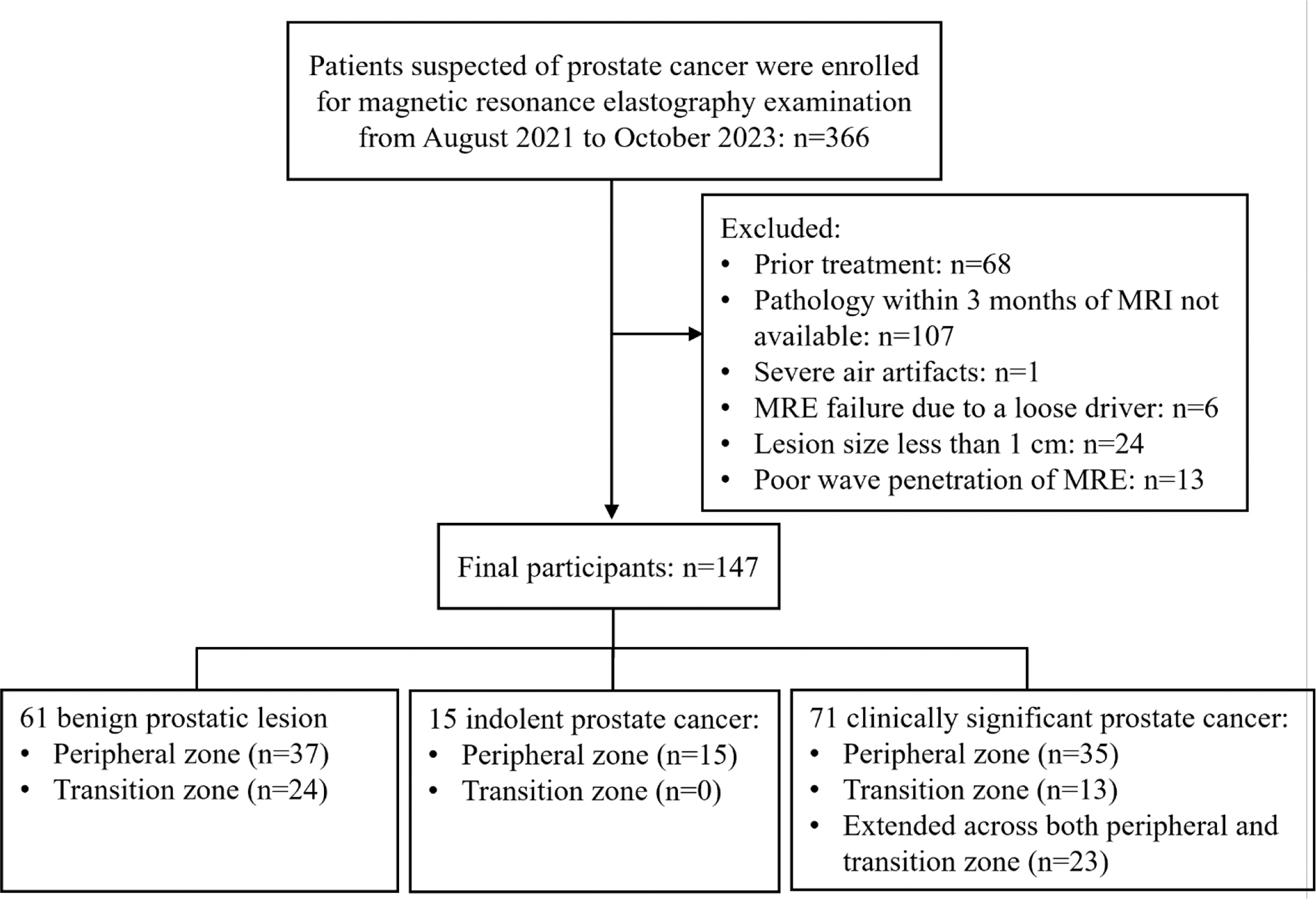
Subjects: One hundred forty-seven participants with pathologically confirmed prostate lesions (≥1 cm), including 71 with csPCa.
Field strength/sequence: T1-weighted fast spin-echo, T2-weighted fast spin-echo, single-shot echo-planar diffusion-weighted imaging, fast 3D gradient-echo T1-weighted dynamic contrast-enhanced imaging, and 3D single-shot spin-echo based echo-planar MR elastography at 3.0 T.
Assessment: The PI-RADS v2.1 score was assessed by three radiologists independently. Lesion shear stiffness (SS) values at 60 Hz and 90 Hz were measured. A modified PI-RADS integrating stiffness with PI-RADS v2.1 was developed. Diagnostic performance for csPCa was compared between stiffness, PI-RADS v2.1 and the modified PI-RADS.
Statistical test: Spearman's correlation, Fleiss κ and intraclass correlation, Pearson correlation, one-way analysis of variance, area under the receiver operating characteristic curve (AUC), and the Delong test. Significance level was P < 0.05.
Results: In the peripheral zone, csPCa (N = 35) had significantly higher SS than non-csPCa at 60 Hz (3.22 ± 0.66 kPa vs. 2.56 ± 0.56 kPa) and at 90 Hz (5.64 ± 1.30 kPa vs. 4.48 ± 0.84 kPa). PI-RADS v2.1 showed 100% sensitivity, 58% specificity, and 0.79 AUC for detecting csPCa. SS achieved 97% sensitivity, 52% specificity, and 0.80 AUC at 60 Hz, while SS had 63% sensitivity, 87% specificity, and 0.78 AUC at 90 Hz. The modified PI-RADS, combing SS at 60 Hz with PI-RADS v2.1, resulted in a significantly increased AUC (0.86) compared to that of PI-RADS v2.1, with a sensitivity of 97% and specificity of 75%.
Data conclusion: Stiffness can help identifying csPCa in the peripheral zone. Combining stiffness with the PI-RADS v2.1 improved the diagnostic accuracy and specificity for csPCa.
Evidence level: 1 TECHNICAL EFFICACY: Stage 2.
Keywords: Prostate Imaging Reporting and Data System; clinically significant prostate cancer; elastography.
© 2024 International Society for Magnetic Resonance in Medicine.
Figures



References
-
- Bray F, Ferlay J, Soerjomataram I, Siegel RL, Torre LA, Jemal A: Global cancer statistics 2018: GLOBOCAN estimates of incidence and mortality worldwide for 36 cancers in 185 countries. CA Cancer J Clin 2018; 68:394–424. - PubMed
-
- Litwin MS, Tan H-J: The Diagnosis and Treatment of Prostate Cancer: A Review. JAMA 2017; 317:2532–2542. - PubMed
-
- Turkbey B, Rosenkrantz AB, Haider MA, et al.: Prostate Imaging Reporting and Data System Version 2.1: 2019 Update of Prostate Imaging Reporting and Data System Version 2. Eur Urol 2019; 76:340–351. - PubMed
-
- Stabile A, Giganti F, Rosenkrantz AB, et al.: Multiparametric MRI for prostate cancer diagnosis: current status and future directions. Nat Rev Urol 2020; 17:41–61. - PubMed
MeSH terms
Grants and funding
LinkOut - more resources
Full Text Sources
Medical
Research Materials
Miscellaneous
