Review
. 2024 Oct 30;16(21):3709.
doi: 10.3390/nu16213709.

Plant-Based Diets and Phytochemicals in the Management of Diabetes Mellitus and Prevention of Its Complications: A Review

Affiliations
Review

Plant-Based Diets and Phytochemicals in the Management of Diabetes Mellitus and Prevention of Its Complications: A Review

Prawej Ansari et al. Nutrients. .

Abstract

Diabetes mellitus (DM) is currently regarded as a global public health crisis for which lifelong treatment with conventional drugs presents limitations in terms of side effects, accessibility, and cost. Type 2 diabetes (T2DM), usually associated with obesity, is characterized by elevated blood glucose levels, hyperlipidemia, chronic inflammation, impaired β-cell function, and insulin resistance. If left untreated or when poorly controlled, DM increases the risk of vascular complications such as hypertension, nephropathy, neuropathy, and retinopathy, which can be severely debilitating or life-threatening. Plant-based foods represent a promising natural approach for the management of T2DM due to the vast array of phytochemicals they contain. Numerous epidemiological studies have highlighted the importance of a diet rich in plant-based foods (vegetables, fruits, spices, and condiments) in the prevention and management of DM. Unlike conventional medications, such natural products are widely accessible, affordable, and generally free from adverse effects. Integrating plant-derived foods into the daily diet not only helps control the hyperglycemia observed in DM but also supports weight management in obese individuals and has broad health benefits. In this review, we provide an overview of the pathogenesis and current therapeutic management of DM, with a particular focus on the promising potential of plant-based foods.

Keywords: diabetes; dietary adjuncts; glucose; insulin; medicinal plants; phytoconstituents.


Conflict of interest statement

The authors affirm that there are no conflicts of interest present in this paper.

Figures
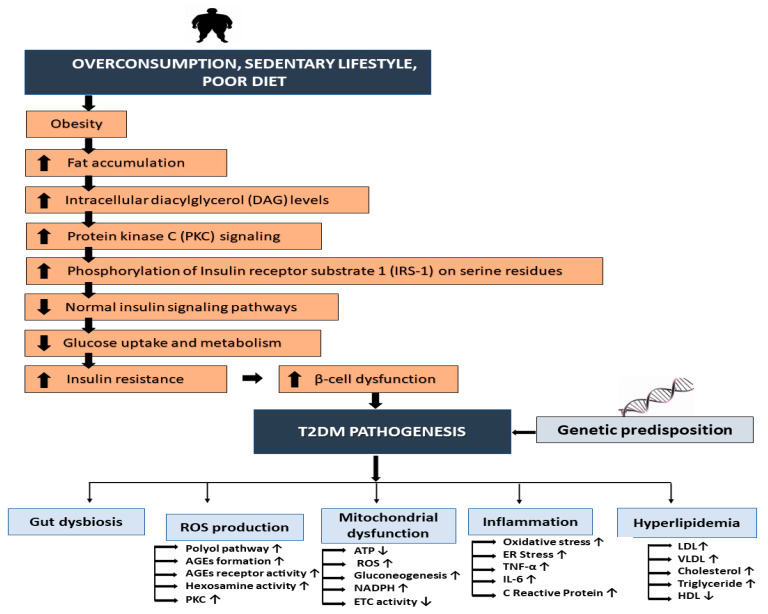
Figure 1
Figure 1
Mechanistic overview of T2DM pathogenesis. Obesity, driven by overconsumption, a sedentary lifestyle, and poor diet, results in increased fat accumulation and intracellular diacylglycerol (DAG) levels, which activate Protein Kinase C (PKC) signaling. This leads to the phosphorylation of Insulin Receptor Substrate 1 (IRS-1) on serine residues, impairing normal insulin signaling pathways, reducing glucose uptake, and increasing insulin resistance. Insulin resistance, in turn, promotes β-cell dysfunction, contributing to the progression of type 2 diabetes mellitus (T2DM). Genetic predisposition further influences the disease’s development. Key processes downstream include gut dysbiosis, reactive oxygen species (ROS) production, mitochondrial dysfunction, inflammation, and hyperlipidemia. Increase (↑) and decrease (↓).
Figure 2
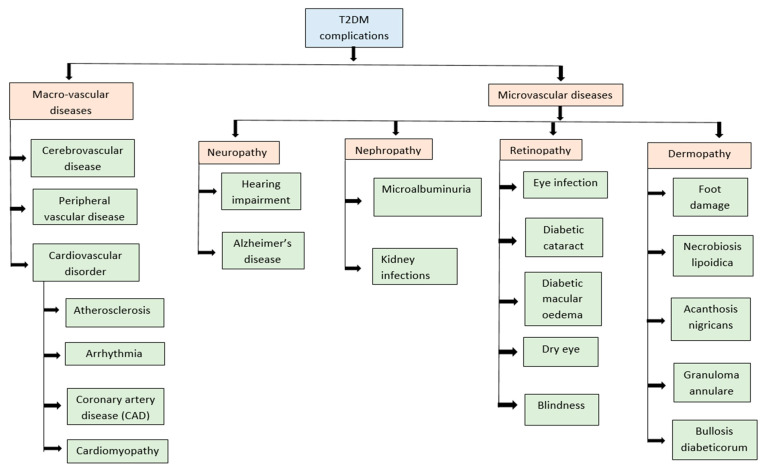
Figure 2
Flow chart of T2DM-associated vascular complications.
Figure 3
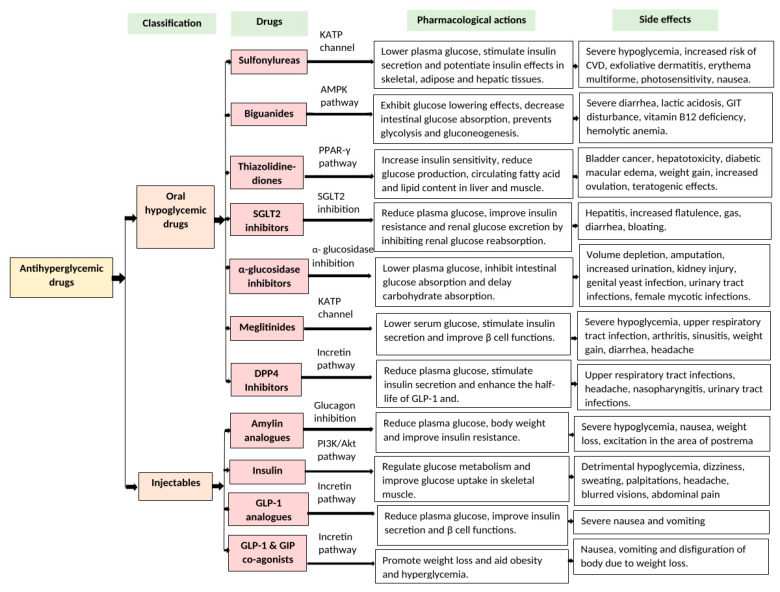
Figure 3
Flow chart of the current oral and injectable antidiabetic drugs, their pharmacological actions, and adverse side effects.
Figure 4
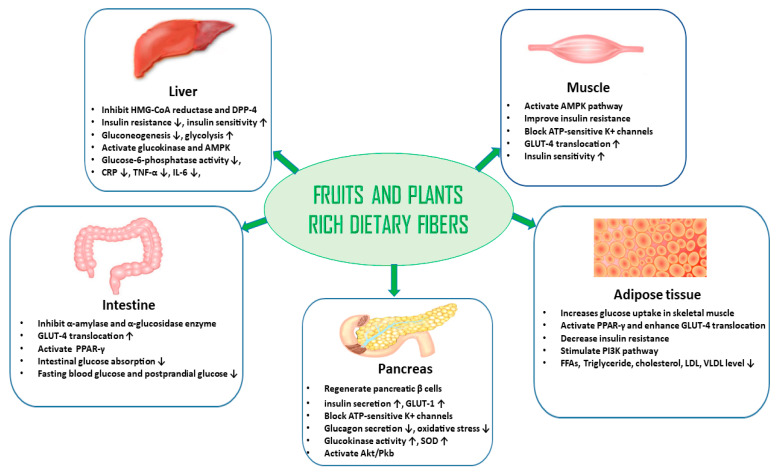
Figure 4
Antidiabetic effects of dietary fiber-rich plants and fruits on various organs and tissues. Dietary fiber-rich herbs and fruits exhibit antihyperglycemic properties by activating several molecular pathways. They may contribute to the regeneration of pancreatic β-cells; increase insulin secretion; enhance insulin sensitivity; increase glucose uptake in tissues; enhance GLUT-4 translocation; increase glycolysis in the liver; activate the AMPK, PPAR-γ, Akt/Pkb, or PI3K pathways in adipose tissue; improve glucokinase activity; reduce insulin resistance; delay intestinal glucose absorption; lower fasting blood sugar and postprandial glucose; reduce glucagon secretion and oxidative stress; inhibit α-amylase, α-glucosidase, DPP-4, and glucose-6-phosphatase enzymatic activity; decrease gluconeogenesis; suppress TNF-α and IL-6 release; and block ATP-sensitive K+ channels in the pancreas and muscle to regulate blood glucose levels. Increase (↑) and decrease (↓).
Figure 5
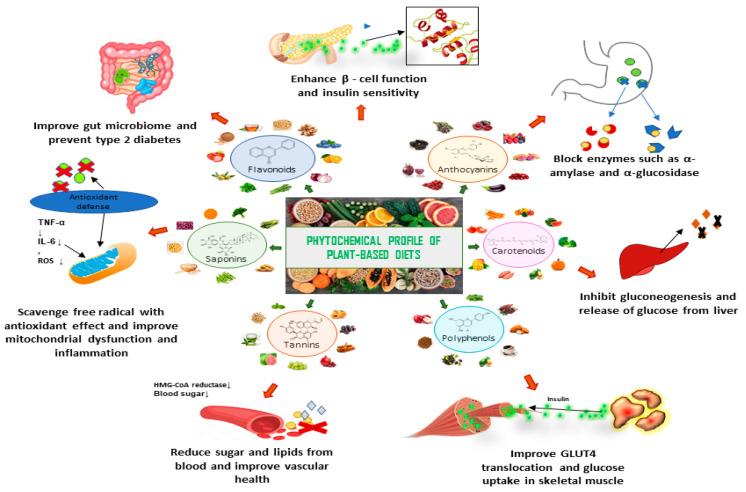
Figure 5
Antidiabetic effects of phytochemicals in diabetes management. Phytochemicals, including flavonoids, anthocyanins, carotenoids, saponins, tannins, and polyphenols, are abundant in plant-based foods such as fruits, vegetables, legumes, and whole grains. These compounds play a critical role in diabetes management by (i) enhancing beta-cell function, (ii) improving insulin sensitivity, (iii) inhibiting carbohydrate-digesting enzymes such as α-amylase and α-glucosidase, (iv) reducing glucose production in the liver, (v) improving gut health and promoting beneficial microbiota, and (vi) reducing inflammation and oxidative stress. Such actions contribute to improved glycemic control, thereby limiting the impact of diabetes and its complications. Increase (↑) and decrease (↓).

References

    1. Maggio C.A., Pi-Sunyer F.X. Obesity and Type 2 Diabetes. Endocrinol. Metab. Clin. N. Am. 2003;32:805–822. doi: 10.1016/S0889-8529(03)00071-9. - DOI - PubMed
    1. Harreiter J., Roden M. Diabetes Mellitus–Definition, Klassifikation, Diagnose, Screening und Prävention (Update 2019) [Diabetes Mellitus-Definition, Classification, Diagnosis, Screening and Prevention (Update 2019)] Wien. Klin. Wochenschr. 2019;131((Suppl. S1)):6–15. doi: 10.1007/s00508-019-1450-4. - DOI - PubMed
    1. Malone J.I., Hansen B.C. Does Obesity Cause Type 2 Diabetes Mellitus (T2DM)? Or Is It the Opposite? Pediatr. Diabetes. 2019;20:5–9. doi: 10.1111/pedi.12787. - DOI - PubMed
    1. Thomas C.C., Philipson L.H. Update on Diabetes Classification. Med. Clin. N. Am. 2015;99:1–16. doi: 10.1016/j.mcna.2014.08.015. - DOI - PubMed
    1. Acharjee S., Ghosh B., Al-Dhubiab B., Nair A. Understanding Type 1 Diabetes: Etiology and Models. Can. J. Diabetes. 2013;37:269–276. doi: 10.1016/j.jcjd.2013.05.001. - DOI - PubMed

LinkOut - more resources