. 2024 Oct 25;13(21):2979.
doi: 10.3390/plants13212979.

Environmental Pollutant Anthracene Induces ABA-Dependent Transgenerational Effects on Gemmae Dormancy in Marchantia polymorpha

Affiliations

Environmental Pollutant Anthracene Induces ABA-Dependent Transgenerational Effects on Gemmae Dormancy in Marchantia polymorpha

Juan I Tolopka et al. Plants (Basel). .

Abstract

Anthracene, a polycyclic aromatic hydrocarbon (PAH) from fossil fuel combustion, poses significant environmental threats. This study investigates the role of abscisic acid (ABA) in the anthracene tolerance of the liverwort Marchantia polymorpha using mutants deficient in ABA perception (Mppyl1) or biosynthesis (Mpaba1). In this study, we monitored the role of ABA in the anthracene tolerance response by tracking two ABA-controlled traits: plant growth inhibition and gemmae dormancy. We found that the anthracene-induced inhibition of plant growth is dose-dependent, similar to the growth-inhibiting effect of ABA, but independent of ABA pathways. However, gemmae dormancy was differentially affected by anthracene in ABA-deficient mutants. We found that gemmae from anthracene-exposed WT plants exhibited reduced germination compared to those from mock-treated plants. This suggests that the anthracene exposure of mother plants induces a transgenerational effect, resulting in prolonged dormancy in their asexual propagules. While Mppyl1 gemmae retained a dormancy delay when derived from anthracene-exposed thalli, the ABA biosynthesis mutant Mpaba1 did not display any significant dormancy delay as a consequence of anthracene exposure. These results, together with the strong induction of ABA marker genes upon anthracene treatment, imply that anthracene-induced germination inhibition relies on ABA synthesis in the mother plant, highlighting the critical role of MpABA1 in the tolerance response. These findings reveal a complex interplay between anthracene stress and ABA signaling, where anthracene triggers ABA-mediated responses, influencing reproductive success and highlighting the potential for leveraging genetic and hormonal pathways to enhance plant resilience in contaminated habitats.

Keywords: abscisic acid mutants; ecological impact; gemma germination; liverwort tolerance; polycyclic aromatic hydrocarbons; regulation.


Conflict of interest statement

The authors declare no conflicts of interest.

Figures
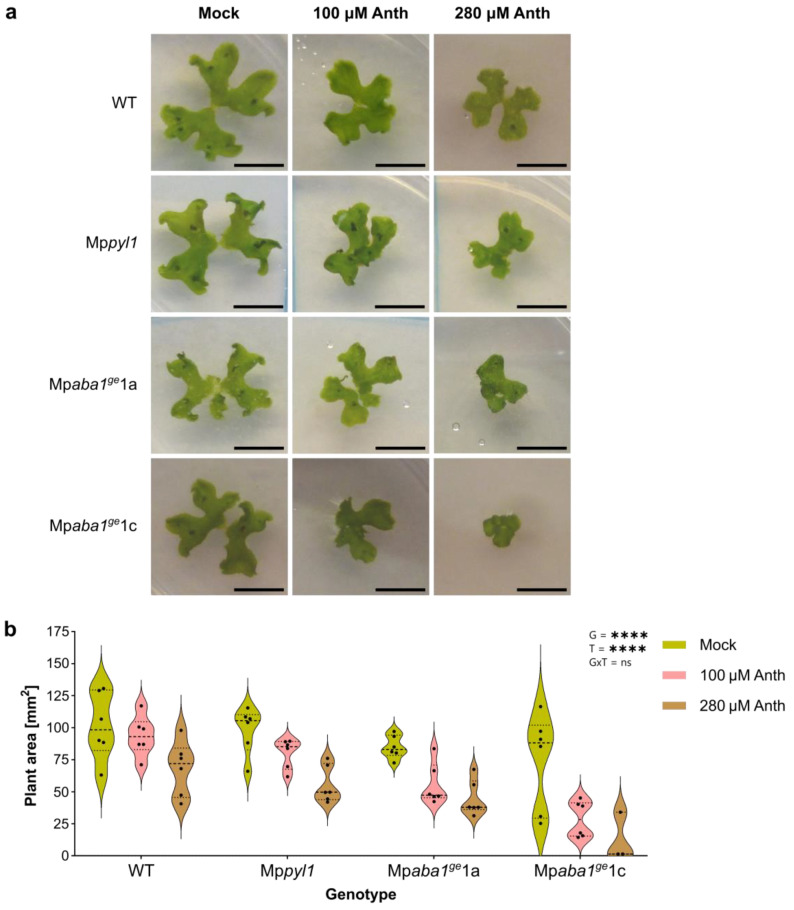
Figure 1
Figure 1
Dose–response inhibition of anthracene on plant area. M. polymorpha plants of different genotypes (WT, Mppyl1, Mpaba1ge1a, and Mpaba1ge1c) were grown in axenic conditions for 28 days using 0.5X× Gamborg medium supplemented with 100 and 280 μM of anthracene (Anth). Mock plants were used as a control. (a) Representative images of 28-day-old plants treated with anthracene, used for area quantification. Scale bars = 1 cm. (b) Violin plots show the distribution of individual measurements (n = 6). Each data point is the average of one Petri dish containing four plants. The inset values summarize the statistical significance of the main effects of G and T and the GxT interaction. Asterisks denote significant differences (p < 0.001).
Figure 2
Figure 2
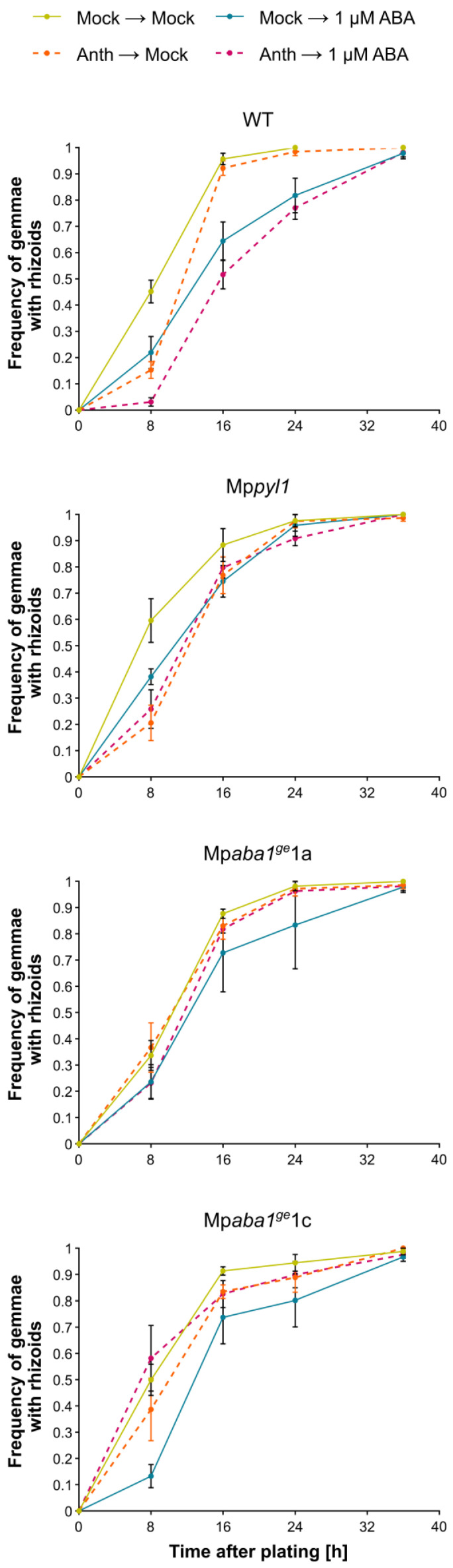
An intact ABA response is required for anthracene to inhibit gemmae germination. Dormant gemmae were placed on 0.5× Gamborg medium supplemented with 0 (Mock) or 1 μM ABA. The gemmae were collected from plants grown under control conditions (Mock) or exposed to 100 μM anthracene (Anth). They were plated on 0.5× Gamborg medium and grown under long-day conditions (80–100 μmol m−2 s−1) at 22 °C. Rhizoid emergence (germination) was scored at regular intervals of 8 h after plating. Each data point represents the average of three plates, with error bars indicating SE of proportions (n = 3). Each plate has an average of 15 plants. A one-way ANOVA was performed to assess the effect of treatment on the frequency of germination at the 8 h time point. Significant differences were further examined using Fisher’s LSD post hoc test (p < 0.05).
Figure 3
Figure 3
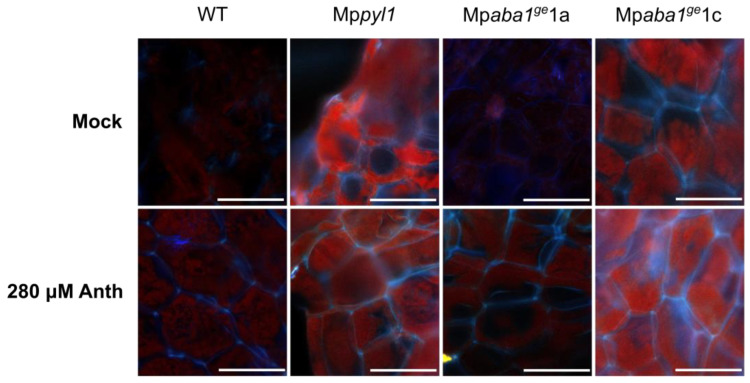
Quantification of autofluorescence associated with anthracene internalization in plants. M. polymorpha plants of different genotypes (WT, Mppyl1, Mpaba1ge1a, and Mpaba1ge1c) were grown in 0.5× Gamborg medium supplemented or not with 280 μM of anthracene (Anth) for 5 d. Mock-treated plants were used as a control. Representative pictures of autofluorescence are shown here (scale bars = 20 μm).
Figure 4
Figure 4
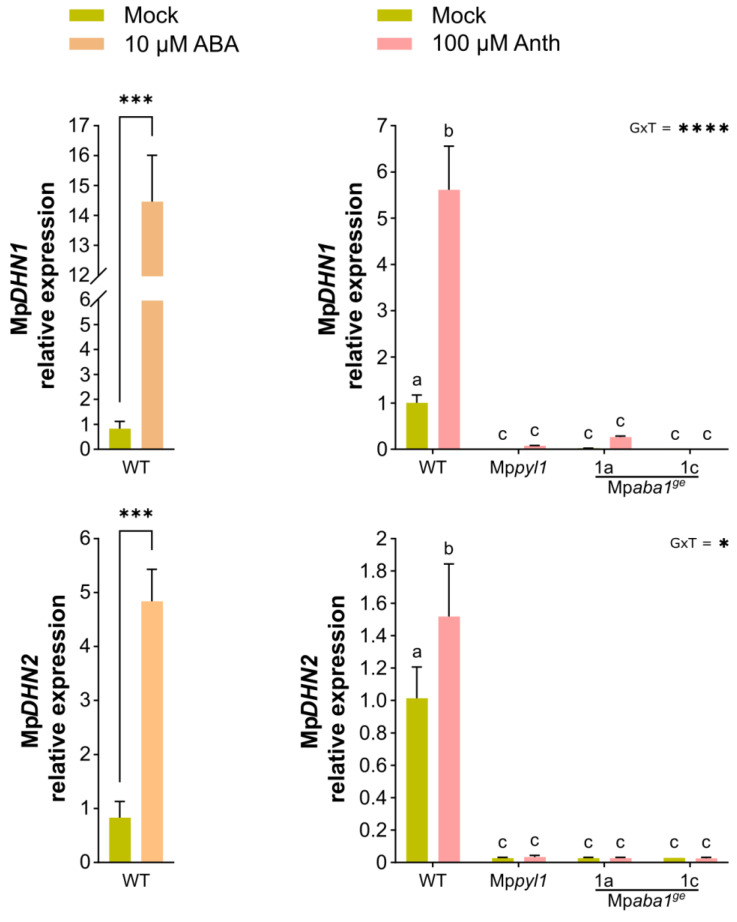
Anthracene induction of ABA-responsive genes is abrogated in ABA-related mutants. Effect of 100 μM anthracene (Anth) on the induction of ABA-responsive genes 24 h after elicitation: MpDHN1 and MpDHN2. WT plants treated with 10 μM ABA for 24 h were used as a positive control. Asterisks denote significant differences between treatment means (p < 0.001). Transcript abundance was measured as the response variable after chemical treatment and expressed relative to the level detected in mock WT plants. Thin bars indicate 1 SEM (n = 3 replicates). The GxT interaction is significant in both panels (p < 0.05); different letters indicate significant differences between treatment means.

References

    1. Idowu O., Semple K.T., Ramadass K., O’Connor W., Hansbro P., Thavamani P. Beyond the obvious: Environmental health implications of polar polycyclic aromatic hydrocarbons. Environ. Int. 2019;123:543–557. doi: 10.1016/j.envint.2018.12.051. - DOI - PubMed
    1. Harrison R.M. Environmental Pollutant Exposures and Public Health. Royal Society of Chemistry; London, UK: 2020.
    1. Han J., Liang Y., Zhao B., Wang Y., Xing F., Qin L. Polycyclic aromatic hydrocarbon (PAHs) geographical distribution in China and their source, risk assessment analysis. Environ. Pollut. 2019;251:312–327. doi: 10.1016/j.envpol.2019.05.022. - DOI - PubMed
    1. Nadal M., Schuhmacher M., Domingo J. Levels of PAHs in soil and vegetation samples from Tarragona County, Spain. Environ. Pollut. 2004;132:1–11. doi: 10.1016/j.envpol.2004.04.003. - DOI - PubMed
    1. González A., Vidal C., Espinoza D., Moenne A. Anthracene induces oxidative stress and activation of antioxidant and detoxification enzymes in Ulva lactuca (Chlorophyta) Sci. Rep. 2021;11:7748. doi: 10.1038/s41598-021-87147-5. - DOI - PMC - PubMed

LinkOut - more resources