. 2024 Nov 9;40(1):300.
doi: 10.1007/s00383-024-05865-z.

Follow-up and transition practices in esophageal atresia: a review of European Reference Network on rare Inherited and Congenital Anomalies (ERNICA) centres and affiliates

Affiliations

Follow-up and transition practices in esophageal atresia: a review of European Reference Network on rare Inherited and Congenital Anomalies (ERNICA) centres and affiliates

Natalie Durkin et al. Pediatr Surg Int. .

Abstract

Purpose: The purpose of this study was to understand the provision and distribution of esophageal atresia (EA) follow-up (FU) and transition services across European Reference Network for rare Inherited and Congenital Anomalies (ERNICA) member and affiliate centers.

Methods: A REDCap questionnaire was sent to clinical leads of 18 ERNICA members and 14 affiliate centers.

Results: 29 of 32 centers responded (91%), the majority of which were highly specialized. Two-thirds had a dedicated EA clinic with a specialist multi-disciplinary team (MDT), offered to selected/complex patients only in 40% of centers. ERNICA centers were more likely to offer an MDT FU clinic than affiliates, with lack of resources most cited as a barrier to uptake (67%). Delivery of routine investigations was heterogeneous, particularly provision of three endoscopies over the course of FU (24%). Only 55% had a dedicated transition pathway, more prevalent in ERNICA centers (81% vs. 30%; p < 0.01). Self-reported awareness of ERNICA and European Society for Pediatric Gastroenterology Hepatology and Nutrition (ESPGHAN) guidance for FU and transition was poor (28%).

Conclusion: Despite the existence of European follow-up and transition guidelines, their delivery is not uniform and may be limited by lack of awareness of the guidelines and a lack of resources.

Keywords: Esophageal atresia; European reference networks; Follow-up; Transition.


Conflict of interest statement

The authors declare no competing interests.

Figures
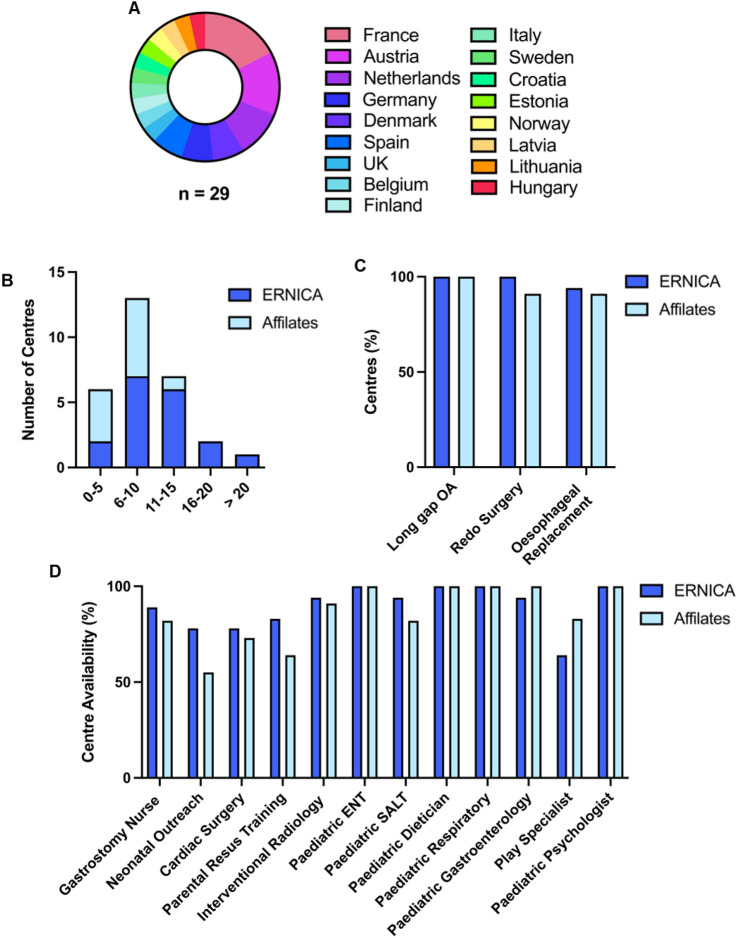
Fig. 1
Fig. 1
ERNICA and affiliate centres have comparable caseloads A 29 of 32 centres (91%) responded from 17 countries in Europe. B 79% of all centres manage > 5 new EA cases/year. ERNICA centres were more likely to have > 10 cases/year than affiliate centres. C The majority of centres were highly specialized managing long-gap EA and performing re-do and replacement surgery. D All centres offered a broad range of EA-related health services
Fig. 2
Fig. 2
ERNICA and affiliate centres offer similar follow-up services A. Two-thirds of centers had a dedicated EA clinic with a specialist MDT. All EA patients attended specialist MDT clinics in 60% of centers, while 40% of centers offered MDT clinics only to selected complex EA patients. B. A broad range of services were available where MDT clinic was provided. C. Follow-up was predominantly offered at specialist hospitals, with limited availability at local services. D. Lack of resource was the most cited reason for lack of provision of MDT clinics
Fig. 3
Fig. 3
Delivery of routine investigations in asymptomatic EA patients is heterogeneous across ERNICA and affiliate centres A. Routine delivery of pH/impedance study, lung function tests, and endoscopy varied, although uptake was broadly higher in ERNICA centres. B. The ERNICA-ESPGHAN guidance of three endoscopies across the course of childhood FU was adhered to by only 24% of centres. C. 86% of all centres routinely prescribed Proton-Pump Inhibitor (PPI), although length of therapy was not standardised
Fig. 4
Fig. 4
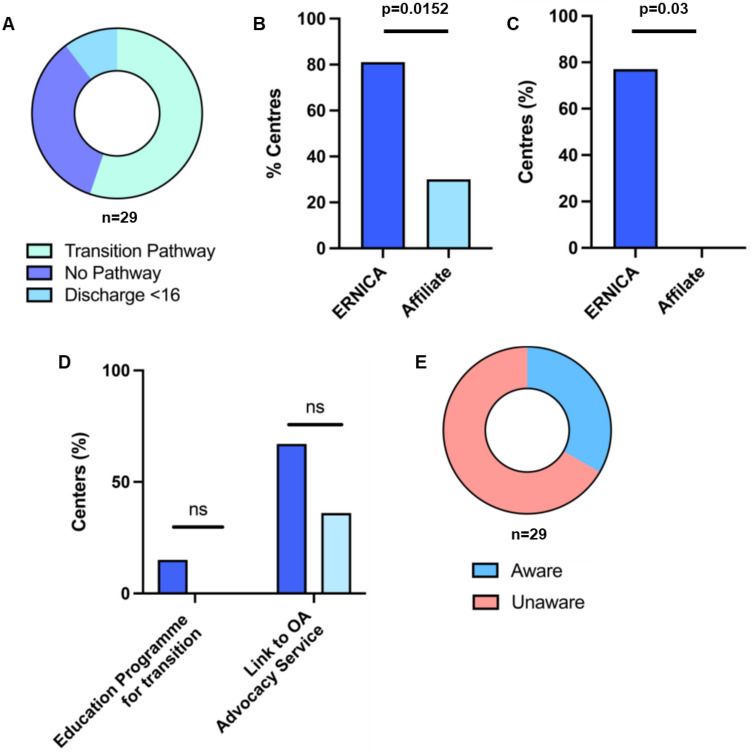
Transition appears to be more established amongst ERNICA centres A 55% of centers had a dedicated transition pathway for EA patients. The existence of a transition pathway (B) and a dedicated transition clinic with an adult specialist with an interest in EA (C) were higher in ERNICA centers. D A specific education program for transitioning EA adolescents existed in only two centers, with poor routine signposting to links to nationally recognized patient charities. E Self-reported awareness of ERNICA and ESPGHAN–NASPGHAN guidance for FU and transition of EA patients was universally poor

References

    1. Dellenmark-Blom M, Quitmann J, Dingemann C (2020) Health-related quality of life in patients after repair of esophageal atresia: a review of current literature. Eur J Pediatr Surg 30:239–250. 10.1055/s-0040-1710389 - PubMed
    1. Gallo G, van van Tuyll Serooskerken ES, Tytgat S, van der Zee DC, Keyzer-Dekker CMG, Zwaveling S, Hulscher JBF, Groen H, Lindeboom MYA (2021) Quality of life after esophageal replacement in children. J Pediatr Surg 56:239–244. 10.1016/j.jpedsurg.2020.07.014 - PubMed
    1. Svoboda E, Fruithof J, Widenmann-Grolig A, Slater G, Armand F, Warner B, Eaton S, De Coppi P, Hannon E (2018) A patient led, international study of long term outcomes of esophageal atresia: EAT 1. J Pediatr Surg 53:610–615. 10.1016/j.jpedsurg.2017.05.033 - PubMed
    1. Brooks G, Gazzaneo M, Bertozzi M, Riccipetitoni G, Raffaele A (2023) Systematic review of long term follow-up and transitional care in adolescents and adults with esophageal atresia—why is transitional care mandatory? Eur J Pediatr 182:2057–2066. 10.1007/s00431-023-04893-6 - PMC - PubMed
    1. Connor MJ, Springford LR, Kapetanakis VV, Giuliani S (2015) Esophageal atresia and transitional care–step 1: a systematic review and meta-analysis of the literature to define the prevalence of chronic long-term problems. Am J Surg 209:747–759. 10.1016/j.amjsurg.2014.09.019 - PubMed