


The Clinical Application Value of a Novel Chip in the Detection of Pathogens in Adult Pneumonia: A Multi-Centre Prospective Study in China
- PMID: 39524976
- PMCID: PMC11549882
- DOI: 10.2147/IDR.S483256
The Clinical Application Value of a Novel Chip in the Detection of Pathogens in Adult Pneumonia: A Multi-Centre Prospective Study in China
Abstract
Purpose: The detection of pathogenic microorganisms plays a significant role in the diagnosis and management of pneumonia that are responsible for a substantial number of deaths worldwide. However, conventional microbiological tests (CMT) have low accuracy and are time-consuming. In this study, we aim to evaluate the clinical value of Chips for Complicated Infection Detection (CCID) in detecting pneumonia pathogens.
Patients and methods: This study was conducted at nine hospitals in China from January 2021 to September 2022. Respiratory samples from adult pneumonia patients were collected from each patient. CMT and CCID were performed in parallel to identify the pathogens.
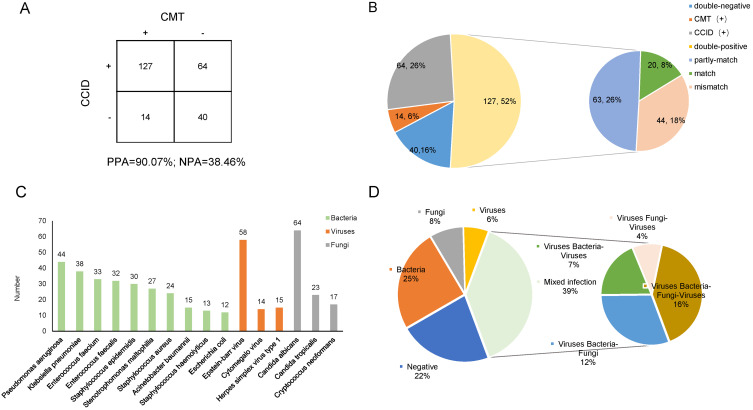
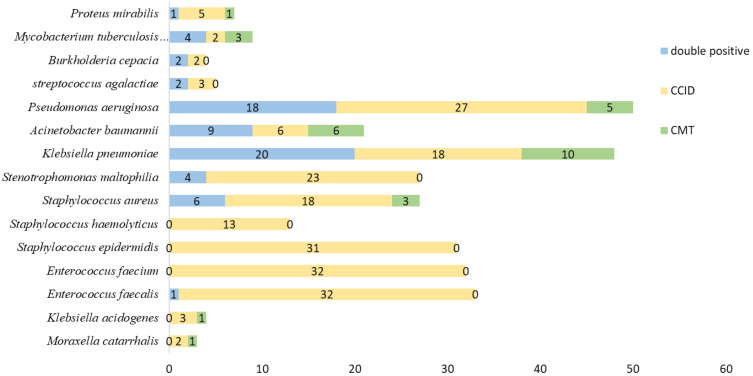
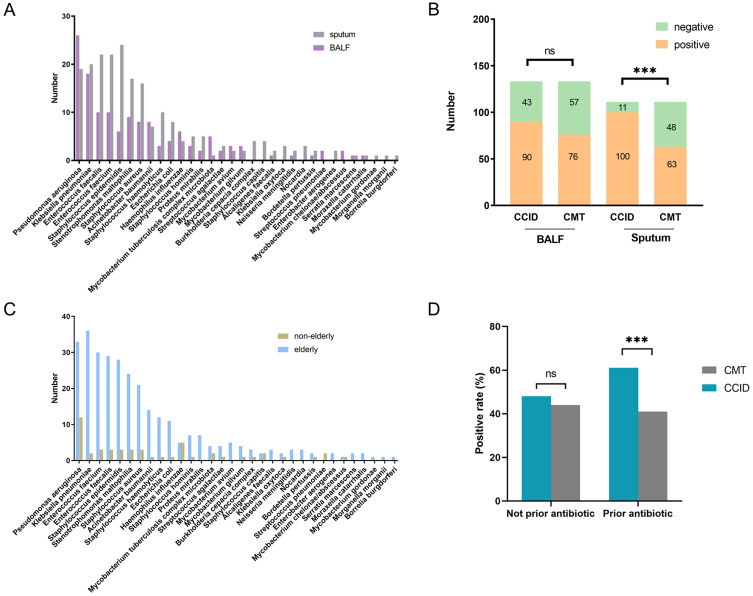
Results: A total of 245 patients were included, with 73% being elderly. CCID identified pathogenic microbes in 78.0% of patients and conventional microbiological tests (CMT) in 57.1% of the patients (p<0.001). The overall positive and negative percent agreements between CCID and CMT for pathogen detection were 90.07% and 38.46%, respectively. 38.8% of patients were diagnosed with mixed infections with at least two pathogens by CCID. Bacterial infections identified by CCID accounted for 60.0% of 245 patients, with the top 3 being Pseudomonas aeruginosa, Klebsiella pneumoniae, and Enterococcus faecium, respectively. K. pneumoniae was the most common pathogen in elderly patients, with a significantly higher prevalence compared to non-elderly patients (p = 0.0011). Among the 197 patients who had used antibiotics before sample collection, the positive rate of CCID was significantly higher than that of CMT (p < 0.001).
Conclusion: This study indicates that compared to CMT, this novel chip has significant advantages in detecting pathogens in pneumonia patients, especially in the elderly.
Keywords: LAMP; chip; elderly; pathogens; pneumonia.
© 2024 Zhang et al.
Conflict of interest statement
The authors report there are no competing interests to declare.
Figures
Similar articles
-
Rapid, accurate, and novel diagnostic technique for respiratory pathogens: Clinical application of loop-mediated isothermal amplification assay in older patients with pneumonia, a multicenter prospective observational study.Front Microbiol. 2022 Dec 19;13:1048997. doi: 10.3389/fmicb.2022.1048997. eCollection 2022. Front Microbiol. 2022. PMID: 36601400 Free PMC article.
-
[Diagnostic value of detection of pathogens in bronchoalveolar lavage fluid by metagenomics next-generation sequencing in organ transplant patients with pulmonary infection].Zhonghua Wei Zhong Bing Ji Jiu Yi Xue. 2021 Dec;33(12):1440-1446. doi: 10.3760/cma.j.cn121430-20211008-01439. Zhonghua Wei Zhong Bing Ji Jiu Yi Xue. 2021. PMID: 35131010 Chinese.
-
Microbiological Profile of Patients with Aspiration Pneumonia Identified by Combined Detection Methods.Infect Drug Resist. 2024 May 25;17:2077-2088. doi: 10.2147/IDR.S461935. eCollection 2024. Infect Drug Resist. 2024. PMID: 38813526 Free PMC article.
-
Clinical Efficiency of Metagenomic Next-Generation Sequencing in Sputum for Pathogen Detection of Patients with Pneumonia According to Disease Severity and Host Immune Status.Infect Drug Resist. 2023 Sep 6;16:5869-5885. doi: 10.2147/IDR.S419892. eCollection 2023. Infect Drug Resist. 2023. PMID: 37700802 Free PMC article.
-
Distribution of Pathogens in Elderly Chinese Patients With Pneumonia: A Systematic Review and Meta-Analysis.Front Med (Lausanne). 2021 Jul 26;8:584066. doi: 10.3389/fmed.2021.584066. eCollection 2021. Front Med (Lausanne). 2021. PMID: 34381791 Free PMC article.
References
LinkOut - more resources
Full Text Sources
