


Glucagon-like peptide-1 receptor agonists (GLP-1RAs) as treatment for nicotine cessation in psychiatric populations: a systematic review
- PMID: 39529123
- PMCID: PMC11552190
- DOI: 10.1186/s12991-024-00527-9
Glucagon-like peptide-1 receptor agonists (GLP-1RAs) as treatment for nicotine cessation in psychiatric populations: a systematic review
Abstract
Background: Nicotine use and nicotine use disorder (NUD) are the leading causes of preventable death in the United States. Persons with mental disorders (e.g., bipolar disorder) are differentially susceptible to nicotine use. Glucagon-like peptide-1 receptor agonists (GLP-1RAs) are indicated for type 2 diabetes mellitus (T2DM) and obesity and show preliminary evidence of efficacy in addiction-related behaviours. Herein, we synthesize extant preclinical and clinical evidence evaluating the effect of GLP-1RAs on neurobiological systems and behaviours salient to nicotine consumption and cessation.
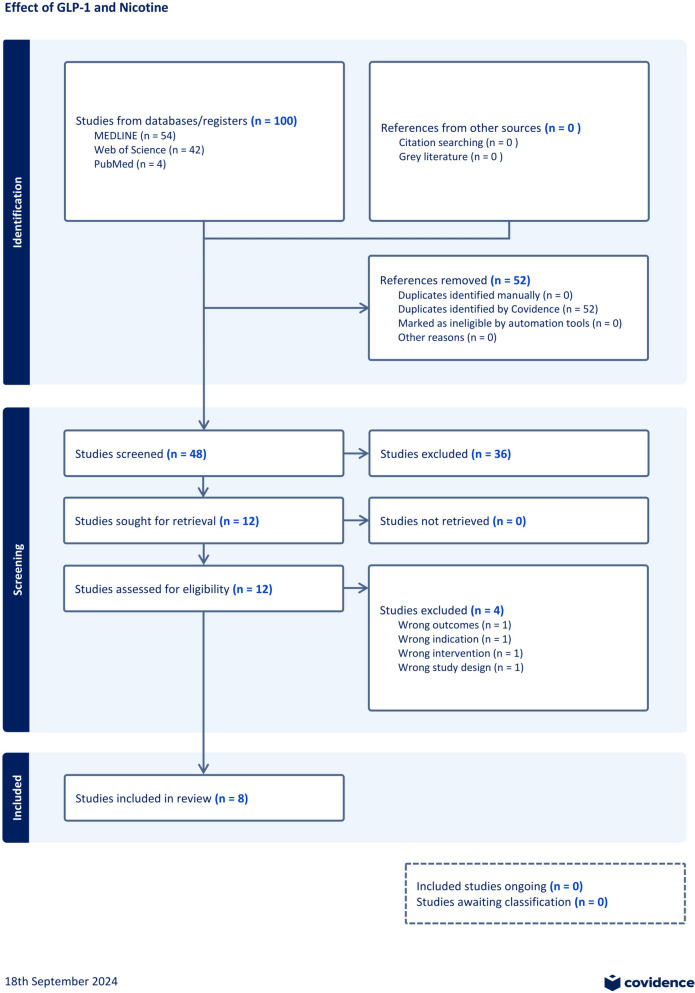
Methods: Online databases (MedLine, Embase, AMED, PsychINFO, JBI EBP Database, PubMed, Web of Science, Google Scholar) were searched from inception to May 21, 2024. Relevant studies were also extracted from the reference lists of the obtained articles. All articles were screened against inclusion and exclusion criteria.
Results: Administration of GLP-1RAs reduced nicotine self-administration and nicotine-seeking behaviour in animal models that, in some cases, is sustained beyond exposure to the agent. GLP-1RAs also mitigated post-nicotine cessation weight gain, craving, withdrawal, and hyperphagia. The preceding effects are attributable to modulation of reward-related brain regions (e.g., mesolimbic dopamine system), resulting in nicotine aversion. GLP-1RAs were also efficacious as adjunctive therapies [e.g., in combination with nicotine replacement therapies (NRTs)].
Conclusion: The multi-effect characteristics in NUD paradigms provide a compelling rationale for large, adequately powered, long-term, randomized controlled trials of GLP-1RAs in the treatment and prevention of NUD. The replicated effect on mitigating post-nicotine cessation weight gain is a differentiating feature of GLP-1RAs from extant proven therapies for NUD.
Keywords: Dulaglutide; Exenatide; GLP-1; Liraglutide; Lixisenatide; Nicotine; Nicotine use disorder; Semaglutide; Tirzepatide.
© 2024. The Author(s).
Conflict of interest statement
References
-
- Smoking Cessation Treatments: Current Psychological and Pharmacological Options | Revista de Investigación Clínica. www.clinicalandtranslationalinvestigation.com. Available from: https://www.clinicalandtranslationalinvestigation.com/frame_esp.php?id=198. - PubMed
-
- Brady KT. Social determinants of health and smoking cessation: a challenge. Am J Psychiatry. 2020;177(11):1029–30. 10.1176/appi.ajp.2020.20091374. - PubMed
-
- McIntyre RS, Berk M, Brietzke E, Goldstein BI, López-Jaramillo C, Kessing LV, et al. Bipolar disorders. The Lancet. 2020;396(10265):1841–56. - PubMed
-
- Pompili M, Venturini P, Palermo M, Stefani H, Seretti ME, Lamis DA, et al. Mood disorders medications: predictors of nonadherence—review of the current literature. Expert Rev Neurother. 2013;13(7):809–25. - PubMed
Publication types
LinkOut - more resources
Full Text Sources
