. 2024 Nov 12;14(1):27707.
doi: 10.1038/s41598-024-77983-6.

Murine vaginal secretory responses to a male volatile chemical messenger

Affiliations

Murine vaginal secretory responses to a male volatile chemical messenger

Natalia Murataeva et al. Sci Rep. .

Abstract

Many species use chemical messengers to communicate a remarkable range of information. Mice appear to make particular use of chemical messengers, including effects on estrous cycling and initiation, pregnancy, aggression, stress and of course attraction. Behavioral studies have helped identify several candidate messengers, or pheromones, that mediate attraction in mice. One question is whether attractive chemical messengers induced a physical vaginal secretory response. The preparation hypothesis posits that increased vaginal secretion would lubricate and protect the vagina in response to the prospect of imminent coitus, but this has been difficult to assess experimentally, particularly in mice. We developed a rapid, sensitive, minimally invasive method of quantifying vaginal moisture in mice and used this model to test vaginal secretory responses to male bedding. We report that female mice experience an increase in vaginal moisture after exposure to male, but not female, bedding. This response is induced by either physical or airborne exposure to male urine, to preputial gland extract, and to the preputial gland-derived pheromone alpha/beta farnesenes. This vaginal response is diurnally regulated, seen only during their active phase. The response is sensitive to the estrous phase, with a clear response during estrus but not during metestrus. We conclude that mice may serve as a model for aspects of vaginal function and that this assay will be readily applicable to other small animals. The identification of a pheromone-mediated vaginal secretory response offers a window into the regulation of the vaginal environment and the neurobiology of sexual responses in mice.

Keywords: Chemical messenger; Exocrine; Method; Pheromone; Secretion; Vagina; Vaginal.


Conflict of interest statement

Declarations Competing interests The authors declare no competing interests.

Figures

Fig. 1
Fig. 1
Vaginal responses to male but not female bedding. (A) Vaginal moisture before (baseline) and after exposure to male bedding shows that levels increase. (B) The same experiment, exposure to female bedding does not elicit a response. A, n = 12; B, n = 11. **, p < 0.01 by paired t-test.
Fig. 2
Fig. 2
The chemical messenger is carried in urine, volatile and derived from the preputial gland. Vaginal moisture before (BSL) or after exposure to (A) male urine, (B) male urine scent (without physical interaction), (C) Preputial gland scent, or (D) Farnesenes. A, n = 19, B, n = 27, C, n = 16, D, n = 13. **, p < 0.01; ***, p < 0.0001 by paired t-test.
Fig. 3
Fig. 3
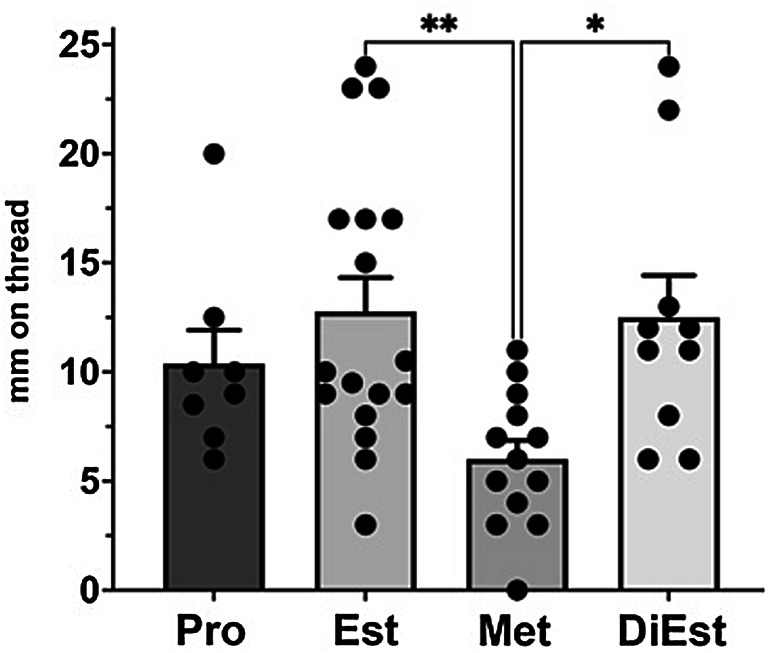
Vaginal moisture in mice by estrous phase. Pro, proestrus (n = 8); Est, estrus (n = 17); Met, metestrus (n = 13); DiEst, Diestrus (n = 10). 1-way ANOVA with Bonferroni post hoc test. *, p < 0.05; **, p < 0.01.
Fig. 4
Fig. 4
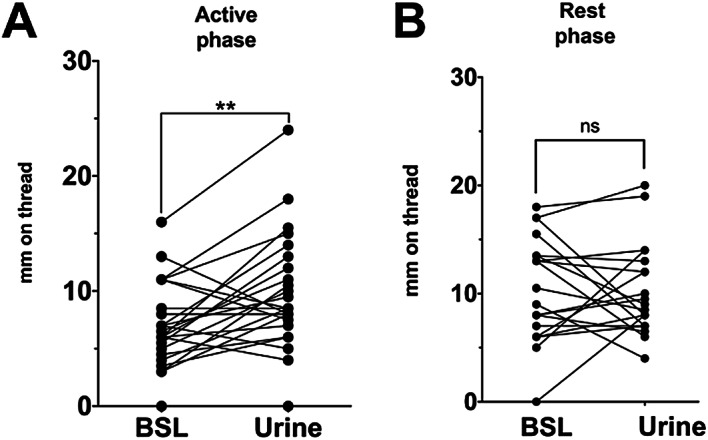
Females exhibit a vaginal response to male urine during their active phase but not during their rest phase. (A) CD1 strain during their active phase vaginal moisture at baseline (BSL) and after exposure to male urine during their active phase (A) or their rest phase (B). A, n = 25; B, n = 22. **, p < 0.01 by paired t-test vs. baseline; ns, not significant.
Fig. 5
Fig. 5
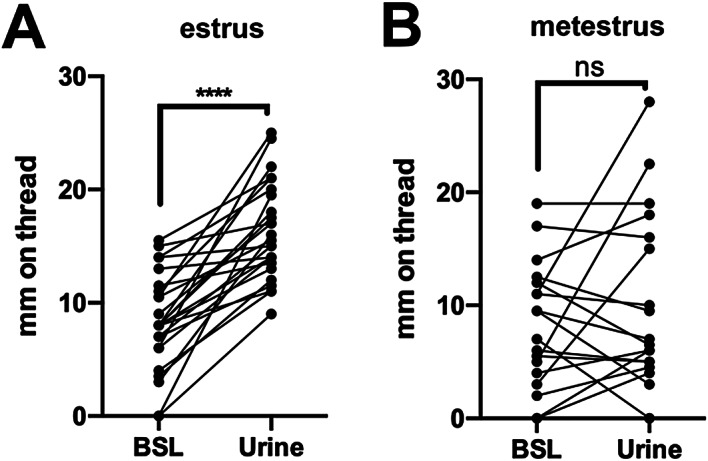
Vaginal responses are sensitive to estrous phase. Baseline vaginal moisture (BSL) and responses to presentation of male urine during estrus (A), or metestrus (B). A, n = 25, B, n = 18. ns, not significant, ****, p < 0.0001, paired t-test vs. baseline.

References

    1. Petrulis, A. Chemosignals and hormones in the neural control of mammalian sexual behavior. Front. Neuroendocrinol.34, 255–267. 10.1016/j.yfrne.2013.07.007 (2013). - PubMed
    1. Halpern, M. The organization and function of the vomeronasal system. Annu. Rev. Neurosci.10, 325–362. 10.1146/annurev.ne.10.030187.001545 (1987). - PubMed
    1. Dorries, K. M., Adkins-Regan, E. & Halpern, B. P. Sensitivity and behavioral responses to the pheromone androstenone are not mediated by the vomeronasal organ in domestic pigs. Brain Behav. Evol.49, 53–62. 10.1159/000112981 (1997). - PubMed
    1. Kimoto, H., Haga, S., Sato, K. & Touhara, K. Sex-specific peptides from exocrine glands stimulate mouse vomeronasal sensory neurons. Nature. 437, 898–901. 10.1038/nature04033 (2005). - PubMed
    1. Barabas, A. J., Aryal, U. K. & Gaskill, B. N. Protein profiles from used nesting material, saliva, and urine correspond with social behavior in group housed male mice, Mus musculus. J. Proteom.266, 104685. 10.1016/j.jprot.2022.104685 (2022). - PubMed

LinkOut - more resources