


Relationship between breastfeeding and hepatic steatosis in women with previous gestational diabetes mellitus
- PMID: 39533322
- PMCID: PMC11555891
- DOI: 10.1186/s13006-024-00684-3
Relationship between breastfeeding and hepatic steatosis in women with previous gestational diabetes mellitus
Erratum in
-
Correction: Relationship between breastfeeding and hepatic steatosis in women with previous gestational diabetes mellitus.Int Breastfeed J. 2024 Dec 27;19(1):82. doi: 10.1186/s13006-024-00696-z. Int Breastfeed J. 2024. PMID: 39731182 Free PMC article. No abstract available.
Abstract
Background: Non-alcoholic fatty liver disease (NAFLD), characterized by excess liver fat, is common in women with a history of gestational diabetes mellitus (GDM). While breastfeeding improves postpartum lipid levels, its impact on NAFLD in these women is not well studied. We aimed to investigate the relationship between the duration and intensity of breastfeeding and the amount of liver fat and prevalence of NAFLD in women with previous GDM at approximately 1 year postpartum.
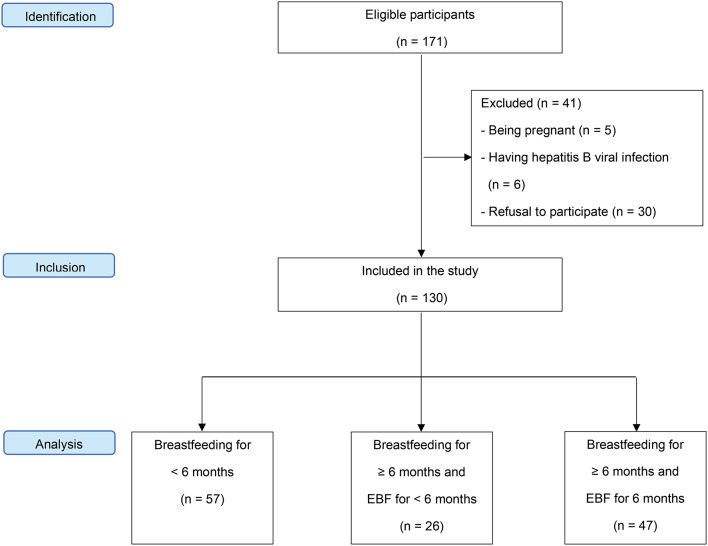
Methods: This prospective cohort study was conducted at a university hospital in Bangkok, Thailand between November 2021 and February 2024. Overall, 130 women who had experienced GDM in their most recent pregnancy were followed up for 1 year postpartum. We collected data on breastfeeding practices and quantified liver fat using controlled attenuation parameters (CAPs) during transient elastography. NAFLD was defined as a CAP of ≥ 302 dB/m. Women were divided into three groups according to the duration and intensity of breastfeeding: group 1 (breastfeeding for < 6 months), group 2 (breastfeeding for ≥ 6 months and exclusive breastfeeding [EBF] for < 6 months), and group 3 (breastfeeding for ≥ 6 months and EBF for 6 months).
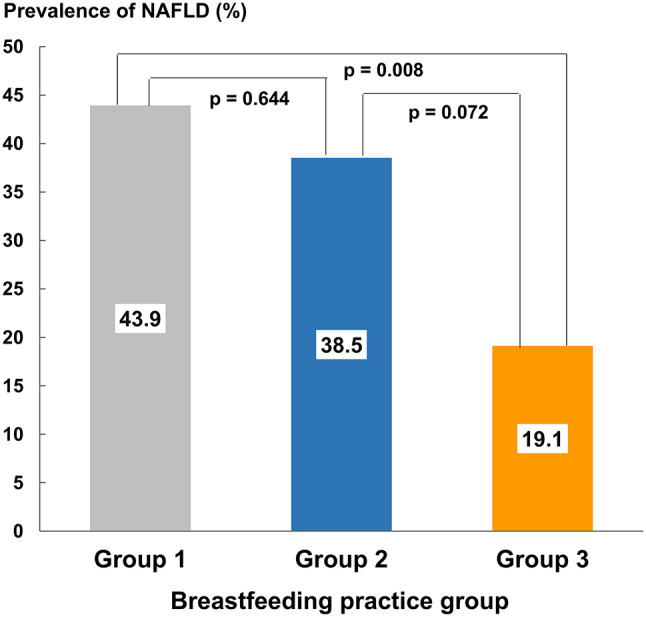
Results: Overall, 57 (43.8%), 26 (20.0%), and 47 (36.2%) participants were categorized into groups 1, 2, and 3, respectively. Group 3 had the lowest CAPs, followed by groups 2 and 1. The median values (interquartile ranges) of the CAPs were 219.0 (189.0-271.0) dB/m, 257.5 (205.3-317.3) dB/m, and 279.0 (191.5-324.0) dB/m for groups 3, 2, and 1, respectively (p = 0.034). NAFLD prevalence was significantly lower in group 3 compared to groups 2 and 1 (19.1% vs. 38.5% vs. 43.9%, respectively; p = 0.026). Multivariate analysis showed that breastfeeding for ≥ 6 months and EBF for 6 months reduced the risk of NAFLD, with an adjusted odds ratio of 0.34 (95% confidence interval 0.14, 0.95).
Conclusions: Breastfeeding for ≥ 6 months, particularly EBF for the first 6 months, may offer a practical strategy to reduce the risk of NAFLD in women with prior GDM.
Trial registration: Thai Clinical Trials Registry: Registration no. TCTR20211027008. Date of registration: October 27, 2021. Date of initial participant enrollment: November 1, 2021.
Keywords: Breastfeeding; Fatty liver; Gestational diabetes mellitus; Hepatic steatosis; Lactation; Non-alcoholic fatty liver disease.
© 2024. The Author(s).
Conflict of interest statement
Figures
References
-
- Forbes S, Taylor-Robinson SD, Patel N, Allan P, Walker BR, Johnston DG. Increased prevalence of non-alcoholic fatty liver disease in European women with a history of gestational diabetes. Diabetologia. 2011;54(3):641–7. - PubMed
Publication types
MeSH terms
LinkOut - more resources
Full Text Sources
Medical
Miscellaneous
