


Hepatic arterial infusion chemotherapy combined with systemic therapy sequentially or simultaneously for advanced hepatocellular carcinoma
- PMID: 39540963
- PMCID: PMC11564491
- DOI: 10.1007/s00262-024-03872-6
Hepatic arterial infusion chemotherapy combined with systemic therapy sequentially or simultaneously for advanced hepatocellular carcinoma
Abstract
Background and aims: The goal of this study was to compare the efficacy and safety of hepatic arterial infusion chemotherapy (HAIC) combined with targeted therapy and PD-(L)1 blockade (triple therapy), either sequentially (SE) or simultaneously (SI), in the treatment of Barcelona Clinic Liver Cancer (BCLC) stage C hepatocellular carcinoma (HCC).
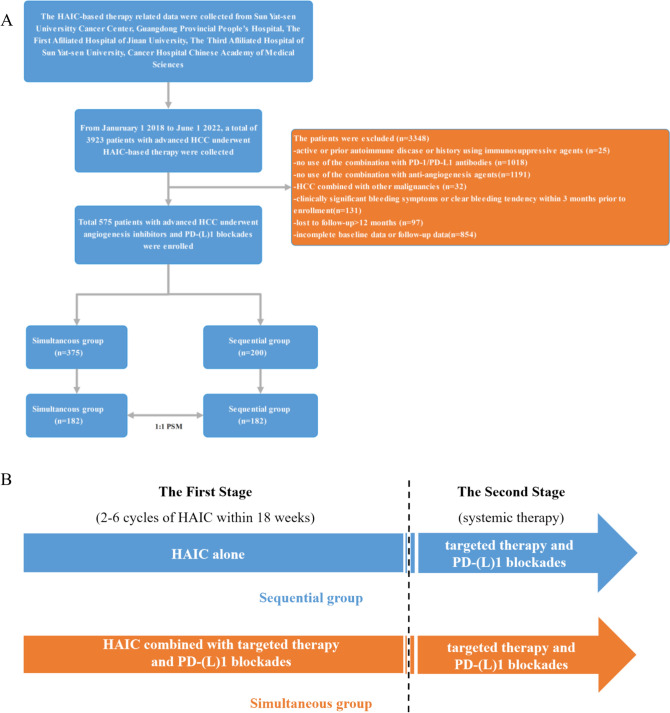
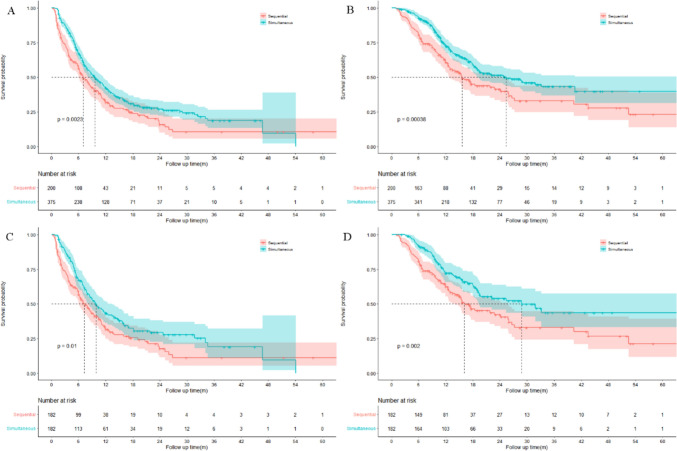
Approach and results: From January 1, 2018, to June 1, 2022, 575 patients with BCLC stage C HCC who underwent SE or SI triple therapy were retrospectively enrolled. Propensity score matching (PSM; 1:1) was performed to eliminate possible confounder imbalances across cohorts. We used the Kaplan-Meier method and a log-rank test to compare the overall survival (OS) and progression-free survival (PFS) rates between the SI and SE groups. The tumor response and the incidence of adverse events (AEs) were reported. After PSM, 182 patients in each of the two groups were matched. The median OS in the SI group was significantly longer than that in the SE group (28.8 vs. 16.1 months; P = 0.002), and the median PFS was significantly improved in the SI versus SE group (9.6 vs. 7.0 months; P = 0.01). The objective response rate based on the mRECIST was higher in the SI group (58% vs. 37%; P < 0.001). The total incidences of grade 3-4 AEs were 111/182 (60.9%) and 128/182 (70.3%) in the SE and SI groups, respectively. No grade 5 AEs were reported in either group.
Conclusions: Simultaneous HAIC plus targeted therapy and PD-(L)1 blockade significantly improved outcomes compared to the sequential regimen in patients with BCLC stage C HCC, with no unexpected AEs.
Clinical relevance statement: The patients who received hepatic arterial infusion chemotherapy combined with targeted therapy and PD-(L)1 blockade simultaneously have a better prognosis than those who received it sequentially.
Keywords: Hepatic arterial infusion chemotherapy; Hepatocellular carcinoma; PD-(L)1 blockade; Sequentially and simultaneously; Targeted therapy.
© 2024. The Author(s).
Conflict of interest statement
Figures
References
-
- Sung H, Ferlay J, Siegel RL, Laversanne M, Soerjomataram I, Jemal A, Bray F (2021) Global cancer statistics 2020: GLOBOCAN estimates of incidence and mortality worldwide for 36 cancers in 185 countries. CA Cancer J Clin 71(3):209–249 - PubMed
-
- El-Serag HB, Rudolph KL (2007) Hepatocellular carcinoma: epidemiology and molecular carcinogenesis. Gastroenterology 132(7):2557–2576 - PubMed
-
- Chen LT, Martinelli E, Cheng AL, Pentheroudakis G, Qin S, Bhattacharyya GS, Ikeda M, Lim HY, Ho GF, Choo SP et al (2020) Pan-Asian adapted ESMO clinical practice guidelines for the management of patients with intermediate and advanced/relapsed hepatocellular carcinoma: a TOS-ESMO initiative endorsed by CSCO, ISMPO, JSMO, KSMO. MOS and SSO Ann Oncol 31(3):334–351 - PubMed
-
- Mazzaferro V, Llovet JM, Miceli R, Bhoori S, Schiavo M, Mariani L, Camerini T, Roayaie S, Schwartz ME, Grazi GL et al (2009) Predicting survival after liver transplantation in patients with hepatocellular carcinoma beyond the Milan criteria: a retrospective, exploratory analysis. Lancet Oncol 10(1):35–43 - PubMed
MeSH terms
Substances
LinkOut - more resources
Full Text Sources
Medical
Research Materials
Miscellaneous
