


Using Chronic Kidney Disease as a Model Framework to Estimate Healthcare-Related Environmental Impact
- PMID: 39541083
- PMCID: PMC11782431
- DOI: 10.1007/s12325-024-03039-w
Using Chronic Kidney Disease as a Model Framework to Estimate Healthcare-Related Environmental Impact
Abstract
Introduction: While the economic and clinical burden of chronic diseases are well documented, their environmental impact remains poorly understood. We developed a framework to estimate the environmental impact of a disease care pathway using chronic kidney disease (CKD) as an example.
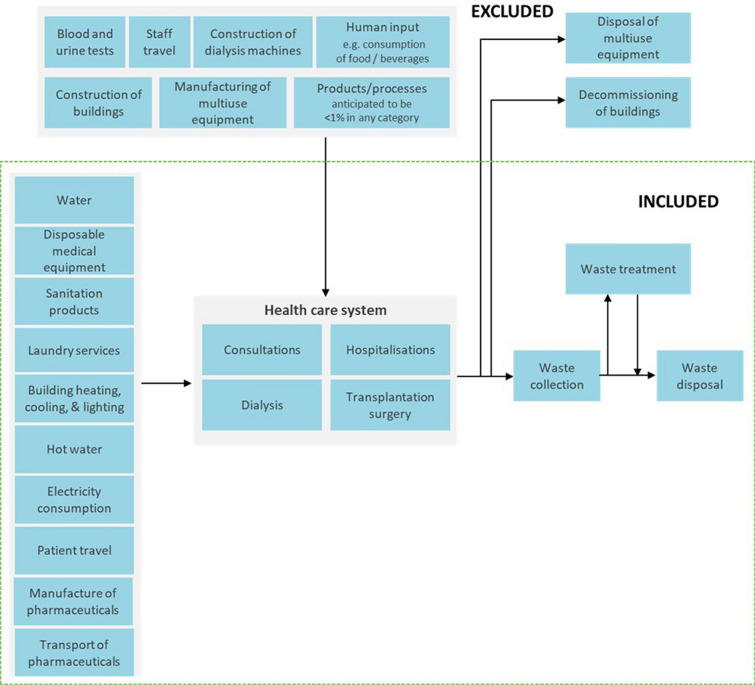
Methods: A life cycle assessment framework was developed for the CKD care pathway and validated by experts. Life cycle stages were characterised for resource utilisation based on a literature review and ecoinvent database inputs, in ten countries. The ReCiPe impact assessment method was used to calculate impacts across multiple environmental dimensions.
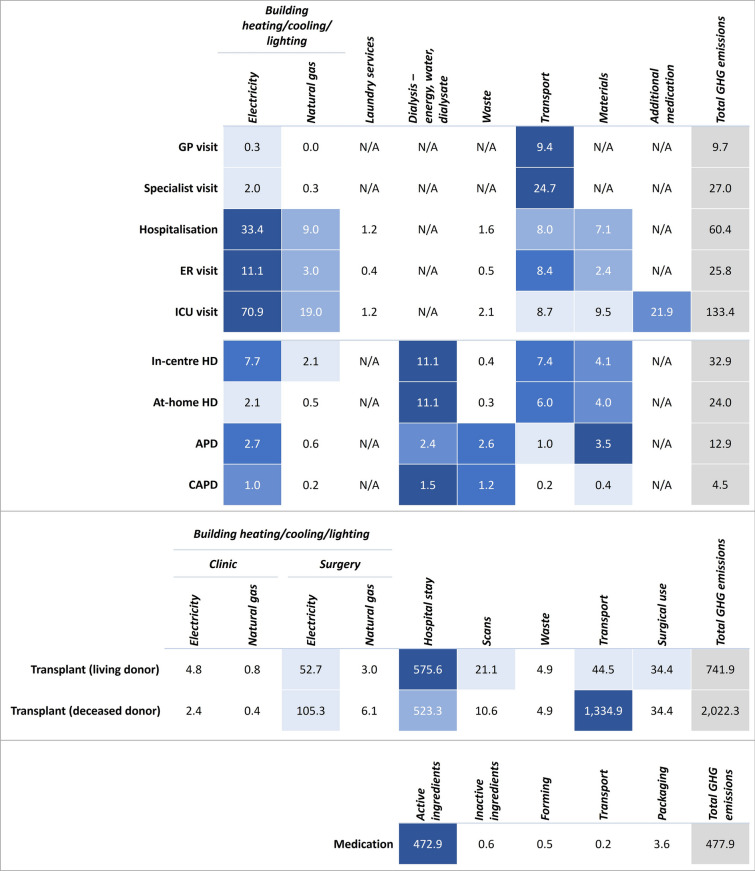
Results: At CKD stage 5, kidney replacement therapies (KRT) have highest impact; emissions ranged between 3.5 and 43.9 kg carbon dioxide equivalents (CO2e) per session depending on dialysis modality, and 336-2022 kg CO2e for kidney transplant surgery, depending on donor type. Hospitalisations have a substantial environmental impact: a 1-day intensive care stay had highest impact (66.4-143.6 kg CO2e), followed by a 1-day hospital stay (28.8-63.9 kg CO2e) and an 8-h emergency room visit (14.4-27.5 kg CO2e). Patient transport to and from healthcare sites was a key driver of environmental impact for all life cycle stages, representing up to 99.5% of total CO2e emissions.
Conclusion: Full care pathways should be analysed alongside specific healthcare processes. Application of this framework enables quantification of the environmental benefits of preventative medicine and effective management of chronic diseases. For CKD, early diagnosis, and proactive management to reduce the need for KRT and hospitalisations could improve patient outcomes and reduce environmental burden.
Keywords: Carbon emissions; Care pathways; Chronic kidney disease; Environmental impact; Greenhouse gas emissions; Healthcare.
© 2024. The Author(s).
Conflict of interest statement
Declarations. Conflict of Interest: Katherine A. Barraclough, Aleix Cases, Roberto Pecoits-Filho, Celine Germond-Duret, Carmine Zoccali, and Matthew J. Eckelman received consulting fees for taking part in Scientific Steering Committee meetings regarding CKD environmental impact research. Aleix Cases has received research grants from CSL Vifor; consultancy fees from Astellas, Astra Zeneca, Bayer, Boehringer Ingelheim, GSK, Lilly, Novo Nordisk, Otsuka, CSL Vifor, and lecture fees from Astellas, Astra Zeneca, Amgen, Bayer, Medscape, Novo Nordisk, Sanofi (Mexico), CSL Vifor. Roberto Pecoits-Filho has received payment or honoraria for lectures, presentations, speakers bureaus, manuscript writing or educational events from Alexion, Akebia, AstraZeneca, Bayer, Boehringer, and Fresenius Medical Care. Juan Jose Garcia Sanchez, Salvatore Barone, Nigel Budgen, Claudia Cabrera, and Viknesh Selvarajah are employees and shareholders of AstraZeneca. Nina Embleton, Antony Wright, Luke Hubbert, and Lindsay Nicholson received consulting fees from AstraZeneca. Ethical Approval: This article is based on previously conducted studies and does not contain any new studies with human participants or animals performed by any of the authors.
Figures



References
-
- Pichler PP, Jaccard IS, Weisz U, Weisz H. International comparison of health care carbon footprints. Environ Res Lett. 2019;14(6):064004.
-
- Drew J, Christie SD, Rainham D, Rizan C. HealthcareLCA: an open-access living database of health-care environmental impact assessments. Lancet Planetary Health. 2022;6(12):e1000–12. - PubMed
-
- KDIGO. Official Journal of the International Society of Nephrology KDIGO 2012 Clinical Practice Guideline for the Evaluation and Management of Chronic Kidney Disease. https://kdigo.org/wp-content/uploads/2017/02/KDIGO_2012_CKD_GL.pdf. Accessed 4 Nov 2024.
-
- Jager KJ, Kovesdy C, Langham R, Rosenberg M, Jha V, Zoccali C. A single number for advocacy and communication-worldwide more than 850 million individuals have kidney diseases. Kidney Int. 2019;96(5):1048–50. - PubMed
MeSH terms
LinkOut - more resources
Full Text Sources
Medical
Research Materials
