. 2025 Jan;301(1):107990.
doi: 10.1016/j.jbc.2024.107990. Epub 2024 Nov 13.

Regulation of de novo and maintenance DNA methylation by DNA methyltransferases in postimplantation embryos

Affiliations

Regulation of de novo and maintenance DNA methylation by DNA methyltransferases in postimplantation embryos

Zhen Xu et al. J Biol Chem. 2025 Jan.

Abstract

DNA methylation is mainly catalyzed by three DNA methyltransferase (DNMT) proteins in mammals. Usually DNMT1 is considered the primary DNMT for maintenance DNA methylation, whereas DNMT3A and DNMT3B function in de novo DNA methylation. Interestingly, we found DNMT3A and DNMT3B exerted maintenance and de novo DNA methylation in postimplantation mouse embryos. Together with DNMT1, they maintained DNA methylation at some pluripotent genes and lineage marker genes. Germline-derived DNA methylation at the imprinting control regions (ICRs) is stably maintained in embryos. DNMT1 maintained DNA methylation at most ICRs in postimplantation embryos. Surprisingly, DNA methylation was increased at five ICRs after implantation, and two DNMT3 proteins maintained the newly acquired DNA methylation at two of these five ICRs. Intriguingly, DNMT3A and DNMT3B maintained preexisting DNA methylation at four other ICRs, similar to what we found in embryonic stem cells before. These results suggest that DNA methylation is more dynamic than originally thought during embryogenesis including the ICRs of the imprinted regions. DNMT3A and DNMT3B exert both de novo and maintenance DNA methylation functions after implantation. They maintain large portions of newly acquired DNA methylation at variable degrees across the genome in mouse embryos, together with DNMT1. Furthermore, they contribute to maintenance of preexisting DNA methylation at a subset of ICRs as well as in the CpG islands and certain lineage marker gene. These findings may have some implications for the important roles of DNMT proteins in development and human diseases.

Keywords: DNA methylation; DNMT1; DNMT3A; DNMT3B; de novo methylation; genomic imprinting; implantation; imprinting control region (ICR); maintenance methylation; whole-genome bisulfite sequencing (WGBS).


Conflict of interest statement

Conflict of interest The authors declare that they have no conflicts of interest with the contents of this article.

Figures
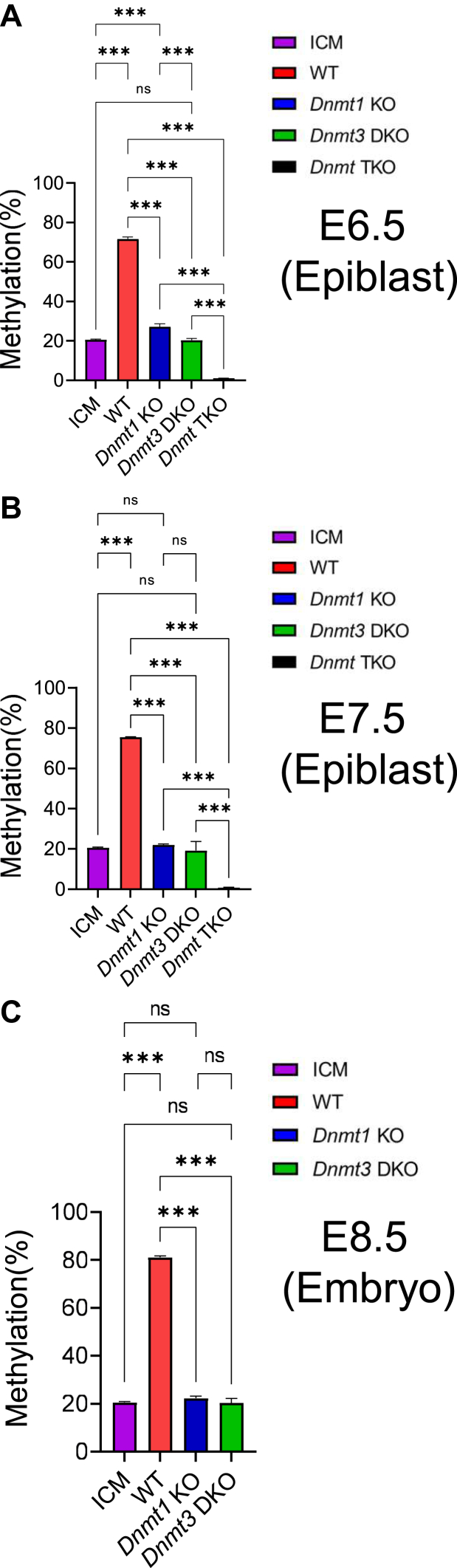
Figure 1
Figure 1
Two DNMT3 proteins, together with DNMT1, maintained DNA methylation in the postimplantation embryos. DNA methylation was quantified at the whole-genome level for the genomic DNA samples derived from the ICM of the WT E3.5 blastocysts, the epiblasts of WT, and Dnmt, 1KO mutant E6.5-E7.5 embryos, as well as WT and Dnmt, 1KO mutant E8.5 embryos that were shown on the horizontal axis. Vertical axis, % of the whole-genome DNA methylation. A, whole-genome DNA methylation was quantified for the ICM of WT blastocysts, the epiblasts of WT, Dnmt1 mutant (Dnmt1 KO), Dnmt3 double mutant (Dnmt3 DKO), and Dnmt triple mutant (Dnmt TKO) E6.5 embryos. B, whole-genome DNA methylation was quantified for the ICM of WT blastocysts, the epiblasts of WT, Dnmt1 mutant (Dnmt1 KO), Dnmt3 double mutant (Dnmt3 DKO), and Dnmt triple mutant (Dnmt TKO) E7.5 embryos. C, whole-genome DNA methylation was quantified for WT, Dnmt1 mutant (Dnmt1 KO), and Dnmt3 double mutant (Dnmt3 DKO) E8.5 embryos in comparison to the ICM of the WT blastocysts. Statistical analysis was carried out by using one-way ANOVA with Dunnett multiple comparison test. The values on the figures are shown as follows: ∗p < 0.05; ∗∗p < 0.01; ∗∗∗p < 0.001. ns, not statistically significant with p-value more than 0.1. DNMT, DNA methyltransferase; ICM, inner cell mass.
Figure 2
Figure 2
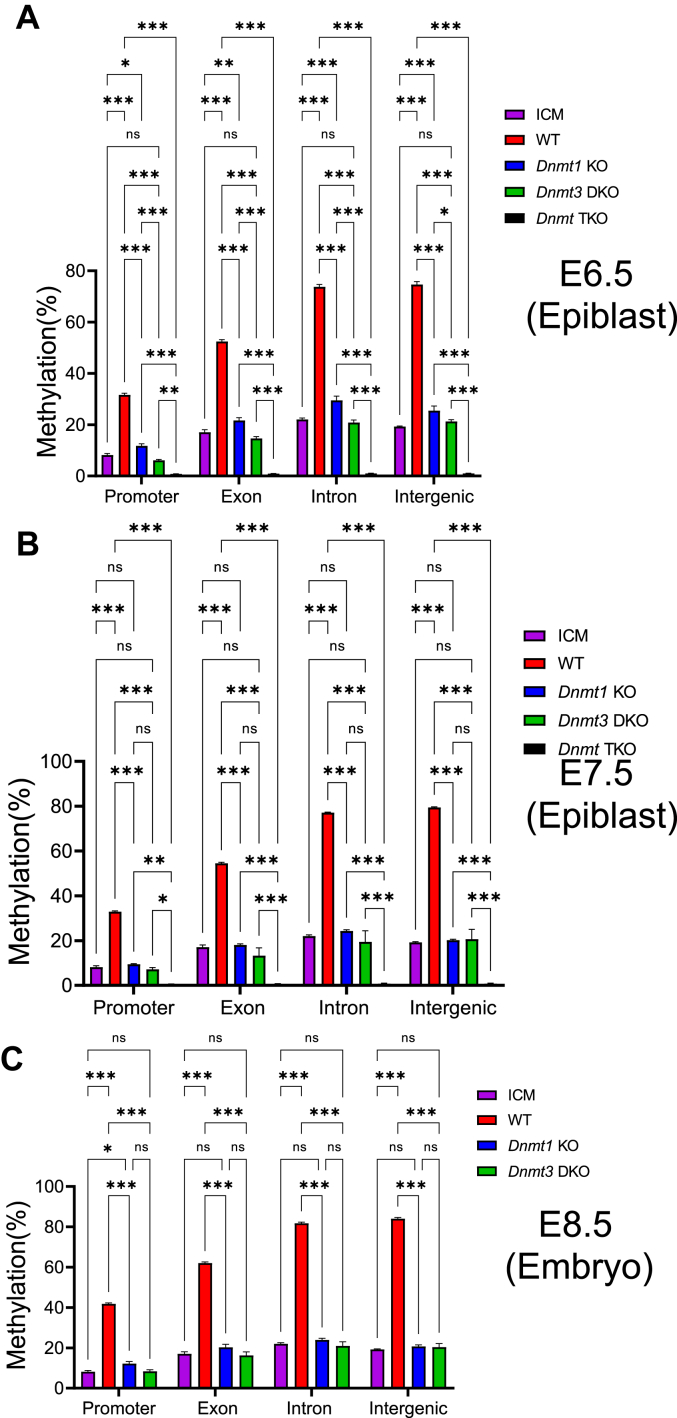
Two DNMT3 proteins, together with DNMT1, maintained DNA methylation in the genic and intergenic regions after implantation. DNA methylation was analyzed for the genic and intergenic regions in the ICM of the WT E3.5 blastocysts, the epiblasts of WT and Dnmt mutant E6.5-E7.5 embryos, as well as WT and Dnmt mutant E8.5 embryos. Horizontal axis, the genic and intergenic regions in the ICM at E3.5 or embryos at E6.5-E8.5. Vertical axis, % of DNA methylation. A, DNA methylation was analyzed for the WT ICM, the epiblasts of WT, Dnmt1 mutant (Dnmt1 KO), Dnmt3 double mutant (Dnmt3 DKO), and Dnmt triple mutant (Dnmt TKO) E6.5 embryos. B, DNA methylation was analyzed for the WT ICM, the epiblasts of WT, Dnmt1 mutant (Dnmt1 KO), Dnmt3 double mutant (Dnmt3 DKO) and Dnmt triple mutant (Dnmt TKO) E7.5 embryos. C, DNA methylation was examined at the genic and intergenic regions for WT, Dnmt1 mutant (Dnmt1 KO), and Dnmt3 double mutant (Dnmt3 DKO) E8.5 embryos in comparison to the WT ICM. Statistical analysis was carried out by using one-way ANOVA with Dunnett multiple comparison test. The values on the figures are shown as follows: ∗p < 0.05; ∗∗p < 0.01; ∗∗∗p < 0.001. ns, not statistically significant with p-value more than 0.1. DNMT, DNA methyltransferase; ICM, inner cell mass.
Figure 3
Figure 3
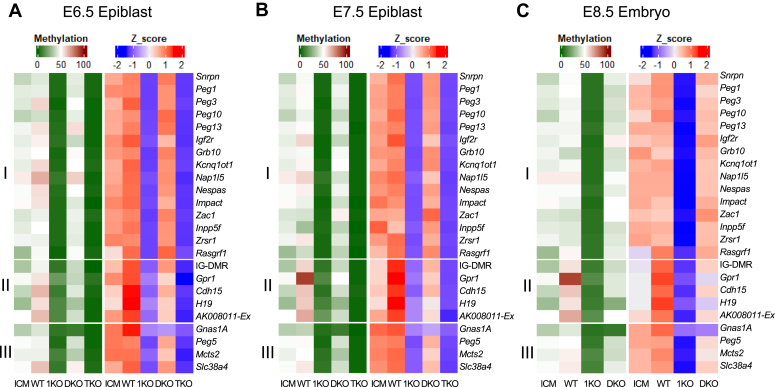
DNA methylation was partially lost at a subset of imprinted regions in the postimplantation mutant embryos lacking DNMT3 proteins. DNA methylation was analyzed for the imprinting control region (ICR) of 24 known imprinted regions in the ICM of WT E3.5 blastocysts, the epiblasts of WT and Dnmt mutant E6.5-E7.5 embryos, as well as WT and Dnmt mutant E8.5 embryos. DNA methylation was significantly reduced in 15 ICRs of group I in the Dnmt1 KO, but not in Dnmt3 DKO, mutant postimplantation embryos. There was significant increase in DNA methylation at 5 ICRs of group II after implantation comparing the epiblasts of WT E6.5-E7.5 embryos and WT E8.5 embryos with the ICM of WT E3.5 blastocysts. Group II includes the AK008011-Ex with the expanded ICR region found in this study (Fig. S9). Partial loss of DNA methylation was observed in four ICRs of group III in the Dnmt3 DKO as well as in the Dnmt1 KO mutant postimplantation embryos. A, DNA methylation was analyzed for the ICRs in the WT ICM, the epiblasts of WT, Dnmt1 mutant (Dnmt1 KO), Dnmt3 double mutant (Dnmt3 DKO), and Dnmt triple mutant (Dnmt TKO) E6.5 embryos. B, DNA methylation was analyzed for the ICRs in the WT ICM, the epiblasts of WT, Dnmt1 mutant (Dnmt1 KO), Dnmt3 double mutant (Dnmt3 DKO), and Dnmt triple mutant (Dnmt TKO) E7.5 embryos. C, DNA methylation was analyzed for the ICRs in the WT, Dnmt1 mutant (Dnmt1 KO), and Dnmt3 double mutant (Dnmt3 DKO) E8.5 embryos in comparison to the WT ICM. See the Methods details for DNA methylation and statistical analyses in this figure. DNMT, DNA methyltransferase; ICM, inner cell mass.
Figure 4
Figure 4
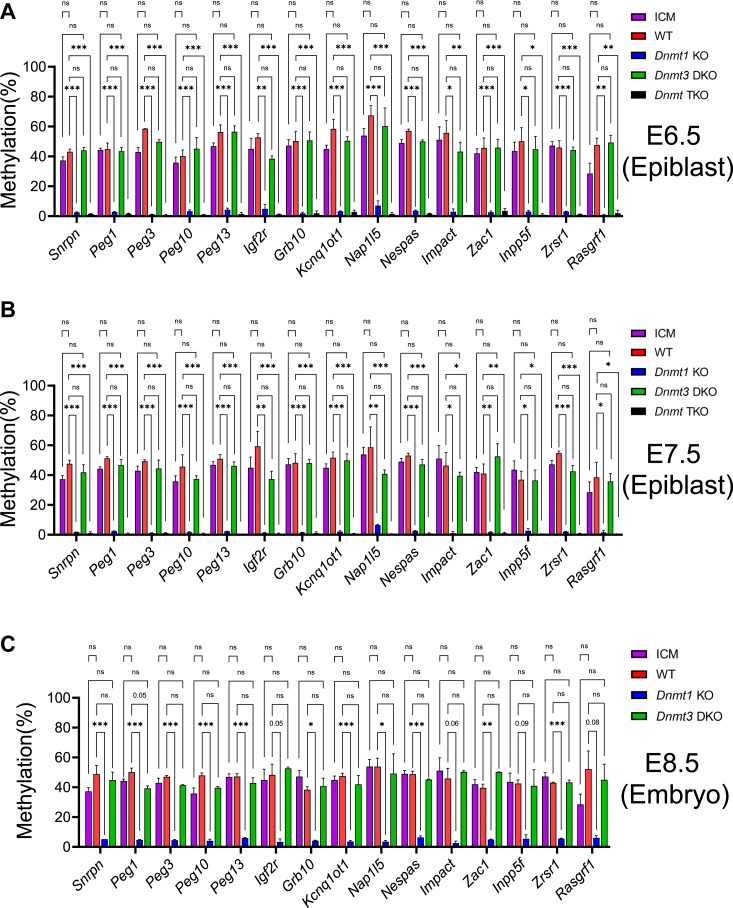
DNMT1 maintained DNA methylation at most imprinted regions in the postimplantation embryos. DNA methylation was analyzed for the imprinting control region (ICR) of the known imprinted regions in the ICM of the WT E3.5 blastocysts, the epiblasts of WT and Dnmt mutant E6.5-E7.5 embryos, as well as WT and Dnmt mutant E8.5 embryos. DNA methylation was significantly reduced in these ICRs in the Dnmt1 KO, but not in Dnmt3 DKO, mutant postimplantation embryos. A, DNA methylation was analyzed for these ICRs in the WT ICM, the epiblasts of WT, Dnmt1 mutant (Dnmt1 KO), Dnmt3 double mutant (Dnmt3 DKO), and Dnmt triple mutant (Dnmt TKO) E6.5 embryos. B, DNA methylation was analyzed for these ICRs in the WT ICM, the epiblasts of WT, Dnmt1 mutant (Dnmt1 KO), Dnmt3 double mutant (Dnmt3 DKO), and Dnmt triple mutant (Dnmt TKO) E7.5 embryos. C, DNA methylation was analyzed for these ICRs in the WT, Dnmt1 mutant (Dnmt1 KO), and Dnmt3 double mutant (Dnmt3 DKO) E8.5 embryos in comparison to the WT ICM. Statistical analysis was carried out by using one-way ANOVA with Dunnett multiple comparison test. Besides a few numbers for the real values, these symbols represent the following values in statistical analysis on the figure: ∗p < 0.05; ∗∗p < 0.01; ∗∗∗p < 0.001. ns, not statistically significant with p-value more than 0.1. DNMT, DNA methyltransferase; ICM, inner cell mass.
Figure 5
Figure 5
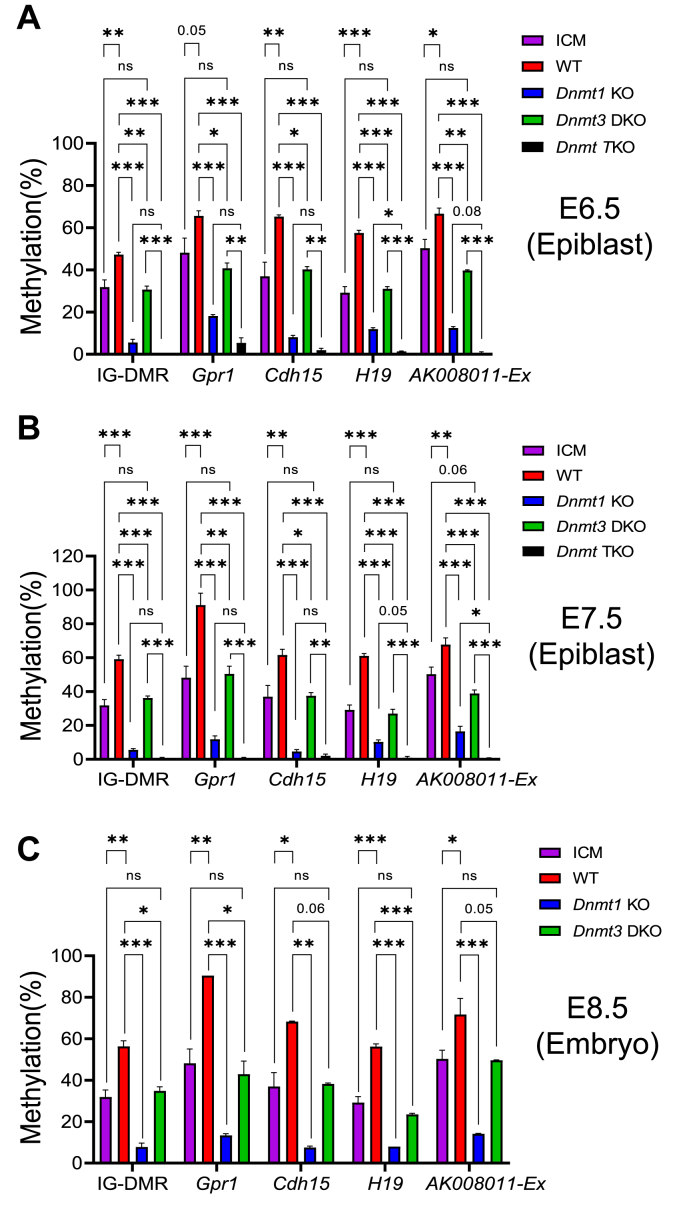
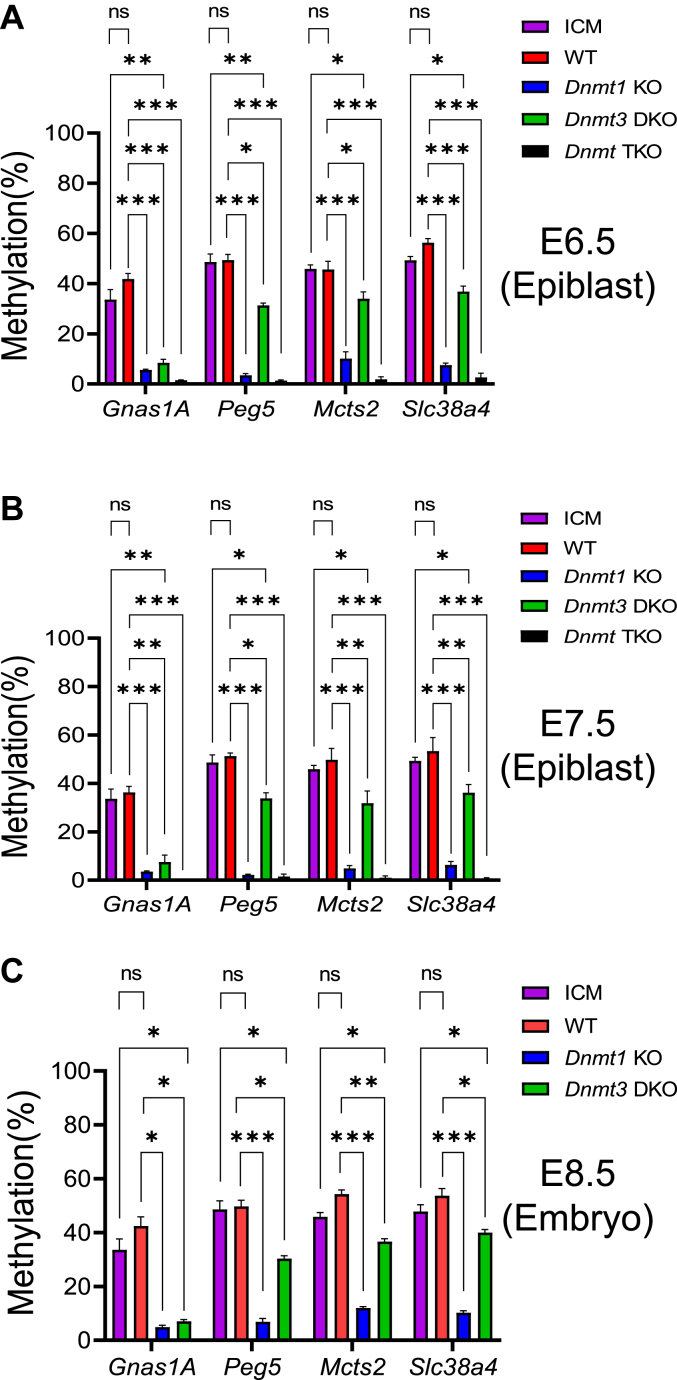
DNMT3A and DNMT3B were required for increased DNA methylation as well as maintenance DNA methylation at five imprinted regions after implantation. DNA methylation was analyzed for the imprinting control region (ICR) of the imprinted regions in the ICM of the WT E3.5 blastocysts, the epiblasts of WT and Dnmt mutant E6.5-E7.5 embryos, as well as WT and Dnmt mutant E8.5 embryos. DNA methylation was significantly reduced in the IG-DMR of the Dlk1-Dio3, Gpr1, Cdh15, H19, and AK008011-Ex ICRs of the Dnmt3 DKO mutant postimplantation embryos (Fig. S9 for AK008011-Ex). A, DNA methylation was analyzed for these five ICRs in the WT ICM, the epiblasts of WT, Dnmt1 mutant (Dnmt1 KO), Dnmt3 double mutant (Dnmt3 DKO), and Dnmt triple mutant (Dnmt TKO) E6.5 embryos. B, DNA methylation was analyzed for these five ICRs in the WT ICM, the epiblasts of WT, Dnmt1 mutant (Dnmt1 KO), Dnmt3 double mutant (Dnmt3 DKO), and Dnmt triple mutant (Dnmt TKO) E7.5 embryos. C, DNA methylation was analyzed for these five ICRs in the WT, Dnmt1 mutant (Dnmt1 KO), and Dnmt3 double mutant (Dnmt3 DKO) E8.5 embryos in comparison to the WT ICM. Statistical analysis was performed by using one-way ANOVA with Dunnett multiple comparison test. In addition to several numbers for the p-value, the significance in statistical analysis is shown with the symbols representing the following values: ∗p < 0.05; ∗∗p < 0.01; ∗∗∗p < 0.001. ns, not statistically significant with p-value more than 0.1. DNMT, DNA methyltransferase; ICM, inner cell mass.
Figure 6
Figure 6
DNMT3 proteins maintained preexisting germline-derived DNA methylation at a subset of imprinted regions in the postimplantation embryos. DNA methylation was analyzed for the imprinting control region (ICR) of the imprinted regions in the ICM of the WT E3.5 blastocysts, the epiblasts of WT and Dnmt mutant E6.5-E7.5 embryos, as well as WT and Dnmt mutant E8.5 embryos. DNA methylation was significantly reduced in the Gnas1A, Peg5, Mcts2, and Slc38a4 ICRs of the Dnmt3 DKO mutant postimplantation embryos in comparison to the WT ICM or WT embryos at E6.5-E8.5. A, DNA methylation was analyzed for these four ICRs in the WT ICM, the epiblasts of WT, Dnmt1 mutant (Dnmt1 KO), Dnmt3 double mutant (Dnmt3 DKO), and Dnmt triple mutant (Dnmt TKO) E6.5 embryos. B, DNA methylation was analyzed for these four ICRs in the WT ICM, the epiblasts of WT, Dnmt1 mutant (Dnmt1 KO), Dnmt3 double mutant (Dnmt3 DKO), and Dnmt triple mutant (Dnmt TKO) E7.5 embryos. C, DNA methylation was analyzed for these four ICRs in the WT, Dnmt1 mutant (Dnmt1 KO), and Dnmt3 double mutant (Dnmt3 DKO) E8.5 embryos in comparison to the WT ICM. One-way ANOVA with Dunnett multiple comparison test was used for statistical analyses, with the values shown on the figure as follows: ∗p < 0.05; ∗∗p < 0.01; ∗∗∗p < 0.001. ns, not statistically significant with p-value more than 0.1. DNMT, DNA methyltransferase; ICM, inner cell mass.
Figure 7
Figure 7
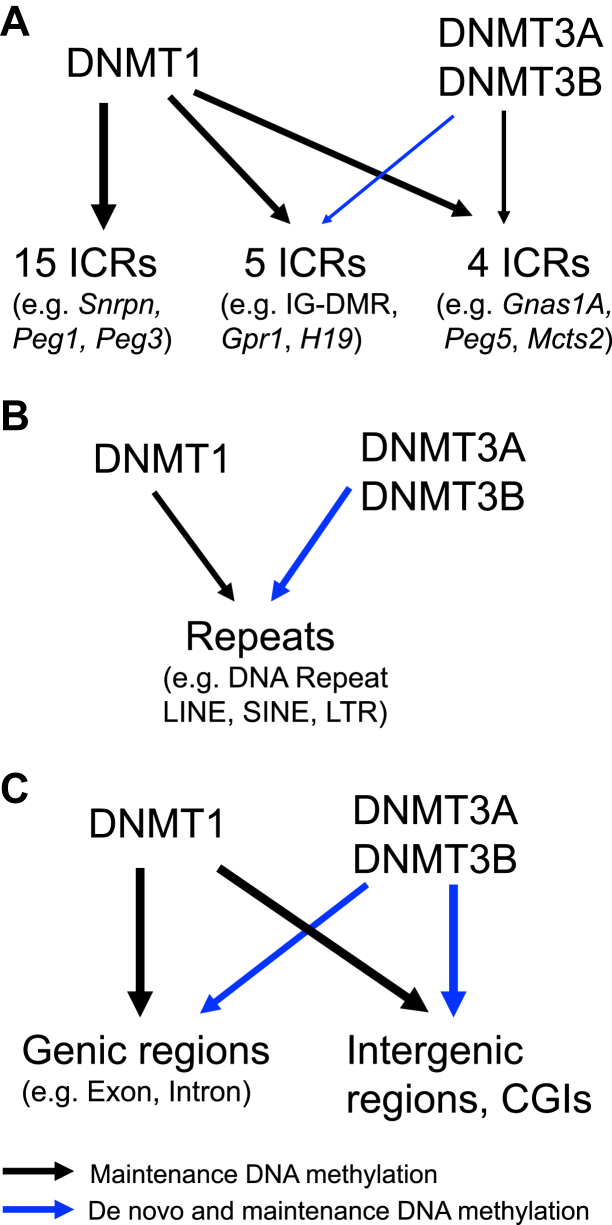
The schematic diagrams show the functions of three DNMT proteins in DNA methylation in the embryos after implantation. Two DNMT3 proteins, together with DNMT1, may maintain DNA methylation in the ICRs, repeats, genic, intergenic or CpG island (CGI) regions after implantation. Besides maintenance DNA methylation, DNMT3A and DNMT3B may also function in de novo DNA methylation of these genomic regions after implantation. The line thickness of the arrows are in proportion to their hypothetical roles in DNA methylation. A, DNA methylation at the ICRs in the postimplantation embryos. DNMT1 maintains preexisting DNA methylation at 15 ICRs such as Snrpn, Peg1, and Peg3. Interestingly, DNMT3A and DNMT3B display de novo DNA methylation at five other ICRs including IG-DMR, Gpr1, Cdh15, H19, and AK008011-Ex that was shown to probably harbor a broader genomic region in this study. There is strong evidence that DNMT3A and DNMT3B, together with DNMT1, maintain newly acquired DNA methylation at the H19 and AK008011-Ex ICRs, although DNMT1 likely maintains the preexisting DNA methylation at these five ICRs. Despite that DNMT1 is the major DNMT for maintaining preexisting DNA methylation at four other ICRs that includes Gnas1A, Peg5, Mcts2, and Slc38a4, DNMT3A and DNMT3B contribute to the maintenance of preexisting DNA methylation at these four ICRs in the postimplantation embryos. However, we could not rule out the possibility, with the current available data, that they might play a role, albeit unlikely, in de novo DNA methylation at these four ICRs in the postimplantation embryos. B, DNA methylation at repeats in the postimplantation embryos. DNMT1 maintains DNA methylation at the repeats including DNA repeat, LINE, SINE, and LTR. Interestingly, DNMT3A and DNMT3B function in the maintenance DNA methylation as well as de novo DNA methylation at these repeats after implantation. C, DNA methylation in the genic and intergenic regions in the postimplantation embryos. DNMT1 maintains DNA methylation in the genic (e.g. exon and intron), intergenic and CpG island (CGI) regions in the postimplantation embryos. Besides de novo DNA methylation, DNMT3A and DNMT3B are also important for the maintenance of DNA methylation in the genic and intergenic regions after implantation. DNMT, DNA methyltransferase; ICR, imprinting control region.

Similar articles

Cited by

References

    1. Chen Z., Zhang Y. Role of mammalian DNA methyltransferases in development. Annu. Rev. Biochem. 2020;89:135–158. - PubMed
    1. Dor Y., Cedar H. Principles of DNA methylation and their implications for biology and medicine. Lancet. 2018;392:777–786. - PubMed
    1. Li E., Zhang Y. DNA methylation in mammals. Cold Spring Harb. Perspect. Biol. 2014;6:a019133. - PMC - PubMed
    1. Mattei A.L., Bailly N., Meissner A. DNA methylation: a historical perspective. Trends Genet. 2022;38:676–707. - PubMed
    1. Tibben B.M., Rothbart S.B. Mechanisms of DNA methylation regulatory function and crosstalk with histone lysine methylation. J. Mol. Biol. 2024;436 - PMC - PubMed

MeSH terms

Substances

LinkOut - more resources