. 2024 Nov 14;14(1):27949.
doi: 10.1038/s41598-024-75319-y.

Gut microbes of a high-value marine fish, Snubnose Pompano (Trachinotus blochii) are resilient to therapeutic dosing of oxytetracycline

Affiliations

Gut microbes of a high-value marine fish, Snubnose Pompano (Trachinotus blochii) are resilient to therapeutic dosing of oxytetracycline

T G Sumithra et al. Sci Rep. .

Abstract

Trachinotus blochii is a high-value tropical mariculture species. The present study evaluated the gut microbial impact of therapeutic exposure (80 mg/day/kg biomass for 10 days) to oxytetracycline, the most common aquaculture antibiotic in T. blochii. The cultivable counts, α-diversity measures of taxonomic and functional metagenomics, microbial dysbiosis (MD) index, and microbial taxon abundances showed the resilience of gut microbiota at 16-26 days of treatment. A significant reduction in bacterial abundance, diversity measures, Firmicutes and Actinobacteria and an increase in γ-Proteobacteria was recorded on the 6th and 11th day of treatment. The increased metagenomic stress signatures, decreased beneficial bacterial abundances, decreased abundance of microbial pathways on energy metabolism, and MD index indicated short-term transient stress during the initial days of therapeutic withdrawal, warranting health management measures. Therapeutic exposure reduced the abundance of fish pathogens, including Vibrio spp., kanamycin and ampicillin-resistant bacteria. Strikingly, oxytetracycline treatment did not increase tetracycline-resistant bacterial counts and the predicted abundance of tetracycline resistance encoding genes in the gut, illustrating that therapeutic application would not pose a risk in the context of antimicrobial resistance in short term. Altogether, the present study provides a foundation for oxytetracycline treatment to develop suitable risk minimization tactics in sustainable aquaculture.

Keywords: AMR; Antibiotic; Gut microbial impact; Microbial dysbiosis; Probiotics.


Conflict of interest statement

Declarations Competing interests The authors declare no competing interests.

Figures

Fig. 1
Fig. 1
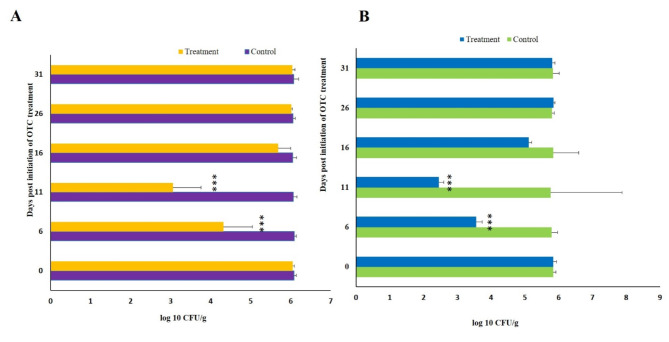
Dynamics of total cultivable bacteria and presumptive Vibrio spp. in pompano gut following oxytetracycline therapy. (A) Dynamics of total cultivable bacteria in pompano gut following oxytetracycline therapy. (B) Dynamics of presumptive Vibrio spp. in pompano gut following oxytetracycline therapy. p-values ≤ 0.001 are summarized with three asterisks, to represent the significant difference from the control fish. OTC Oxytetracycline, CFU colony-forming units, g Gram of gut.
Fig. 2
Fig. 2
Antimicrobial-resistant cultivable gut bacterial counts in pompano following oxytetracycline therapy. (A) Kanamycin-resistant cultivable gut bacterial counts following oxytetracycline therapy. (B) Ampicillin-resistant cultivable gut bacterial counts following oxytetracycline therapy. p-values ≤ 0.001 are summarized with three asterisks, to represent the significant difference from the control fish. CFU colony-forming units, g Gram of gut.
Fig. 3
Fig. 3
Taxonomic landscape in the gut microbiota during various days of oxytetracycline exposure. Top-30 were considered for making plots from class level onwards. (A) At phylum level; (B) At class level; (C) At order level; (D) At family level; (E) At genus level.
Fig. 4
Fig. 4
Perturbations in the diversity measures of taxonomic gut metagenomics following therapeutic exposure to oxytetracycline. (A) Perturbations in the observed taxa of gut bacterial taxonomy. (B) Perturbations in the Shannon’s H index. (C) Perturbations in the Simpson’s index. (D) Cladogram analysis based on β-diversity measures of gut bacterial taxonomy. p-values ≤ 0.05 are summarized with one asterisk, to represent the significant difference from the control fish.
Fig. 5
Fig. 5
Gut bacterial genera discriminating the fish at different days of oxytetracycline exposure. Top-15 discriminating genera in each day of treatment from the control fish was used to generate the plot. The diameter of each bubble indicates dissmilarity index. OTC Oxytetracycline, C.vs.D11 Control versus Day 11, C.vs.D16 Control versus Day 16, C.vs.D26 Control versus Day 26, C.vs.D31 Control versus Day 31, C.vs.D6 Control versus Day 6.
Fig. 6
Fig. 6
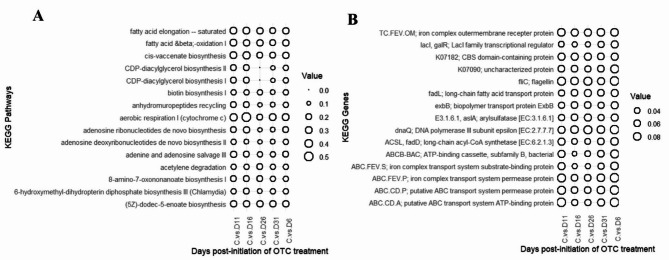
Discriminating KEGG pathways and genes in pompano gut at different days of oxytetracycline exposure. (A) Discriminating KEGG pathways; (B) Discriminating KEGG genes. Top-15 discriminating KEGG pathways and genes were used to generate the plot. The diameter of each bubble indicates dissmilarity index. OTC Oxytetracycline, C.vs. D11 Control versus Day 11, C.vs.D16 Control versus Day 16, C.vs.D26 Control versus Day 26, C.vs.D31 Control versus Day 31, C.vs.D6 Control versus Day 6.
Fig. 7
Fig. 7
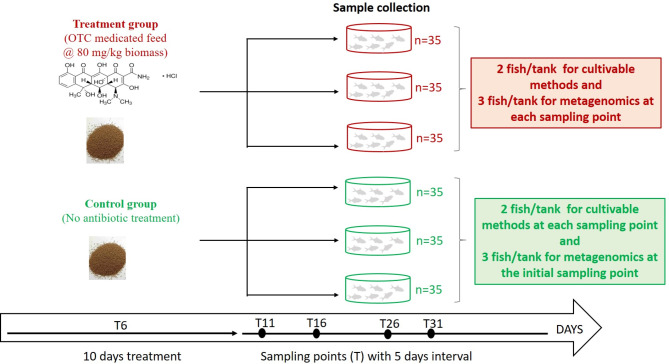
Experimental plan followed in the study.

References

    1. The state of world fisheries and aquaculture 2022. Towards blue transformation. FAO. FAO & Rome Italy. (2022). 10.4060/cc0461en (Accessed on 03 Mar 2024).
    1. Naylor, R. L. et al. A 20-year retrospective review of global aquaculture. Nature. 591, 551–563. 10.1038/s41586-021-03308-6 (2021). - PubMed
    1. Rigas, D. et al. Persistent dysbiosis, parasite rise and growth impairment in aquacultured European Seabass after oxytetracycline treatment. Microorganisms. 11, 2302. 10.3390/microorganisms11092302 (2023). - PMC - PubMed
    1. Pennycook, J. H. & Scanlan, P. D. Ecological and evolutionary responses to Antibiotic Treatment in the human gut microbiota. FEMS Microbiol. Rev.. 10.1093/femsre/fuab018 (2021). - PMC - PubMed
    1. Kokou, F., Sasson, G., Mizrahi, I. & Cnaani, A. Antibiotic effect and microbiome persistence vary along the European seabass gut. Sci. Rep. 10, 10003. 10.1038/s41598-020-66622-5 (2020). - PMC - PubMed