


Infrastructure development in children's behavioral health systems of care: essential elements and implementation strategies
- PMID: 39543361
- PMCID: PMC11564964
- DOI: 10.1038/s44184-024-00102-w
Infrastructure development in children's behavioral health systems of care: essential elements and implementation strategies
Abstract
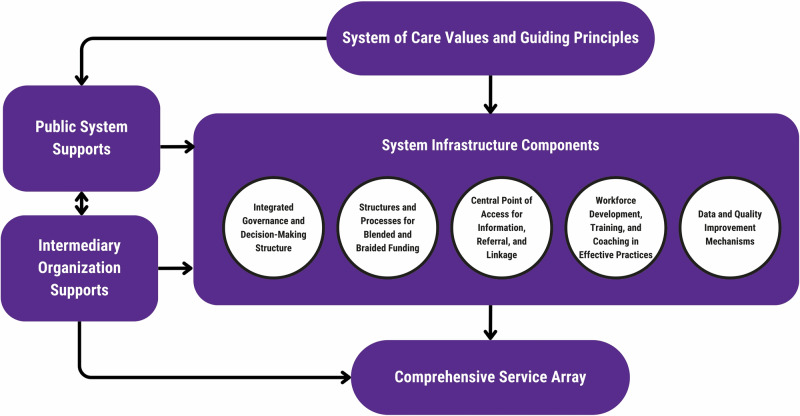
To improve the outcomes of children's behavioral health systems, states must invest in expanding infrastructure; however, infrastructure is a commonly used and poorly understood concept. This paper aims to provide a definition of infrastructure in the context of state-level children's behavioral system of care development and describes five essential infrastructure elements: an integrated governance and decision-making structure; structures and processes for blended and braided funding; a central point of access for information, referral, and linkage; workforce development, training, and coaching in effective practices; and data and quality improvement mechanisms. Suggested implementation activities are offered for each of the five proposed infrastructure components. The important role of public-private partnership, particularly with intermediary organizations, is described, and future directions for research and scholarship are proposed.
© 2024. The Author(s).
Conflict of interest statement
Figures
References
-
- Bitsko. et al. Surveillance of children’s mental health - United States, 2013-2019. Morbidity Mortal. Wkly. Report.71, 1–42 (2022).
-
- Perou, R. et al. Mental health surveillance among children: United States, 2005-2011. Morbidity and Mortality Weekly Report. Centers for Disease Control and Prevention (2013).
Publication types
LinkOut - more resources
Full Text Sources
