


Optimal levels of sleep, sedentary behaviour, and physical activity needed to support cognitive function in children of the early years
- PMID: 39543525
- PMCID: PMC11562365
- DOI: 10.1186/s12887-024-05186-z
Optimal levels of sleep, sedentary behaviour, and physical activity needed to support cognitive function in children of the early years
Abstract
Background: Sleep, sedentary behaviour, physical activity, and the composition of these movement behaviours across the 24-h day are associated with cognitive function in early years children. This study used a Goldilocks day compositional data analysis approach to identify the optimal duration of sleep, sedentary behaviour, light physical activity, and moderate-to-vigorous physical activity associated with desired cognitive function outcomes in early years children.
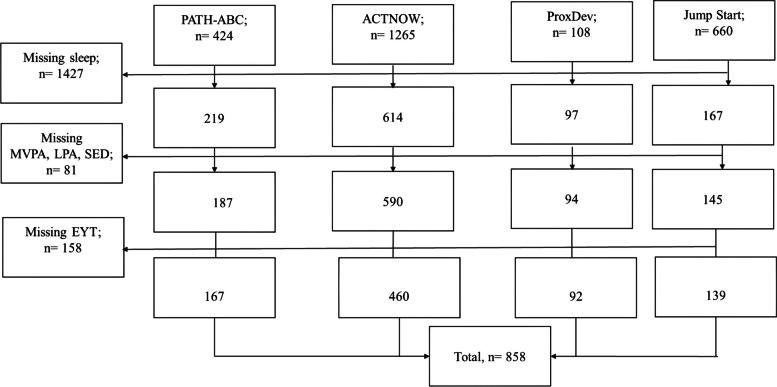
Methods: This cross-sectional study included 858 children aged 2.8-5.5 years from the Sleep and Activity Database for the Early Years. 24-h movement behaviours (sleep, sedentary behaviour, light physical activity, moderate-to-vigorous physical activity) were measured using ActiGraph accelerometers. Cognitive function was measured using three tasks from the Early Years Toolbox: visual-spatial working memory, response inhibition, and expressive vocabulary. A Goldilocks day compositional data analysis approach was used in R software to identify the optimal time-use compositions associated with the best 10% of the cognitive function scores.
Results: The movement behaviour composition and the relative time spent in sleep and sedentary behaviour but not different intensities of physical activity were significantly associated with working memory (P ≤ 0.01). The movement behaviour composition and relative time spent in sleep, sedentary behaviour, and different intensities of physical activity were not significantly associated with response inhibition or expressive vocabulary (P > 0.2). Therefore, optimal time use was only determined for working memory. Optimal daily durations for working memory were observed with 11:00 (hr:min) of sleep, 5:42 of sedentary behaviour, 5:06 of light physical activity, and 2:12 of moderate-to-vigorous physical activity.
Conclusion: Working memory was the only cognitive function outcome related to the 24-h movement behaviour composition. Optimal sleep for working memory was consistent with current recommended durations, while optimal moderate-to-vigorous physical activity greatly exceeded minimal recommended levels. Optimal sedentary behaviour was longer and light physical activity was shorter than the sample average.
Keywords: Cognition; Compositional data analysis; Early childhood; Movement behaviours; Preschool; Time use epidemiology.
© 2024. The Author(s).
Conflict of interest statement
Figures
References
-
- Griffin JA, McCardle PD, Freund L: Executive function in preschool-age children: Integrating measurement, neurodevelopment, and translational research: JSTOR; 2016.
MeSH terms
LinkOut - more resources
Full Text Sources
Medical
