


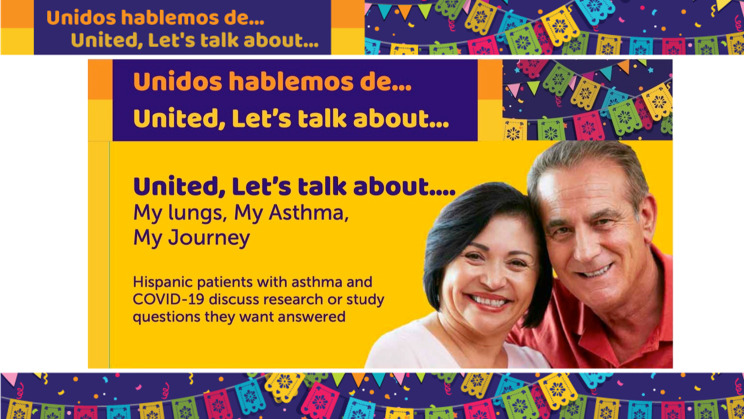
"Unidos Hablemos" - description of a virtual conference series to engage the Hispanic and Latino community in asthma and COVID-19 education and research
- PMID: 39543773
- PMCID: PMC11566250
- DOI: 10.1186/s40900-024-00656-1
"Unidos Hablemos" - description of a virtual conference series to engage the Hispanic and Latino community in asthma and COVID-19 education and research
Abstract
Background: Inequity in asthma and COVID-19 outcomes and research among Hispanic or Latino individuals is well established. Patient centered outcomes research (PCOR) may help address these inequalities. This report describes the development, implementation, and evaluation of a virtual conference series program titled "Unidos Hablemos de/United, Let's Talk About" intended to address the health literacy of the Hispanic/Latino community regarding asthma and COVID-19 and to encourage involvement in PCOR.
Methods: A Project Advisory Group consisting of Hispanic/Latino patient advisors who had been diagnosed with asthma and/or COVID-19, healthcare providers, researchers, a Hispanic faith-based leader, and a program evaluator designed and implemented a six-month series of monthly one-hour virtual sessions. Speakers and topics were selected that fit the Hispanic/Latino community and culture regarding asthma, COVID-19, and PCOR. Recruitment was through a multichannel digital promotion strategy, including social media. The virtual sessions were free on the ZOOM webinar platform and included interactive polling questions, live chat box, and Q&A. All audio and written materials from the sessions were translated into Spanish and English. Evaluations were used to rate the overall satisfaction with the program.
Results: An average of 382 participants attended each of the six sessions, and participation generally increased with each session. The proportion of participants who considered themselves a Hispanic/Latino patient with asthma, caregiver, or clergy who served Hispanic/Latino communities increased by 100% from session one to session two. Preference for materials in Spanish ranged from 12 to 20% of participants over the six sessions. Among the sessions, 74-84% of polling question respondents indicated they would be willing to participate in research or a study, and 88% said they would be willing to serve as a patient partner/advocate. Program evaluations consistently indicated high satisfaction with the session content, session format, and feeling of inclusion.
Conclusions: Unidos Hablemos provided a voice to the Hispanic/Latino community that will inform future strategies to improve equity in asthma management, COVID-19, and PCOR. Patient speakers generated trust from the participants and "bridged the gap" between physicians, researchers, and the Hispanic/Latino community. Providing evidence-based, current information will empower patients and caregivers to make informed healthcare decisions.
Keywords: Asthma; Availability; Awareness; COVID-19; Disparities; Hispanic; Inequalities; Patient engagement; Patient-centered outcomes research; Understanding; Virtual.
Plain language summary
Hispanic/Latino patients have more emergency visits, hospitalizations, and deaths from asthma and COVID-19 than non-Hispanic/Latino White patients. Puerto Rican patients may have these outcomes more often than other Hispanic/Latino patients. Hispanic/Latino patients may not seek healthcare or take part in research because of language barriers and cultural differences. Patient centered outcomes research (PCOR) can be a solution to these issues. This type of research uses information from real-world situations to improve inequalities in research. A group of Hispanic/Latino patients, caregivers, and experts led the planning of a free webinar series that focused on asthma, COVID-19, and how patients can get involved in PCOR. The webinars and material were offered in both English and Spanish. Spanish was the preferred language for some of the webinar participants. During the sessions, most people indicated they would be willing to participate in research and be an advisor for PCOR. The patient speakers were important in generating the trust of the participants. Patients and caregivers were satisfied with the content and format and said they felt included. Programs, like this one, help patients make informed decisions about their medical care and take part in PCOR.
© 2024. The Author(s).
Conflict of interest statement
Figures
References
-
- Asthma and Hispanic Americans. [Internet]. U.S. Department of Health and Human Services; 2021 [cited 2023 December 12]. https://www.minorityhealth.hhs.gov/asthma-and-hispanic-americans
-
- Crist JD, Koerner KM, Hepworth JT, Pasvogel A, Marshall CA, Cruz TP, et al. Differences in transitional care provided to Mexican American and non-Hispanic white older adults. J Transcult Nurs. 2017;28:159–67. - PubMed
-
- Documet PI, Troyer MM, Macia L. Social support, health, and health care access among Latino immigrant men in an emerging community. Health Educ Behav. 2019;46:137–45. - PubMed
Grants and funding
LinkOut - more resources
Full Text Sources
Miscellaneous
