. 2024 Nov 15;15(1):9640.
doi: 10.1038/s41467-024-53813-1.

Antiseizure medication use during pregnancy and children's neurodevelopmental outcomes

Affiliations

Antiseizure medication use during pregnancy and children's neurodevelopmental outcomes

Paul Madley-Dowd et al. Nat Commun. .

Abstract

The teratogenic potential of valproate in pregnancy is well established; however, evidence regarding the long-term safety of other antiseizure medications (ASMs) during pregnancy remains limited. Using routinely collected primary care data from the UK and nationwide Swedish registries to create a cohort of 3,182,773 children, of which 17,495 were exposed to ASMs in pregnancy, we show that those exposed to valproate were more likely to receive a diagnosis of autism, intellectual disability, and ADHD, when compared to children not exposed to ASMs. Additionally, children exposed to topiramate were 2.5 times more likely to be diagnosed with intellectual disability (95% CI: 1.23-4.98), and those exposed to carbamazepine were 1.25 times more likely to be diagnosed with autism (95% CI: 1.05-1.48) and 1.30 times more likely to be diagnosed with intellectual disability (95% CI: 1.01-1.69). There was little evidence that children exposed to lamotrigine in pregnancy were more likely to receive neurodevelopmental diagnoses. While further research is needed, these findings may support considering safer treatment alternatives well before conception when clinically appropriate.


Conflict of interest statement

Competing interests T.T. has received support to the EURAP pregnancy registry from Accord, Eisai, GSK, UCB, Bial, Sanofi, GW Pharma, Teva, Angelini Pharma, Zentiva, SF Group, Glenmark and personal fees from Eisai, Sanofi, UCB and Angelini Pharma outside the submitted work. BL reports receiving consulting fees from Beasley Allen Law Firm, Patterson Belknap Webb & Tyler LLP and AlphaSights. None of the above entities had any role in the design and conduct of the study; collection, management, analysis and interpretation of the data; preparation, review, or approval of the manuscript; and decision to submit the manuscript for publication. The remaining authors have no conflicts of interest.

Figures

Fig. 1
Fig. 1. The pooled absolute adjusted risk (%) of offspring neurodevelopmental conditions by ASM exposure during pregnancy at ages 4, 8, and 12.
All estimates are adjusted for maternal age, region, diagnosis of neurodevelopmental conditions before pregnancy, evidence of hazardous drinking and illicit drug use during pregnancy, gravidity, health care utilization, seizure events, use of antipsychotics and antidepressants in the year prior to pregnancy, vomiting or antiemetic prescriptions during pregnancy, and socioeconomic position. Data are presented as pooled absolute adjusted risk (end line of bars) ± 95% confidence limits (grey error bars). Presented measures were estimated using fixed-effects meta-analysis on the log-risk scale. Note that pooled estimates of the risk of ADHD among those not exposed to an ASM are heavily weighted towards the UK (risk age 12 = 2.10; 95% CI = 1.99–2.21), where a lower risk was estimated than in Sweden (risk age 12 = 5.70; 95% CI = 5.09–6.38), due to the calculation of lower standard errors for estimated risks closer to 0 (see Supplementary Results Tables S2 and S3). Sample size for figure: Total cohort = 3,182,771, No ASM = 3,165,276, Carbamazepine = 3030, Gabapentin = 1428, Lamotrigine = 5974, Levetiracetam = 806, Phenytoin = 240, Pregabalin = 1715, Topiramate = 418, Valproate = 1601, Other ASM = 543, Polytherapy = 1740. Source data are provided as a Source Data file. ADHD attention deficit hyperactivity disorder, ASM antiseizure medication.
Fig. 2
Fig. 2. The pooled adjusted hazard ratios of offspring neurodevelopmental conditions by ASM exposure during pregnancy.
All estimates are adjusted for maternal age, region, diagnosis of neurodevelopmental conditions before pregnancy, evidence of hazardous drinking and illicit drug use during pregnancy, gravidity, health care utilization, seizure events, use of antipsychotics and antidepressants in the year prior to pregnancy, vomiting or antiemetic prescriptions during pregnancy, and socioeconomic position. Error bars show 95% confidence limits. The presented measures were estimated using fixed-effects meta-analysis on the log-hazard ratio scale. Sample size for figure: Total cohort = 3,182,771, No ASM = 3,165,276, Carbamazepine = 3030, Gabapentin = 1428, Lamotrigine = 5974, Levetiracetam = 806, Phenytoin = 240, Pregabalin = 1715, Topiramate =  418, Valproate = 1601, Other ASM = 543, Polytherapy = 1740. Source data are provided as a Source Data file. ADHD attention deficit hyperactivity disorder, ASM antiseizure medication, HR hazard ratio.
Fig. 3
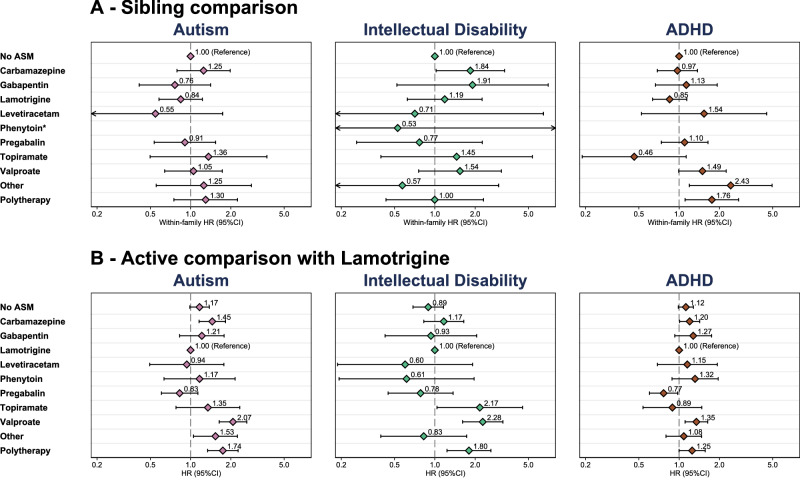
Fig. 3. Sibling comparisons and active comparison with lamotrigine by ASM exposure during pregnancy.
The pooled estimates for (A) sibling comparisons (within-family hazard ratio) and (B) active comparison with lamotrigine (hazard ratio) by ASM prescription during pregnancy. All estimates are adjusted for maternal age, region, diagnosis of neurodevelopmental conditions before pregnancy, evidence of hazardous drinking and illicit drug use during pregnancy, gravidity, health care utilization, seizure events, use of antipsychotics and antidepressants in the year prior to pregnancy, vomiting or antiemetic prescriptions during pregnancy, and socioeconomic position. Error bars show 95% confidence limits. The presented measures were estimated using fixed-effects meta-analysis on the log-hazard ratio scale. Sample size for figure: Total cohort = 3,182,771, No ASM = 3,165,276, Carbamazepine = 3030, Gabapentin = 1428, Lamotrigine = 5974, Levetiracetam = 806, Phenytoin = 240, Pregabalin = 1715, Topiramate = 418, Valproate = 1601, Other ASM = 543, Polytherapy = 1740. * Sibling comparison results for phenytoin are presented in the text. Source data are provided as a Source Data file. ADHD attention deficit hyperactivity disorder, ASM antiseizure medication, HR hazard ratio.

References

    1. Medicines & Healthcare products Regulatory Agency (MHRA). Guidance: valproate use by women and girls: UK Government. https://www.gov.uk/guidance/valproate-use-by-women-and-girls (2018).
    1. Sisodiya, S. M., Epilepsy Advisory Group for the Association of British Neurologists.Valproate and childbearing potential: new regulations. Pract. Neurol.18, 176–178 (2018). - PubMed
    1. Bromley, R. L. et al. The prevalence of neurodevelopmental disorders in children prenatally exposed to antiepileptic drugs. J. Neurol. Neurosurg. Psychiatry84, 637–643 (2013). - PMC - PubMed
    1. Maimburg, R. D. & Vaeth, M. Perinatal risk factors and infantile autism. Acta Psychiatr. Scand.114, 257–264 (2006). - PubMed
    1. Meador, K. J. et al. Fetal antiepileptic drug exposure and cognitive outcomes at age 6 years (NEAD study): a prospective observational study. Lancet Neurol.12, 244–252 (2013). - PMC - PubMed

Publication types

MeSH terms

LinkOut - more resources