. 2024 Nov 15;14(1):28249.
doi: 10.1038/s41598-024-75282-8.

Creative music therapy in preterm infants effects cerebrovascular oxygenation and perfusion

Affiliations

Creative music therapy in preterm infants effects cerebrovascular oxygenation and perfusion

Felix Scholkmann et al. Sci Rep. .

Abstract

Creative music therapy (CMT) has been shown to promote the development of brain function and structure in preterm infants. We aimed to investigate the effect of CMT on cerebral oxygenation and perfusion to examine how the brain reacts to CMT. Absolute levels of cerebrovascular oxygen saturation (StO2) were measured in clinically stable preterm-born neonates (n = 20, gestational age: ≥30 weeks and < 37 weeks) using two near-infrared spectroscopy (NIRS)-based tissue oximeters over the right prefrontal cortex and left auditory cortex. We applied the systemic physiology augmented functional NIRS approach. Each CMT session lasted 55 min and involved 9 intervals, including two 10-minute intervals during which the music therapist hummed and held the neonate. We found that CMT-induced changes in cerebrovascular StO2, perfusion and systemic physiology (i) could be classified into two groups (group 1: increase in StO2 during the first singing interval, group 2: decrease in StO2), (ii) differed in female neonates compared to male neonates, and (iii) correlated with individual blood haematocrit levels. Our exploratory study (i) demonstrates the impact of CMT on the neonate's physiology and (ii) highlights the need to analyze functional NIRS measurements in neonates separately according to their response pattern to avoid erroneous conclusions, e.g. when only the group average of the signal change is determined.

Keywords: Brain development; Creative music therapy; Functional near-infrared spectroscopy; Optical neuroimaging; Preterm infants; fNIRS.


Conflict of interest statement

Declarations Competing interests F.H., T.K., T.R., T.R., B.C.H.V., E.O., H.Z, H.U.B., U.W. and D.B. declare no conflict of interest. D.O. and S.K. are affiliated with and MW is co-founder and president of the board of OxyPrem AG (a University of Zurich spin-off that produces an improved version of the near-infrared spectroscopy oximeters employed in the study). S.K., D.O., and M.W. had no influence on how the data were analyzed by F.S. F. S. provided scientific consulting for companies producing fNIRS devices (NIRx GmbH, Berlin, Germany; Kernel, Culver City, Los Angeles, USA).

Figures

Fig. 1
Fig. 1
Measurement setup. (a) Picture of a measurement session where the music therapist touches the child with both hands while measuring StO2, SpO2 and PR. (b) One of the OxyPrem v1.4 NIRS-based oximeters used for the fNIRS measurements. (c) Visualization of the NIRS optode placement on the neonate’s head. (The neonatal head model is based on an fMRI scan of a 35-week-old infant as available in the AtlasViewer software).
Fig. 2
Fig. 2
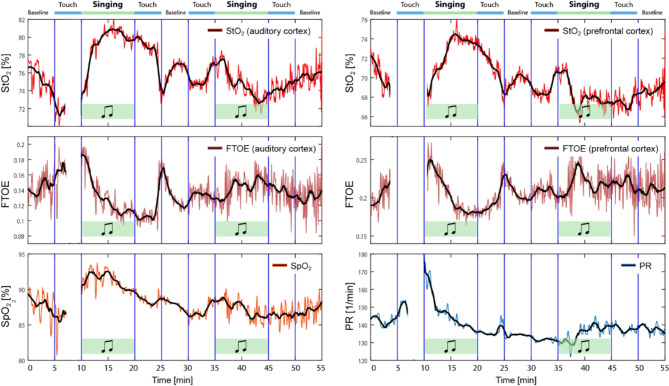
Example of CMT-induced changes in cerebral tissue oxygenation and metabolism as well as systemic physiological signals in one single neonate with a particularly marked change in all physiological signals. StO2: cerebrovascular oxygenation, FTOE: dependent fractional tissue oxygen extraction, SpO2: peripheral arterial oxygenation, PR: pulse rate. The optodes of the NIRS-based tissue oximeter were placed over the right prefrontal cortex and left auditory cortex.
Fig. 3
Fig. 3
Group-averages of CMT-induced changes in cerebral tissue oxygenation and metabolism as well as systemic physiological signals, depending on the two subgroups. StO2: cerebrovascular oxygenation, FTOE: dependent fractional tissue oxygen extraction, SpO2: peripheral arterial oxygenation, PR: pulse rate. The optodes of the NIRS-based tissue oximeter were placed over the right prefrontal cortex and left auditory cortex.
Fig. 4
Fig. 4
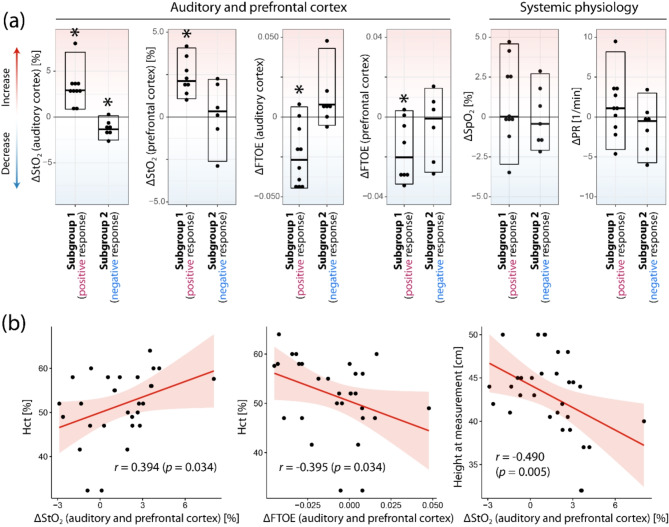
(a) CMT-induced changes in cerebral oxygenation and hemodynamics as well as systemic physiology. Asterisks above the boxplots indicate a statistically significant (p < 0.05, Wilcoxon signed-rank test) difference from baseline (first touch). (b) Statistically significant correlations between haematocrit (Hct) and ΔStO2 and ΔFTOE as well as ΔStO2 and height at measurement.
Fig. 5
Fig. 5
Results of four GAM models linking cerebrovascular oxygenation at the auditory and prefrontal cortex to systemic physiological activity based on the models g(ΔStO2 (AC)) = β0 + fts(ΔSpO2, ΔPR) + ε and g(ΔStO2 (PFC)) = β0 + fts(ΔSpO2, ΔPR) + ε. The models were evaluated for each of the two subgroups separately (a, b). It can be clearly seen that the relationships between ΔStO2 and ΔSpO2 as well as ΔPR are different for each subgroup.

References

    1. Chawanpaiboon, S. et al. Global, regional, and national estimates of levels of preterm birth in 2014: A systematic review and modelling analysis. Lancet Glob Health7(1), e37–e46 (2019). - PMC - PubMed
    1. Boardman, J. P. et al. Abnormal deep grey matter development following preterm birth detected using deformation-based morphometry. Neuroimage32(1), 70–78 (2006). - PubMed
    1. Dubois, J. et al. The early development of brain white matter: A review of imaging studies in fetuses, newborns and infants. Neuroscience276, 48–71 (2014). - PubMed
    1. Romeo, D. M. et al. Longitudinal cognitive assessment in healthy late preterm infants. Eur. J. Paediatr. Neurol.16(3), 243–247 (2012). - PubMed
    1. Restin, T. et al. Newborn incubators do not protect from high noise levels in the neonatal intensive care unit and are relevant noise sources by themselves. Children8(8). (2021). - PMC - PubMed