


Facilitating the transition from hospital to home after hip fracture surgery: a qualitative study from the HIP HELPER trial
- PMID: 39548386
- PMCID: PMC11566269
- DOI: 10.1186/s12877-024-05390-7
Facilitating the transition from hospital to home after hip fracture surgery: a qualitative study from the HIP HELPER trial
Abstract
Background: People post-hip fracture have reported experiences of fragmented care and poor discharge planning, therefore improvements in patient flow are required. This study reports the challenges people face during the discharge process and offers potential solutions for improving the transition from hospital to home from the perspectives of patients, carers, and health professionals.
Methods: This was a qualitative study embedded within a multi-centre, feasibility randomised controlled trial (HIP HELPER). We undertook semi-structured interviews with 10 patient-carer dyads (10 people with hip fracture; 10 unpaid carers) and eight health professionals (four physiotherapists, two occupational therapists, one nurse and one physiotherapy researcher) between November 2021 and March 2022. Data were analysed using the principles of Framework Analysis.
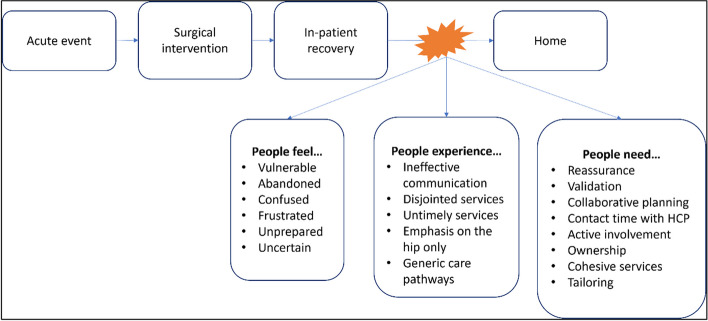
Results: Participants identified challenges in the transition from hospital to home post-hip fracture surgery: ineffective communication, disjointed systems, untimely services and 'it's more than just the hip'. Possible solutions and insights to facilitate this transition included the need for reassurance, collaborative planning, and individualisation.
Conclusion: The transition from hospital to home following hip fracture surgery can be a challenging experience for patients, and for friends and family who support them as carers, making them feel vulnerable, frustrated and uncertain. Enabling a coordinated, collaborative approach to discharge planning and early recovery provision is considered a positive approach to improving NHS care.
Trial registration: ISRCTN13270387. Registered 29th October 2020.
Keywords: Hip fracture; Qualitative; Rehabilitation; Transition.
© 2024. The Author(s).
Conflict of interest statement
Figures
References
-
- National Hip Fracture Database. NHFD Annual Report. 2022. https://www.nhfd.co.uk/2022report. Accessed 7 Feb 2024.
-
- Glynn J, Hollingworth W, Bhimjiyani A, Ben-Shlomo Y, Gregson CL. How does deprivation influence secondary care costs after hip fracture? Osteoporos Int. 2020;31:1573–85. - PubMed
-
- Chartered Society of Physiotherapy. Hip fracture rehabilitation in physiotherapy practice: from hospital to home. 2018. Hip fracture rehabilitation in physiotherapy practice | The Chartered Society of Physiotherapy (csp.org.uk). Accessed 7 Feb 2024.
-
- Tyas B, Lukic J, Harrison J, Singisetti K. A comparative study of hip fracture care and outcomes in major trauma centres versus trauma units. Injury. 2022;53:1455–8. - PubMed
Publication types
MeSH terms
Grants and funding
- NIHR200731/Research for Patient Benefit Programme
- NIHR200731/Research for Patient Benefit Programme
- NIHR200731/Research for Patient Benefit Programme
- NIHR200731/Research for Patient Benefit Programme
- NIHR200731/Research for Patient Benefit Programme
- NIHR200731/Research for Patient Benefit Programme
- NIHR200731/Research for Patient Benefit Programme
- NIHR200731/Research for Patient Benefit Programme
- NIHR200731/Research for Patient Benefit Programme
- NIHR200731/Research for Patient Benefit Programme
- NIHR200731/Research for Patient Benefit Programme
- NIHR200731/Research for Patient Benefit Programme
- NIHR200731/Research for Patient Benefit Programme
LinkOut - more resources
Full Text Sources
Medical
