


Long read sequencing identifies complex structural variant landscape and recurrent TERT rearrangements in mucoepidermoid carcinoma
- PMID: 39549430
- PMCID: PMC11983472
- DOI: 10.1016/j.oraloncology.2024.107108
Long read sequencing identifies complex structural variant landscape and recurrent TERT rearrangements in mucoepidermoid carcinoma
Abstract
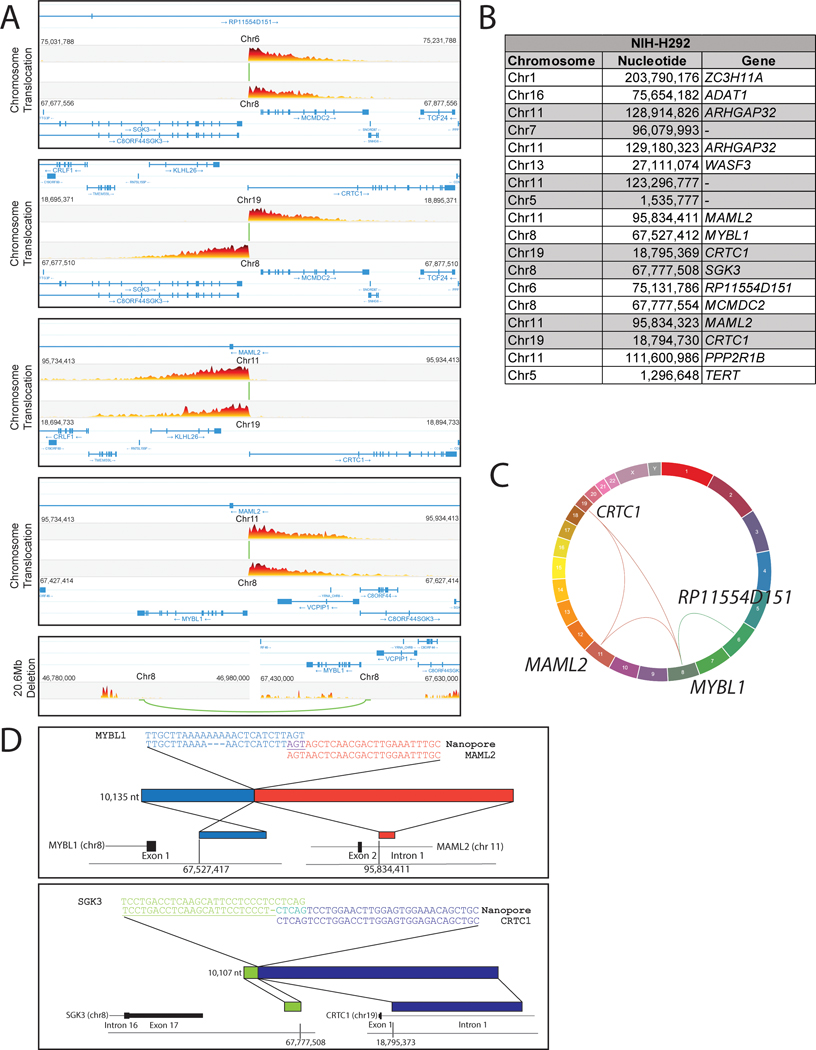
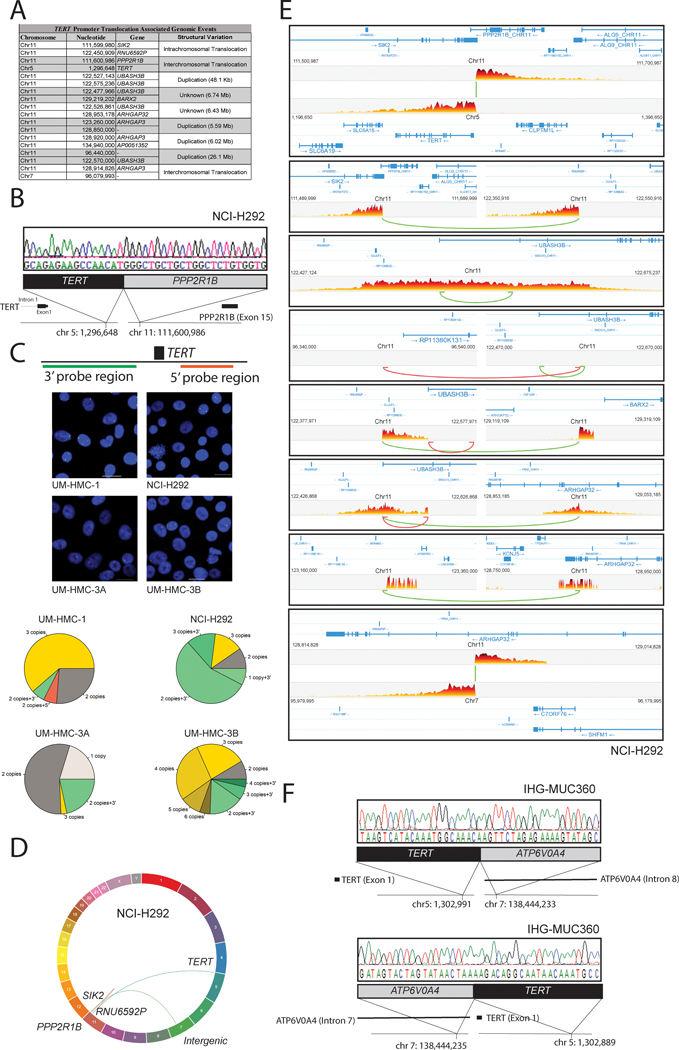
Mucoepidermoid Carcinoma (MEC) is a common salivary malignant neoplasm. Approximately 60 % of MECs harbor translocations between CRTC1 or CRTC3 and MAML2, which are thought to drive disease pathogenesis. However, the precise structural mechanism driving this rearrangement remains uncharacterized. Here, we performed multi-omic and long read genomic sequencing, discovering a chain of alterations that created the CRTC1::MAML2 fusion, but also an unexpected MAML2 to MYBL1 rearrangement, suggesting that MYBL1 may play a larger role in salivary gland cancers than previously recognized. Furthermore, we discovered and validated recurrent TERT rearrangements and amplifications in MEC models. 5/5 MEC cell lines and 36/39 (92 %) primary MEC tumors harbored a TERT rearrangement or copy number amplification. Custom sequencing of the TERT locus confirmed translocation breakpoints in 13/33 (39 %) MECs, while exome sequencing confirmed frequent TERT amplifications. Critically, TERT knockdown in NCI-H292, a cell line with TERT promoter rearrangement, reduced clonogenic cell survival, supporting a critical role of this gene in MEC tumorigenesis. Overall, our data suggest that complex chromothripsis rearrangement mechanisms drive the formation of structural variation in CRTC1::MAML2 fusion positive and negative tumors and reveal highly recurrent structural variation driving TERT rearrangement in MEC.
Keywords: CRTC1; MAML2; MEC; NOTCH2; Structural variation; TERT; Translocation.
Copyright © 2024 Elsevier Ltd. All rights reserved.
Conflict of interest statement
Declaration of competing interest The authors declare that they have no known competing financial interests or personal relationships that could have appeared to influence the work reported in this paper.
Figures



References
-
- Dombrowski ND, Wolter NE, Irace AL, Cunningham MJ, Mack JW, Marcus KJ, et al. Mucoepidermoid carcinoma of the head and neck in children. Int J Pediatr Otorhinolaryngol. 2019;120:93–9. - PubMed
-
- Granic M, Suton P, Mueller D, Cvrljevic I, Luksic I. Prognostic factors in head and neck mucoepidermoid carcinoma: experience at a single institution based on 64 consecutive patients over a 28-year period. Int J Oral Maxillofac Surg. 2018;47:283–8. - PubMed
-
- Spiro RH. Salivary neoplasms: overview of a 35-year experience with 2,807 patients. Head Neck Surg. 1986;8:177–84. - PubMed
-
- McHugh CH, Roberts DB, El-Naggar AK, Hanna EY, Garden AS, Kies MS, et al. Prognostic factors in mucoepidermoid carcinoma of the salivary glands. Cancer. 2012;118:3928–36. - PubMed
MeSH terms
Substances
Grants and funding
LinkOut - more resources
Full Text Sources
Miscellaneous
