Review
. 2024 Nov 16;19(1):91.
doi: 10.1186/s40793-024-00638-6.

The role of the rhizobiome recruited by root exudates in plant disease resistance: current status and future directions

Affiliations
Review

The role of the rhizobiome recruited by root exudates in plant disease resistance: current status and future directions

Zengwei Feng et al. Environ Microbiome. .

Abstract

Root exudates serve as a bridge connecting plant roots and rhizosphere microbes, playing a key role in influencing the assembly and function of the rhizobiome. Recent studies have fully elucidated the role of root exudates in recruiting rhizosphere microbes to enhance plant performance, particularly in terms of plant resistance to soil-borne pathogens; however, it should be noted that the composition and amount of root exudates are primarily quantitative traits regulated by a large number of genes in plants. As a result, there are knowledge gaps in understanding the contribution of the rhizobiome to soil-borne plant disease resistance and the ternary link of plant genes, root exudates, and disease resistance-associated microbes. Advancements in technologies such as quantitative trait loci (QTL) mapping and genome-wide association studies (GWAS) offer opportunities for the identification of genes associated with quantitative traits. In the present review, we summarize recent studies on the interactions of plant and rhizosphere microbes through root exudates to enhance soil-borne plant disease resistance and also highlight methods for quantifying the contribution of the rhizobiome to plant disease resistance and identifying the genes responsible for recruiting disease resistance-associated microbes through root exudates.

Keywords: Genome-wide association study; Plant disease resistance; Quantitative traits; Rhizosphere microbes; Root exudates.


Conflict of interest statement

Declarations Ethics approval and consent to participate Not applicable. Consent for publication Not applicable. Competing interests The authors declare no competing interests.

Figures

Fig. 1
Fig. 1
The plant pathway and the rhizobiome pathway of plant disease resistance (PDR) against soil-borne pathogens. a A simulated aseptic microcosm culture system is used to quantify the contribution of the rhizobiome pathway to PDR. b In a simulated natural environment, the soil is sterilized by radiation without altering soil fertility and physical structure. Then, soil microbes and the target pathogen are added to simulate a realistic field environment. In this process, the plant pathway and the rhizobiome pathway cooperate to play a role in PDR. c In another similar system, only the target pathogen is added, and the plant pathway functions as the sole pathway in PDR. To distinguish between these two pathways and simplify them, the contribution of the rhizobiome pathway is defined as the difference in plant resistance to the pathogen between Figure b and Figure c (i.e., the subtraction of these two disease indexes). In other words, the rhizobiome pathway is equal to the combination of both pathways minus the plant pathway
Fig. 2
Fig. 2
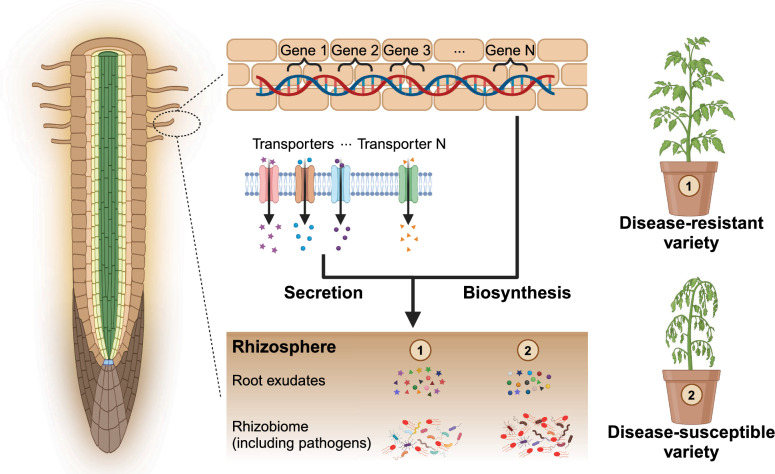
Mechanisms of disease resistance in different plant varieties through rhizosphere microbes mediated by root exudates. A large number of genes and transporters are responsible for the biosynthesis and secretion (including active transport and passive transport) of root exudates, thereby contributing to their compositional diversity in the rhizosphere. Differences in the composition and quantity of root exudates determine contrasting microbial communities in the rhizosphere of different plant genotypes/varieties. Nos. 1 and 2 in the figure represent different rhizobiomes due to different composition and quantity of root exudates. Disease resistance-associated microbes are preferentially enriched in the rhizosphere of disease-resistant genotype/variety
Fig. 3
Fig. 3
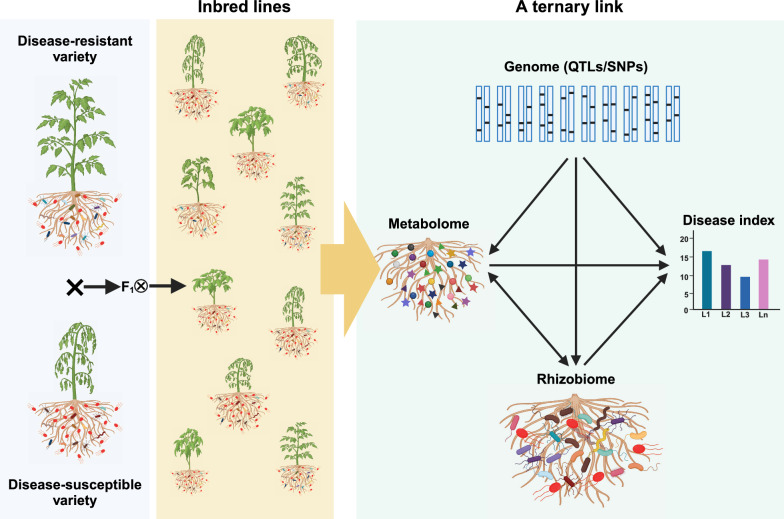
A potential method for establishing the ternary link of plant genes, root exudates, and disease resistance-associated microbes. Disease-resistant and disease-susceptible varieties cross to produce the F1 generation population, which then self-crosses to produce the F2 generation, namely the inbred lines. These inbred lines exhibit varying levels of disease resistance. When the population of the inbred lines is sufficient, their levels of disease resistance follow a normal distribution

References

    1. Savary S, Willocquet L, Pethybridge SJ, Esker P, McRoberts N, Nelson A. The global burden of pathogens and pests on major food crops. Nat Ecol Evol. 2019;3:430–9. 10.1038/s41559-018-0793-y. - PubMed
    1. Lahlali R, Ezrari S, Radouane N, Kenfaoui J, Esmaeel Q, El Hamss H, et al. Biological control of plant pathogens: a global perspective. Microorganisms. 2022;10:596. 10.3390/microorganisms10030596. - PMC - PubMed
    1. Flynn K, Villarreal BP, Barranco A, Belc N, Björnsdóttir B, Fusco V, et al. An introduction to current food safety needs. Trends Food Sci Tech. 2019;84:1–3. 10.1016/j.tifs.2018.09.012.
    1. Ons L, Bylemans D, Thevissen K, Cammue BP. Combining biocontrol agents with chemical fungicides for integrated plant fungal disease control. Microorganisms. 2020;8:1930. 10.3390/microorganisms8121930. - PMC - PubMed
    1. Gururani MA, Venkatesh J, Upadhyaya CP, Nookaraju A, Pandey SK, Park SW. Plant disease resistance genes current status and future directions. Physiol Mol Plant Pathol. 2012;78:51–65. 10.1016/j.pmpp.2012.01.002.

LinkOut - more resources