


Long-term outcomes following posterior fossa decompression in pediatric patients with Chiari malformation type 1, a population-based cohort study
- PMID: 39551853
- PMCID: PMC11570554
- DOI: 10.1007/s00701-024-06332-3
Long-term outcomes following posterior fossa decompression in pediatric patients with Chiari malformation type 1, a population-based cohort study
Abstract
Objective: Posterior fossa decompression for Chiari malformation type I (Chiari 1) is effective and associated with a low risk of complication. However, up to 20% of patients may experience continued deficits or recurring symptoms after surgical intervention. For pediatric patients, there are no established tools to predict outcomes, and the risk factors for unfavorable postoperative outcomes are poorly understood. Hence, our aim was to investigate baseline data and early postoperative predictors of poor outcomes as determined by the Chicago Chiari outcome scale (CCOS).
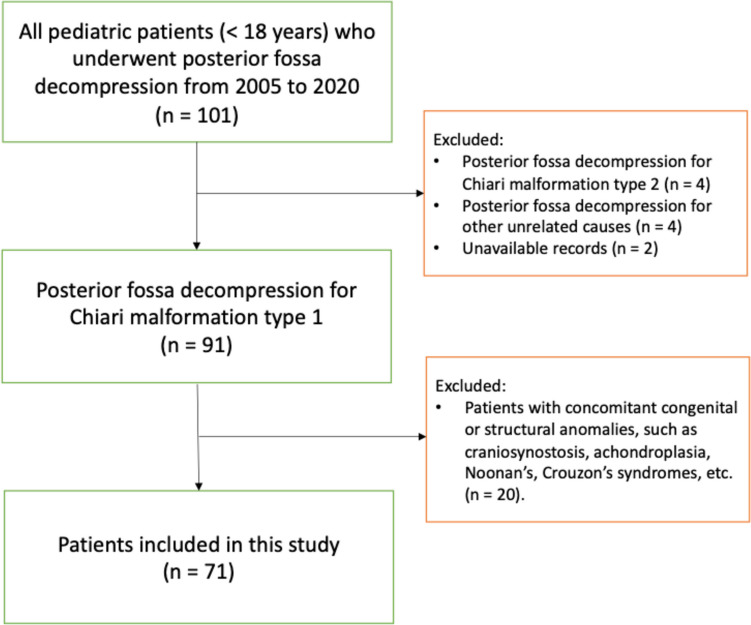
Methods: All pediatric patients (< 18 years) receiving a posterior fossa decompression for Chiari 1 between the years of 2005 and 2020 at the study center were eligible for inclusion. Patients with congenital anomalies were excluded.
Results: Seventy-one pediatric patients with a median age of 9 years were included. Most patients (58%) were females. Chiari 1 was associated with syringomyelia (51%), scoliosis (37%), and hydrocephalus (7%). Perioperative complications occurred in 13 patients (18%) of which two required additional procedures under general anesthesia. On multivariable proportional odds logistic regression, motor deficits (OR: 0.09; CI95%: [0.01-0.62]; p = 0.015), and surgical complications (OR: 0.16; CI95%: [0.41-0.66]; p = 0.011) were significant predictors of worse outcomes. The presence of syringomyelia was identified as a predictor of better outcomes (OR: 4.42 CI95% [1.02-19.35]; p = 0.048). A persistent hydrocephalus during the early postoperative period after posterior fossa decompression was a strong predictor of worse long-term CCOS (OR: 0.026; CI95%: [0.002-0.328]; p = 0.005).
Conclusion: Results from this study indicate that the existence of motor deficits and syringomyelia prior to surgery, and surgical complications and persistent hydrocephalus despite posterior fossa decompression, were useful predictors of long-term outcome.
Keywords: Chiari malformation type 1; Foramen magnum decompression; Pediatric; Posterior fossa decompression; Suboccipital decompression.
© 2024. The Author(s).
Conflict of interest statement
References
-
- Aghakhani N, Parker F, David P, Morar S, Lacroix C, Benoudiba F, Tadie M (2009) Long-term follow-up of Chiari-related syringomyelia in adults: analysis of 157 surgically treated cases. Neurosurgery 64(2):308–315 - PubMed
-
- Ahluwalia R, Foster J, Brooks E, Lim J, Zhao S, Gannon SR, Guidry B, Wellons J, Shannon CN (2020) Chiari type I malformation: role of the Chiari severity index and chicago hiari outcome scale. J Neurosurg Pediatr 26(3):262–268 - PubMed
-
- Alden TD, Ojemann JG, Park TS (2001) Surgical treatment of Chiari I malformation: indications and approaches. Neurosurg Focus. 10.3171/FOC.2001.11.1.3 - PubMed
Publication types
MeSH terms
LinkOut - more resources
Full Text Sources
Medical
