. 2024 Dec;38(12):e70057.
doi: 10.1002/jbt.70057.

Targeting CD36 With EP 80317 Reduces Remote Inflammatory Response to Hind Limb Ischemia-Reperfusion in Mice

Affiliations

Targeting CD36 With EP 80317 Reduces Remote Inflammatory Response to Hind Limb Ischemia-Reperfusion in Mice

Hanan Elimam et al. J Biochem Mol Toxicol. 2024 Dec.

Abstract

Reperfusion of ischemic skeletal muscle triggers oxidative stress and an immediate inflammatory reaction, leading to damage of distant organs such as the lungs. The inflammatory process implicates numerous mediators, including cytokines, chemokines, and arachidonic acid metabolites. In the orchestration of the inflammatory cascade, a critical role is played by the cluster of differentiation-36 receptor (CD36), a scavenger receptor class B protein (SR-B2) which is expressed on macrophages and functions as a Toll-like receptor coreceptor. A mouse model of hind limb ischemia-reperfusion has been used to investigate the interplay between CD36 signaling and remote inflammation: leukocyte recruitment, regulation of the nucleotide-binding domain leucin-rich repeat and pyrin-containing receptor 3 (NLRP3) inflammasome, and release of nuclear factor-kappa B (NF-ĸB) and arachidonic acid metabolites. Levels of reactive oxygen species, inflammatory mediators, and gene expression were measured in blood and lung tissue samples collected from anesthetized mice on which unilateral hind limb ischemia was induced by rubber band constriction for 30 min followed by reperfusion for 3 h. The CD36 modulator EP 80317, a member of the growth hormone releasing peptide 6 family, was employed as a pharmacological agent to mitigate distant lung injury following skeletal limb ischemia-reperfusion. Targeting CD36 on monocytes/macrophages, EP 80317 abated pro-inflammatory signaling and transcriptional activity encompassing lipid and cytokine mediators. Targeting CD36 was shown to offer promise for curtailing tissue injury following hind limb ischemia-reperfusion.

Keywords: CD36; hind limb; ischemia; remote inflammation; reperfusion.


Conflict of interest statement

The authors declare no conflicts of interest.

Figures
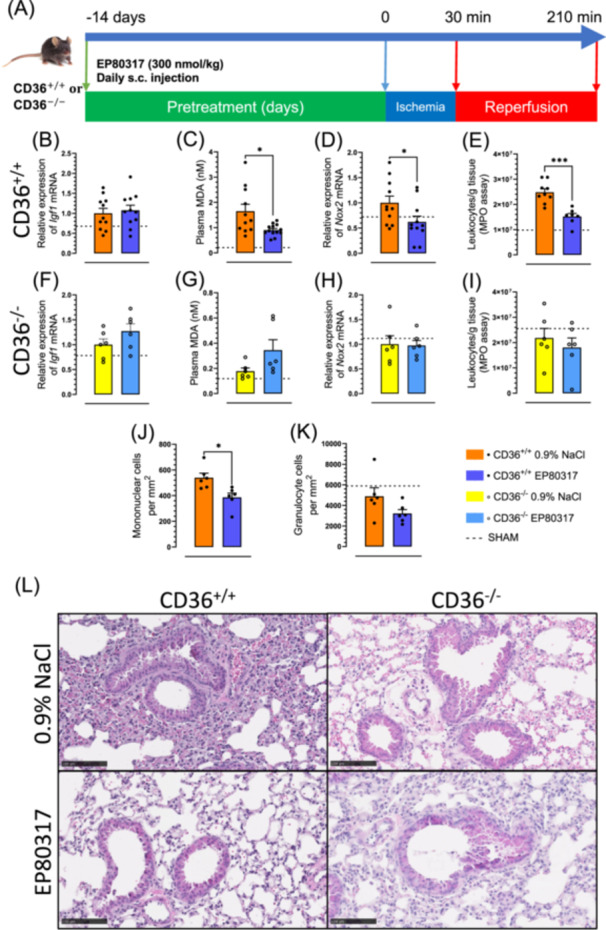
Figure 1
Figure 1
EP 80317 reduces systemic and lung homogenate ROS and inflammatory mediators. (A) Study design. (B) Bar graphs and dot plots represent the relative expression of Igf1 mRNA in lung tissue of CD36+/+ and (F) CD36‐/‐ mice. (C) Mean plasma MDA levels of CD36+/+ and (G) CD36‐/‐ mice, expressed as bar graphs and dot plots. (D) Bar graphs and dot plots represent the relative expression of Nox2 mRNA in lung tissue of CD36+/+ and (H) CD36‐/‐ mice. (E) Bar graphs and dot plots of the total leucocytes recruitment in lung tissue by MPO assay of CD36+/+ and (I) CD36‐/‐ mice. (J) Bar graphs and dot plots represent the mononuclear cells count per mm2 of photomicrographs of lung tissue of CD36+/+ and (K) CD36‐/‐. (L) Representative photomicrographs of lungs after staining with hematoxylin‐eosin (scale bar: 100 μm). Data are mean ± SEM. *p < 0.05 and ***p < 0.001, as assessed by an unpaired t test. n = 6–11 per group for CD36+/+ and n = 6 per group for CD36‐/‐.
Figure 2
Figure 2
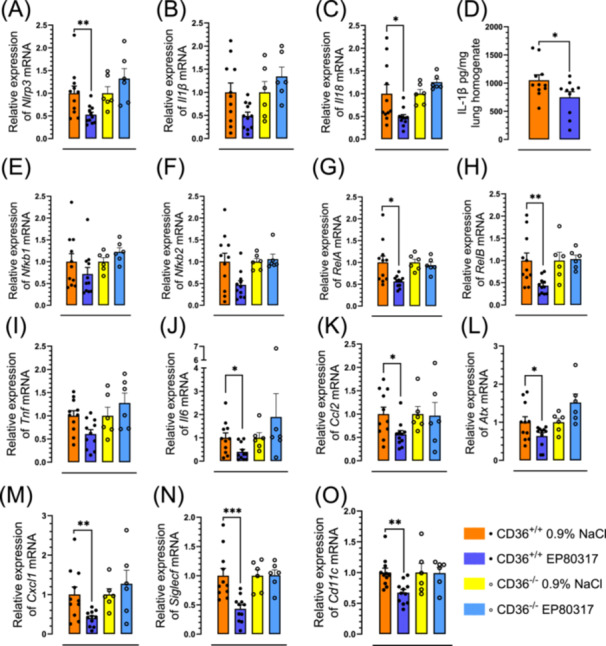
EP 80317 reduces lung NLRP3 inflammasome and pro‐inflammatory cytokines and chemokines. Bar graphs and dot plots represent the relative expression of (A) Nlrp3, (B) Il1β, and (C) Il18 mRNA in lung tissue of CD36+/+ and CD36‐/‐ mice. (D) Mean IL‐1β levels in lung homogenates of CD36+/+ mice, expressed as bar graph and dot plot. Bar graphs and dot plots represent the relative expression of (E) Nfκb1, (F) Nfκb2, (G) RelA, (H) RelB, (I) Tnf, (J) Il6, (K) Ccl2, (L) Atx, (M) Cxcl1, (N) Siglecf, and (O) Cd11c mRNA in lung tissue of CD36+/+ and CD36‐/‐. Data are mean ± SEM. *p < 0.05, **p < 0.01, and ***p < 0.001, as assessed by an unpaired t test. n = 11 for CD36+/+ and n = 6 for CD36‐/‐.
Figure 3
Figure 3
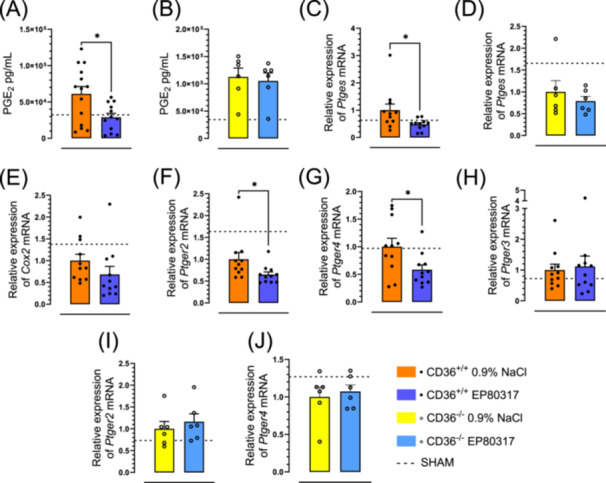
EP 80317 decreases arachidonic acid metabolites‐PGE2. PGE2 levels in lung homogenates of (A) CD36+/+ and (B) CD36‐/‐ mice, represented as bar graphs. Bar graphs and dot plots represent the relative expression of Ptges mRNA in lung tissue of (C) CD36+/+ and (D) CD36‐/‐ mice. (E) Bar graph and dot plot represent the relative expression of Cox2 mRNA in lung tissue of CD36+/+. Relative expression of (F) Ptger2, (G) Ptger4, and (H) Ptger3 mRNA in lung tissue of CD36+/+ mice, expressed as bar graphs and dot plots. Bar graphs and dot plots represent the relative expression of (I) Ptger2 and (J) Ptger4 mRNA in lung tissue of CD36‐/‐ mice. Data are mean ± SEM. *p < 0.05, as assessed by an unpaired t test. n = 14 for CD36+/+ and n = 6 for CD36‐/‐.
Figure 4
Figure 4
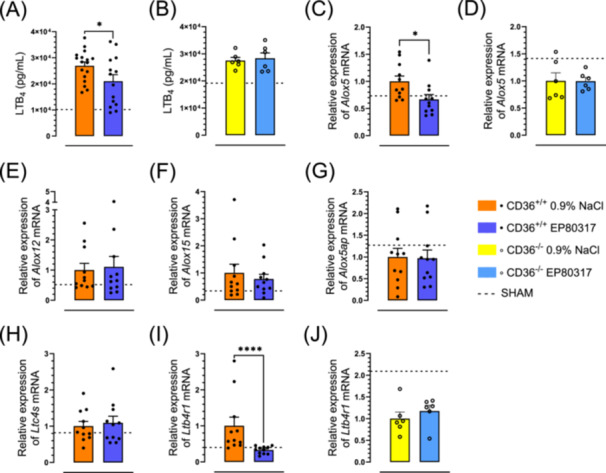
EP 80317 decreases arachidonic acid metabolites‐LTB4. (A) Bar graph and dot plot represent the LTB4 levels in lung homogenates of CD36+/+ and (B) CD36‐/‐ mice. (C) Relative expression of Alox5 mRNA in lung tissue of CD36+/+ and (D) CD36‐/‐ mice. Bar graph and dot plot represent the relative expression of (E) Alox12, (F) Alox15 and (G) Alox5ap mRNA in lung tissue of CD36+/+ mice. (H) Bar graph and dot plot of the relative expression of Ltc4s mRNA in lung tissue of CD36+/+. (I) Bar graph and dot plot represent the relative expression of Ltb4r1 mRNA in lung tissue of CD36+/+ and (J) CD36‐/‐ mice. Data are mean ± SEM. *p < 0.05 and ***p < 0.001, as assessed by an unpaired t test. n = 14 for CD36+/+ and n = 6 for CD36‐/‐.

References

    1. Bo H. and Feng X., “Post‐Treatment Curcumin Reduced Ischemia‐Reperfusion‐Induced Pulmonary Injury Via the Notch2/Hes‐1 Pathway,” Journal of International Medical Research 48, no. 4 (2020): 300060519892432. - PMC - PubMed
    1. Kalogeris T., Baines C. P., Krenz M., and Korthuis R. J., “Cell Biology of Ischemia/Reperfusion Injury,” International Review of Cell and Molecular Biology 298 (2012): 229–317. - PMC - PubMed
    1. Chiu S. and Bharat A., “Role of Monocytes and Macrophages in Regulating Immune Response Following Lung Transplantation,” Current Opinion in Organ Transplantation 21, no. 3 (2016): 239–245. - PMC - PubMed
    1. Hou F., Xiao K., Tang L., and Xie L., “Diversity of Macrophages in Lung Homeostasis and Diseases,” Frontiers in Immunology 12 (2021): 753940. - PMC - PubMed
    1. Nelson K., Herndon B., and Reisz G., “Pulmonary Effects of Ischemic Limb Reperfusion: Evidence for a Role for Oxygen‐Derived Radicals,” Critical Care Medicine 19, no. 3 (1991): 360–363. - PubMed

LinkOut - more resources