


Risk factors and clinical prediction models for low-level viremia in people living with HIV receiving antiretroviral therapy: an 11-year retrospective study
- PMID: 39552647
- PMCID: PMC11563986
- DOI: 10.3389/fmicb.2024.1451201
Risk factors and clinical prediction models for low-level viremia in people living with HIV receiving antiretroviral therapy: an 11-year retrospective study
Abstract
Objective: This study explores the risk factors for low-level viremia (LLV) occurrence after ART and develops a risk prediction model.
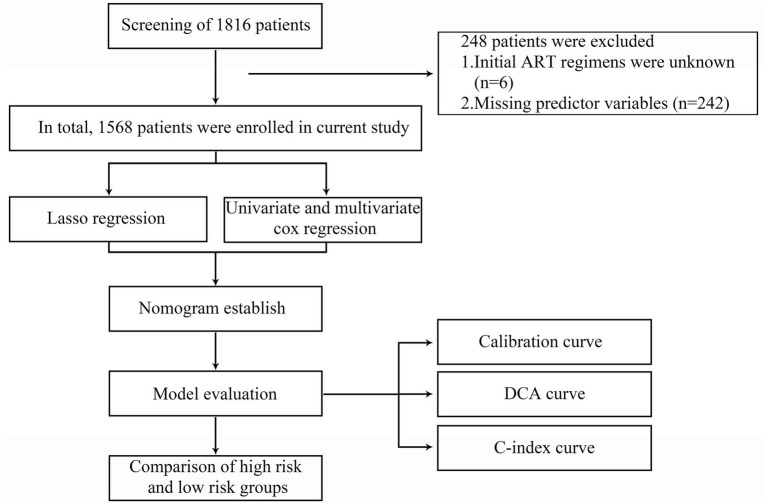
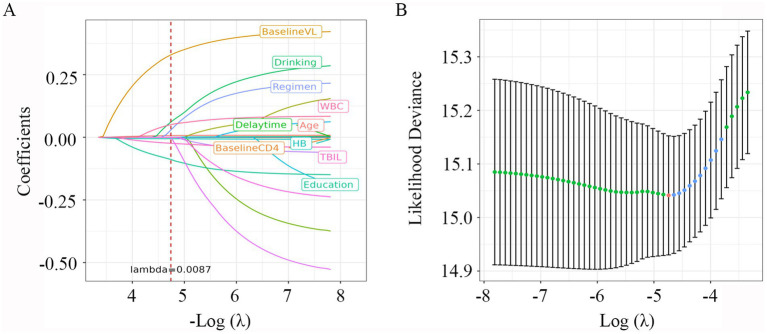
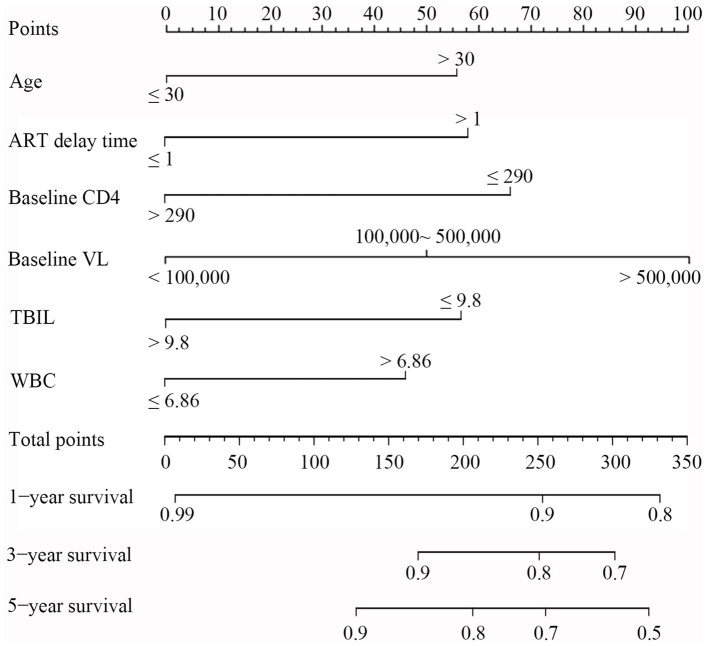
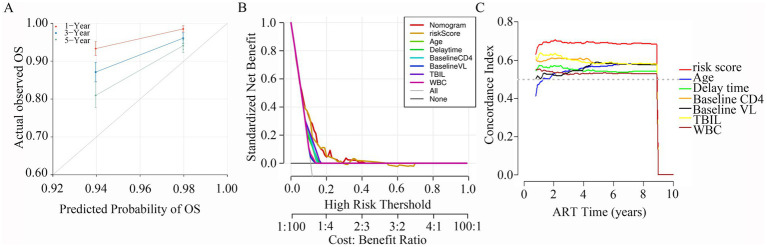
Method: Clinical data and laboratory indicators of people living with HIV (PLWH) at Hangzhou Xixi Hospital from 5 April 2011 to 29 December 2022 were collected. LASSO Cox regression and multivariate Cox regression analysis were performed to identify laboratory indicators and establish a nomogram for predicting LLV occurrence. The nomogram's discrimination and calibration were assessed via ROC curve and calibration plots. The concordance index (C-index) and decision curve analysis (DCA) were used to evaluate its effectiveness.
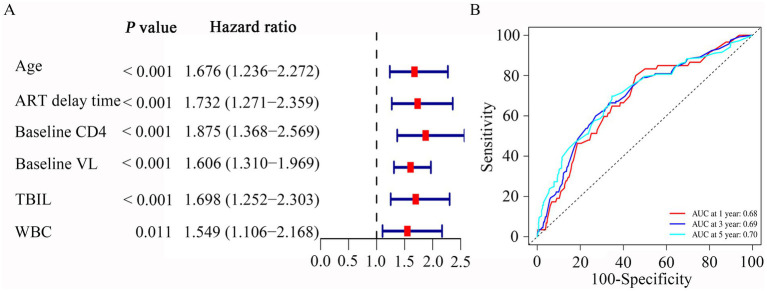
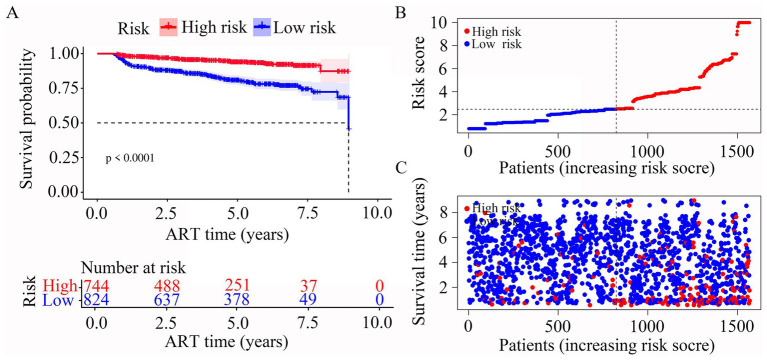
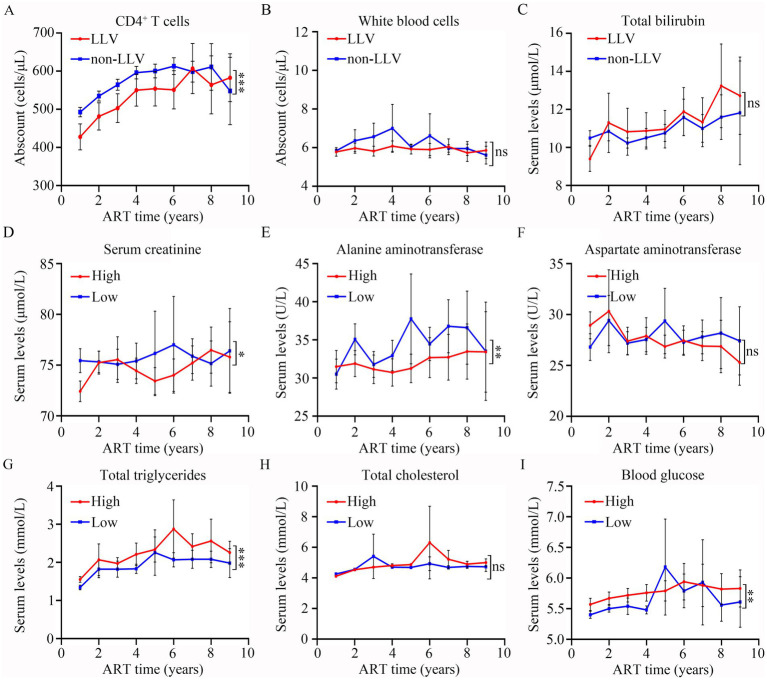
Result: Predictive factors, namely, age, ART delay time, white blood cell (WBC) count, baseline CD4+ T-cell count (baseline CD4), baseline viral load (baseline VL), and total bilirubin (TBIL), were incorporated into the nomogram to develop a risk prediction model. The optimal model (which includes 6 variables) had an AUC for LLV after 1-year, 3-year, and 5-year of listing of 0.68 (95% CI, 0.61-0.69), 0.69 (95% CI, 0.65-0.70), and 0.70 (95% CI, 0.66-0.71), respectively. The calibration curve showed high consistency between predicted and actual observations. The C-index and DCA indicated superior prediction performance of the nomogram. There was a significant difference in CD4 levels between LLV and non-LLV groups during the follow-up time. The dynamic SCR, ALT, TG and BG levels and occurrence of complications differed significantly between the high- and low-risk groups.
Conclusion: A simple-to-use nomogram containing 6 routinely detected variables was developed for predicting LLV occurrence in PLWH after ART.
Keywords: low-level viremia; nomogram; people living with HIV; prediction model; viral load.
Copyright © 2024 Zhang, Shi, Wang, Li, Yan, Zhang, Zhu, Yu and Wang.
Conflict of interest statement
The authors declare that the research was conducted in the absence of any commercial or financial relationships that could be construed as a potential conflict of interest.
Figures
References
-
- Álvarez H., Mocroft A., Ryom L., Neesgaard B., Edwards S., Svedhem V., et al. (2023). RESPOND (international cohort consortium of infectious diseases) study group. Plasma human immunodeficiency virus 1 RNA and CD4+ T-cell counts are determinants of Virological nonsuppression outcomes with initial integrase inhibitor-based regimens: a prospective RESPOND cohort study. Clin. Infect. Dis. 77, 593–605. doi: 10.1093/cid/ciad219, PMID: - DOI - PMC - PubMed
-
- Bai R., Lv S., Hua W., Su B., Wang S., Shao Y., et al. (2022). Factors associated with human immunodeficiency virus-1 low-level viremia and its impact on virological and immunological outcomes: a retrospective cohort study in Beijing, China. HIV Med. 23, 72–83. doi: 10.1111/hiv.13251, PMID: - DOI - PubMed
LinkOut - more resources
Full Text Sources
Research Materials
Miscellaneous
