


Gastrointestinal parasite prevalence, diversity and association in free-ranging Chacma baboon troops in a semi-arid savanna ecosystem of Zimbabwe
- PMID: 39553413
- PMCID: PMC11567109
- DOI: 10.1016/j.ijppaw.2024.101012
Gastrointestinal parasite prevalence, diversity and association in free-ranging Chacma baboon troops in a semi-arid savanna ecosystem of Zimbabwe
Abstract
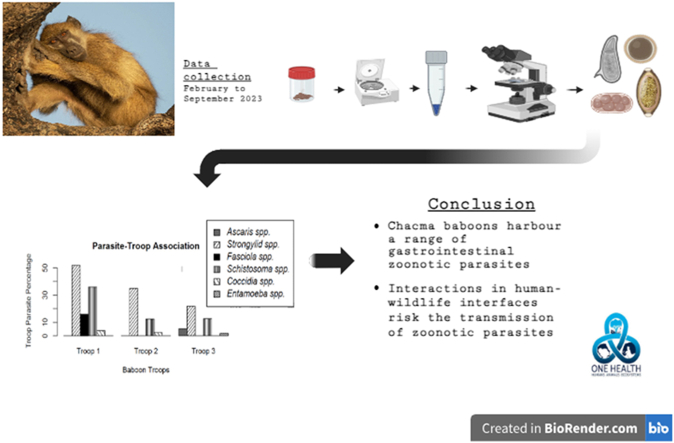
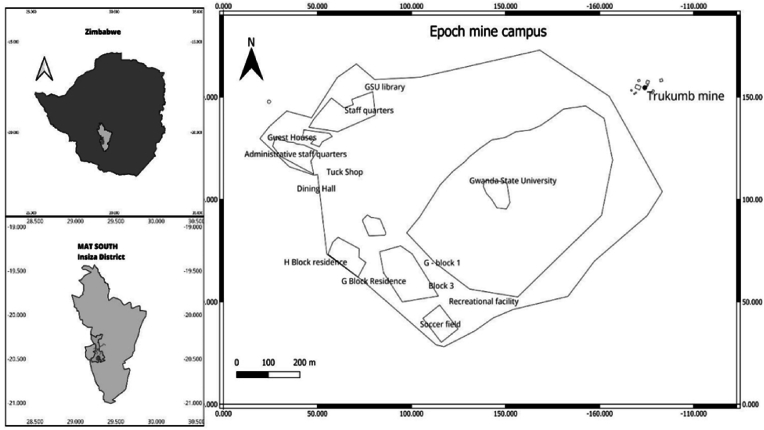
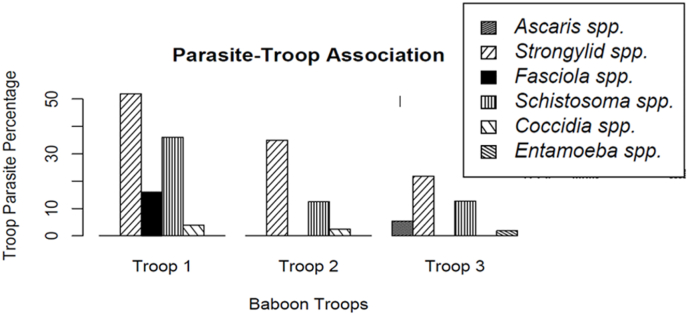
Free-ranging Chacma baboon species are known to harbour a wide range of zoonotic parasites, and their frequent close interactions with humans pose a risk of transmission of zoonotic parasites between the two species. This research study focused on understanding parasite dynamics in free-ranging baboon populations that inhabit human-wildlife interface areas, a case of Gwanda State University's Epoch Mine campus in Filabusi at Insiza district. A descriptive and analytical cross-sectional design was used to investigate the prevalence, diversity and association of gastrointestinal parasites among three baboon troops found at the Epoch Mine campus. One hundred and twenty (120) fresh faecal samples were collected from the three troops between February and September 2023. The centrifugal floatation technique was used to process and analyse faecal samples, and parasite ova and cysts were identified using morphological features like shape and size. The prevalence of the parasite taxa and a chi-squared multiple comparison test was computed. Results showed significant differences among most parasite taxa except Coccidia spp and Entamoeba spp among the three troops. The Shannon-Wiener (H') index was used to calculate diversity and graphs were utilized to present the association. The Kruskal-Wallis tests showed no significant difference in parasite diversity among the three troops. Although troop-parasite association showed different parasite species for each troop, helminths Strongylid spp. and Schistosoma spp. were highly common across all three troops. Troop 1 and 3 were associated with four parasite taxa, whereas Troop 2 had only three. The study reveals the presence of gastro-intestinal parasites of public health concern, as they are capable of causing diseases in humans and domestic animals. The study, therefore, underscores the importance of understanding parasite-host dynamics in mitigating zoonotic disease transmission and suggests the need to generate baseline data for mitigating zoonotic diseases and maintaining a healthy ecosystem.
Keywords: Baboons; Emerging diseases; Human-wildlife interface; Parasite-host interactions; Zoonotic diseases; Zoonotic parasites.
© 2024 The Authors.
Conflict of interest statement
The authors declare that they have no known competing financial interests or personal relationships that could have appeared to influence the work reported in this paper.
Figures
References
-
- Adrus M., Zainudin R., Ahamad M., Jayasilan M., Abdullah M.T. Gastrointestinal parasites of zoonotic importance observed in the wild, urban, and captive populations of non‐human primates in Malaysia. J. Med. Primatol. 2019;48:22–31. - PubMed
-
- Ahmed S.A., Kotepui M., Masangkay F.R., Milanez G.D., Karanis P. Gastrointestinal parasites in Africa: a review. Adv. Parasitol. 2023;119:1–64. - PubMed
LinkOut - more resources
Full Text Sources
Miscellaneous
