


This is a preprint.
Gene expression and DNA methylation changes in response to hypoxia in toxicant-adapted Atlantic killifish (Fundulus heteroclitus)
- PMID: 39554046
- PMCID: PMC11565929
- DOI: 10.1101/2024.11.01.620405
Gene expression and DNA methylation changes in response to hypoxia in toxicant-adapted Atlantic killifish (Fundulus heteroclitus)
Update in
-
Gene expression and DNA methylation changes in response to hypoxia in toxicant-adapted Atlantic killifish (Fundulus heteroclitus).Biol Open. 2025 Jan 15;14(1):BIO061801. doi: 10.1242/bio.061801. Epub 2025 Jan 6. Biol Open. 2025. PMID: 39760289 Free PMC article.
Abstract
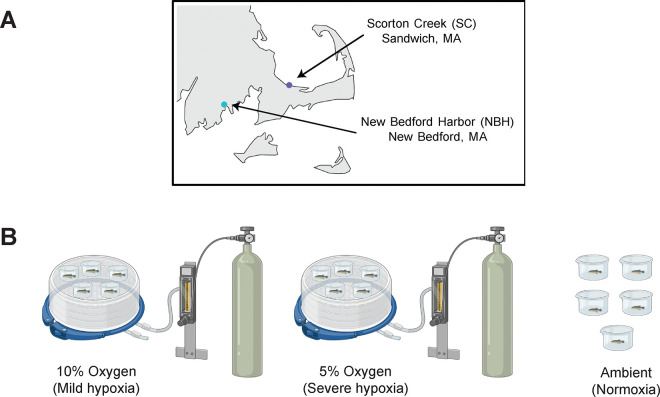
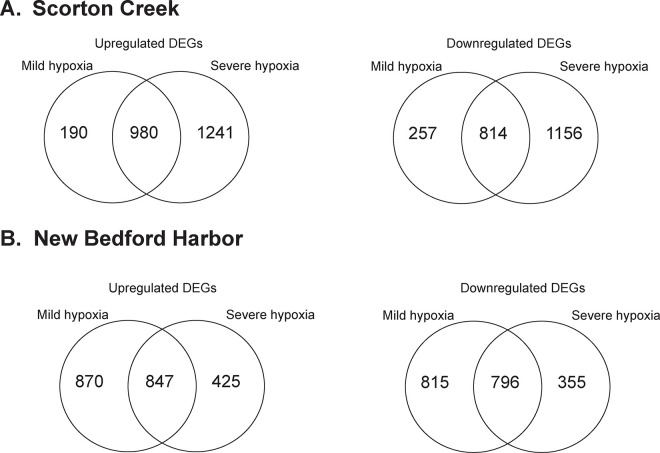
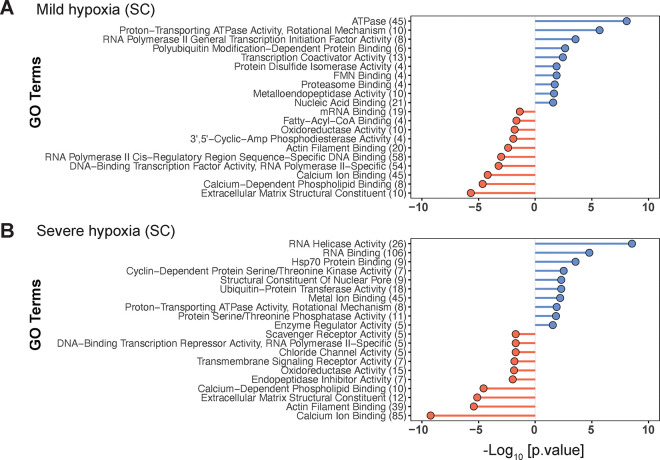
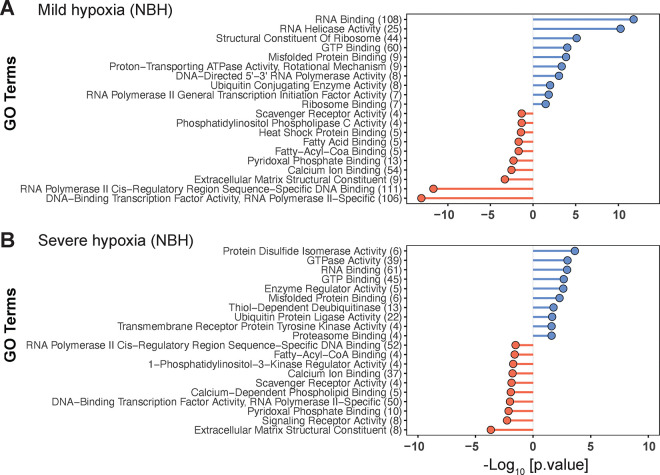
Coastal fish populations are threatened by multiple anthropogenic impacts, including the accumulation of industrial contaminants and the increasing frequency of hypoxia. Some populations of the Atlantic killifish (Fundulus heteroclitus), like those in New Bedford Harbor (NBH), Massachusetts, have evolved a resistance to dioxin-like polychlorinated biphenyls (PCBs) that may influence their ability to cope with secondary stressors. To address this question, we compared hepatic gene expression and DNA methylation patterns in response to mild or severe hypoxia in killifish from NBH and Scorton Creek (SC), a reference population from a relatively pristine environment. We hypothesized that NBH fish would show altered responses to hypoxia due to trade-offs linked to toxicant resistance. Our results revealed substantial differences between populations. SC fish demonstrated a dose-dependent changes in gene expression in response to hypoxia, while NBH fish exhibited a muted transcriptional response to severe hypoxia. Interestingly, NBH fish showed significant DNA methylation changes in response to hypoxia, while SC fish did not exhibit notable epigenetic alterations. These findings suggest that toxicant-adapted killifish may face trade-offs in their molecular response to environmental stress, potentially impacting their ability to survive severe hypoxia in coastal habitats. Further research is needed to elucidate the functional implications of these epigenetic modifications and their role in adaptive stress responses.
Keywords: DNA methylation; Hypoxia; Mummichog; RNAseq; cost of tolerance; evolved resistance.
Figures


References
-
- Wallace RB, Gobler CJ. 2021. The role of algal blooms and community respiration in controlling the temporal and spatial dynamics of hypoxia and acidification in eutrophic estuaries. Marine Pollution Bulletin, 172: 112908. - PubMed
-
- Borowiec BG, McClelland GB, Rees BB, Scott GR. 2018. Distinct metabolic adjustments arise from acclimation to constant hypoxia and intermittent hypoxia in estuarine killifish (Fundulus heteroclitus). J Exp Biol, 221(Pt 23). - PubMed
-
- Borowiec BG, Scott GR. 2020. Hypoxia acclimation alters reactive oxygen species homeostasis and oxidative status in estuarine killifish (Fundulus heteroclitus). J Exp Biol, 223(Pt 13). - PubMed
Publication types
Grants and funding
LinkOut - more resources
Full Text Sources
