


This is a preprint.
Structural Model of Bacteriophage P22 Scaffolding Protein in a Procapsid by Magic-Angle Spinning NMR
- PMID: 39554170
- PMCID: PMC11565965
- DOI: 10.1101/2024.11.01.621488
Structural Model of Bacteriophage P22 Scaffolding Protein in a Procapsid by Magic-Angle Spinning NMR
Abstract
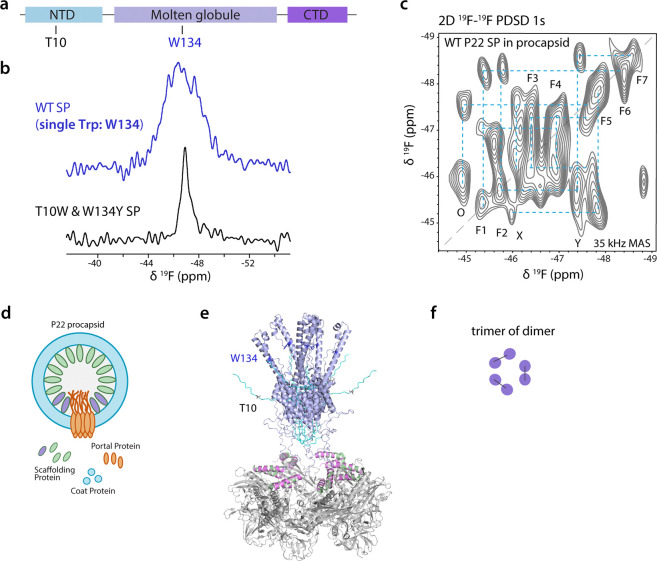
Icosahedral dsDNA viruses such as the tailed bacteriophages and herpesviruses have a conserved pathway to virion assembly that is initiated from a scaffolding protein driven procapsid formation. The dsDNA is actively packaged into procapsids, which undergo complex maturation reactions to form infectious virions. In bacteriophage P22, scaffolding protein (SP) directs the assembly of coat proteins into procapsids that have a T=7 icosahedral arrangement, en route to the formation of the mature P22 capsid. Other than the C-terminal helix-turn-helix involved in interaction with coat protein, the structure of the P22 303 amino acid scaffolding protein within the procapsid is not understood. Here, we present a structural model of P22 scaffolding protein encapsulated within the 23 MDa procapsid determined by magic angle spinning NMR spectroscopy. We took advantage of the 10-fold sensitivity gains afforded by the novel CPMAS CryoProbe to establish the secondary structure of P22 scaffolding protein and employed 19F MAS NMR experiments to probe its oligomeric state in the procapsid. Our results indicate that the scaffolding protein has both α-helical and disordered segments and forms a trimer of dimers when bound to the procapsid lattice. This work provides the first structural information for P22 SP beyond the C-terminal helix-turn-helix and demonstrates the power of MAS NMR to understand higher-order viral protein assemblies involving structural components that are inaccessible to other structural biology techniques.
Keywords: 19F NMR; Biological Sciences- Biophysics; Structural Biology; bacteriophage p22 procapsid; icosahedral dsDNA viruses; magic-angle spinning NMR; scaffolding protein.
Conflict of interest statement
DECLARATION OF INTERESTS The authors declare no conflict of interest.
Figures


References
-
- Newcomb W. W., Homa F. L., Thomsen D. R. & Brown J. C. In vitro assembly of the herpes simplex virus procapsid: formation of small procapsids at reduced scaffolding protein concentration. Journal of Structural Biology 133, 23–31 (2001). - PubMed
-
- Casjens S. & King J. P22 morphogenesis I: Catalytic scaffolding protein in capsid assembly. Journal of Supramolecular Structure 2, 202–224 (1974). - PubMed
Publication types
Grants and funding
LinkOut - more resources
Full Text Sources
Research Materials
