


This is a preprint.
Brain functional connectivity, but not neuroanatomy, captures the interrelationship between sex and gender in preadolescents
- PMID: 39554185
- PMCID: PMC11565917
- DOI: 10.1101/2024.10.31.621379
Brain functional connectivity, but not neuroanatomy, captures the interrelationship between sex and gender in preadolescents
Update in
-
Brain functional connectivity, but not neuroanatomy, captures the interrelationship between sex and gender in preadolescents.Dev Cogn Neurosci. 2025 Dec;76:101624. doi: 10.1016/j.dcn.2025.101624. Epub 2025 Oct 3. Dev Cogn Neurosci. 2025. PMID: 41061484 Free PMC article.
Abstract
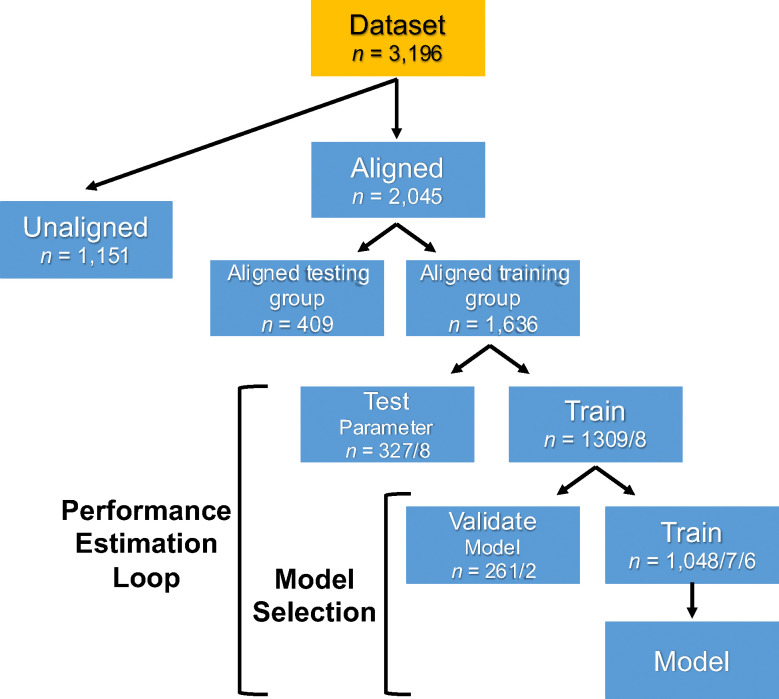
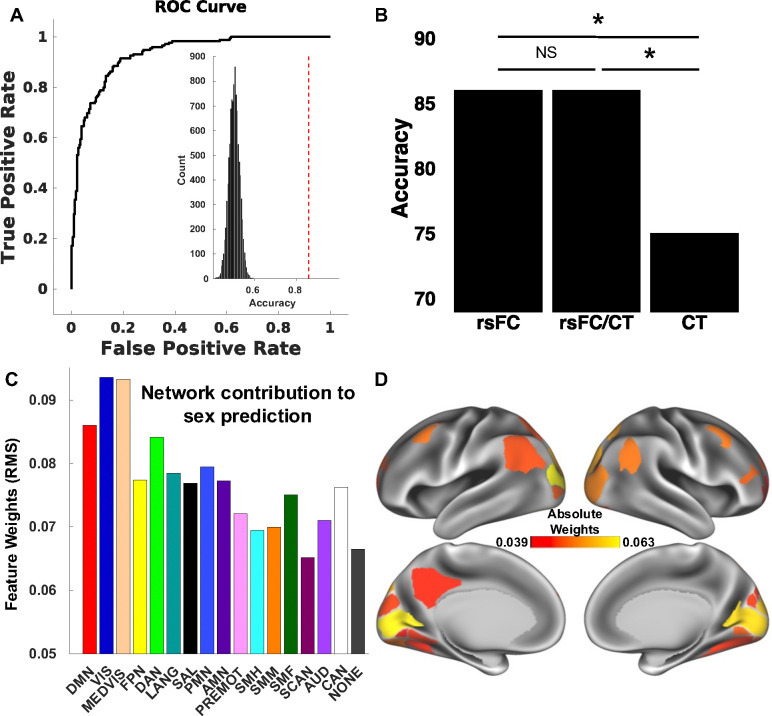
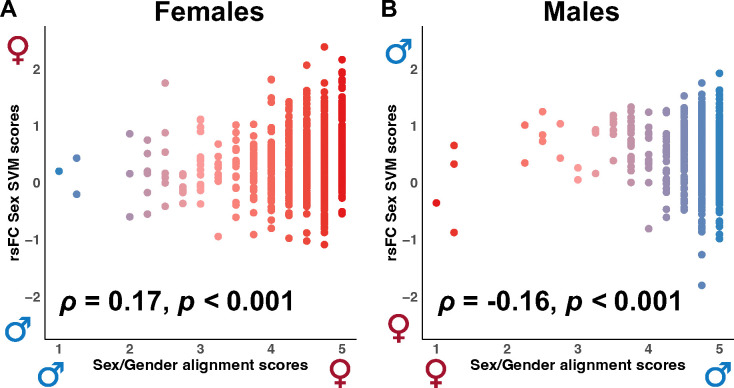
Understanding sex differences in the adolescent brain is crucial, as these differences are linked to neurological and psychiatric conditions that vary between males and females. Predicting sex from adolescent brain data may offer valuable insights into how these variations shape neurodevelopment. Recently, attention has shifted toward exploring socially-identified gender, distinct from sex assigned at birth, recognizing its additional explanatory power. This study evaluates whether resting-state functional connectivity (rsFC) or cortical thickness more effectively predicts sex and sex/gender alignment (the congruence between sex and gender) and investigates their interrelationship in preadolescents. Using data from the Adolescent Brain Cognitive Development (ABCD) Study, we employed machine learning to predict both sex (assigned at birth) and sex/gender alignment from rsFC and cortical thickness. rsFC predicted sex with significantly higher accuracy (86%) than cortical thickness (75%) and combining both did not improve the rsFC model's accuracy. Brain regions most effective in predicting sex belonged to association (default mode, dorsal attention, and parietal memory) and visual (visual and medial visual) networks. The rsFC sex classifier trained on sex/gender aligned youth was significantly more effective in classifying unseen youth with sex/gender alignment than in classifying unseen youth with sex/gender unalignment. In females, the degree to which their brains' rsFC matched a sex profile (female or male), was positively associated with the degree of sex/gender alignment. Lastly, neither rsFC nor cortical thickness predicted sex/gender alignment. These findings highlight rsFC's predictive power in capturing the relationship between sex and gender and the complexity of the interplay between sex, gender, and the brain's functional connectivity and neuroanatomy.
Keywords: ABCD; Adolescent Brain Cognitive Development Study; adolescence; brain networks; cortical thickness; gender; machine learning; resting-state functional connectivity; sex.
Conflict of interest statement
Declaration of Competing Interests E.M.G. may receive royalty income based on technology developed at Washington University School of Medicine and licensed to Turing Medical Inc. N.U.F.D. has a financial interest in Turing Medical Inc. and may benefit financially if the company is successful in marketing Framewise Integrated Real-Time Motion Monitoring (FIRMM) software products. N.U.F.D. may receive royalty income based on FIRMM technology developed at Washington University School of Medicine and Oregon Health and Sciences University and licensed to Turing Medical Inc. N.U.F.D. is a co-founder of Turing Medical Inc. TOL is a consultant for Turing Medical Inc. TOL holds a patent for taskless mapping of brain activity licensed to Sora Neurosciences and a patent for optimizing targets for neuromodulation, implant localization, and ablation is pending. These potential conflicts of interest have been reviewed and are managed by Washington University School of Medicine. The other authors declare that they have no known competing financial interests or personal relationships that could have appeared to influence the work reported in this paper.
Figures
References
-
- Akosa J. (2017). Predictive accuracy: A misleading performance measure for highly imbalanced data. Proceedings of the SAS Global Forum, 12, 1–4.
-
- Alarcón G., Morgan J. K., Allen N. B., Sheeber L., Silk J. S., & Forbes E. E. (2020). Adolescent gender differences in neural reactivity to a friend’s positive affect and real-world positive experiences in social contexts. Developmental Cognitive Neuroscience, 43. 10.1016/j.dcn.2020.100779 - DOI - PMC - PubMed
-
- Allen E. A., Erhardt E. B., Damaraju E., Gruner W., Segall J. M., Silva R. F., Havlicek M., Rachakonda S., Fries J., Kalyanam R., Michael A. M., Caprihan A., Turner J. A., Eichele T., Adelsheim S., Bryan A. D., Bustillo J., Clark V. P., Ewing S. W. F., … Calhoun V. D. (2011). A baseline for the multivariate comparison of resting-state networks. Frontiers in Systems Neuroscience, 5, 2093. 10.3389/FNSYS.2011.00002/BIBTEX - DOI - PMC - PubMed
Publication types
Grants and funding
- U01 DA041120/DA/NIDA NIH HHS/United States
- K23 NS088590/NS/NINDS NIH HHS/United States
- K99 MH129616/MH/NIMH NIH HHS/United States
- K23 NS123345/NS/NINDS NIH HHS/United States
- T32 MH100019/MH/NIMH NIH HHS/United States
- K99 MH121518/MH/NIMH NIH HHS/United States
- R01 MH096773/MH/NIMH NIH HHS/United States
- R00 MH129616/MH/NIMH NIH HHS/United States
- R44 MH121276/MH/NIMH NIH HHS/United States
- R44 NS129521/NS/NINDS NIH HHS/United States
- R00 MH121518/MH/NIMH NIH HHS/United States
- R44 MH124567/MH/NIMH NIH HHS/United States
- R44 MH122066/MH/NIMH NIH HHS/United States
LinkOut - more resources
Full Text Sources
