


Empagliflozin add-on therapy is superior to metformin monotherapy in diabetic patients with NAFLD: An open-label, single-center, pilot clinical trial
- PMID: 39554295
- PMCID: PMC11565072
- DOI: 10.1002/jgf2.723
Empagliflozin add-on therapy is superior to metformin monotherapy in diabetic patients with NAFLD: An open-label, single-center, pilot clinical trial
Abstract
Background: The prevalence of non-alcoholic fatty liver disease (NAFLD), which is characterized by hepatic steatosis, inflammation, and advanced fibrosis, is high among type-2 diabetes mellitus (T2DM) patients. Empagliflozin (EMPA), a sodium-glucose cotransporter-2 inhibitor, has been well established to improve glycemic status in T2DM. However, evidence of the desirable effects of EMPA, when added to the standard treatment in diabetics with coexisting NAFLD, has yet to be determined.
Objective: The main objective of the current study is to explore the benefits of EMPA on hepatic fat content in patients with T2DM and NAFLD, who received metformin (MET) monotherapy.
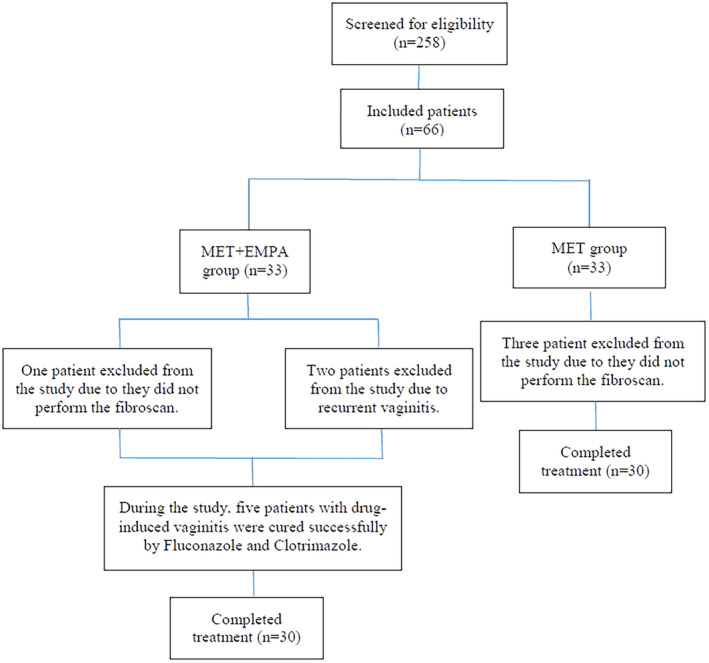
Methods: In this open-label clinical trial study, 60 patients with T2DM and NAFLD were assigned to either the MET + EMPA or MET group in an up-titrated manner for 24 weeks. Anthropometric characteristics, blood glucose indices, lipid profile, liver enzymes, and steatosis grades were measured at baseline and 24 weeks after the intervention.
Results: The results showed that in patients with a mean age of 53.26 ± 7.64 who received MET+ EMPA, all the parameters had a greater decrease than the MET group. In addition, the reduction of FBS, BS, HbA1C, TG, and ALT had a statistically significant difference between the two groups after 24 weeks follow-up (p < 0.05). Notably, in the MET+ EMPA group, there was a substantial improvement in steatosis grades based on the fibroscan and ultrasound modality results.
Conclusion: The EMPA add-on therapeutic schedule in uncontrolled T2DM patients with NAFLD significantly ameliorated steatosis stages, liver function, anthropometric features, and biochemical parameters.
Keywords: empagliflozin; fibroscan; metformin; non‐alcoholic fatty liver disease; type 2 diabetes.
© 2024 The Author(s). Journal of General and Family Medicine published by John Wiley & Sons Australia, Ltd on behalf of Japan Primary Care Association.
Conflict of interest statement
The authors have stated explicitly that there are no conflicts of interest in connection with this article.
Figures
References
-
- Chalasani N, Younossi Z, Lavine JE, Diehl AM, Brunt EM, Cusi K, et al. The diagnosis and management of non‐alcoholic fatty liver disease: practice guideline by the American Association for the Study of Liver Diseases, American College of Gastroenterology, and the American Gastroenterological Association. Hepatology. 2012;55(6):2005–2023. - PubMed
-
- Ciardullo S, Muraca E, Perra S, Bianconi E, Zerbini F, Oltolini A, et al. Screening for non‐alcoholic fatty liver disease in type 2 diabetes using non‐invasive scores and association with diabetic complications. BMJ Open Diabetes Res Care. 2020;8(1):e000904. 10.1136/bmjdrc-2019-000904 - DOI - PMC - PubMed
-
- Krishan S. Correlation between non‐alcoholic fatty liver disease (NAFLD) and dyslipidemia in type 2 diabetes. Diabetes Metab Syndr Clin Res Rev. 2016;10(2):S77–S81. - PubMed
-
- Ballestri S, Zona S, Targher G, Romagnoli D, Baldelli E, Nascimbeni F, et al. Nonalcoholic fatty liver disease is associated with an almost twofold increased risk of incident type 2 diabetes and metabolic syndrome. Evidence from a systematic review and meta‐analysis. J Gastroenterol Hepatol. 2016;31(5):936–944. - PubMed
LinkOut - more resources
Full Text Sources
Miscellaneous