


Uremic sarcopenia: the role of intramuscular adipose tissue as a potential early identifier
- PMID: 39554503
- PMCID: PMC11563970
- DOI: 10.3389/fmed.2024.1372668
Uremic sarcopenia: the role of intramuscular adipose tissue as a potential early identifier
Abstract
Introduction: Sarcopenia is a chronic pathological condition, first defined in 2010 and revised in 2018. The most recent definition of sarcopenia focuses mostly on "low muscle strength." A secondary form of sarcopenia is represented by uremic sarcopenia (US), a condition that characterizes end-stage kidney disease (ESKD) patients. The intramuscular adipose tissue (IMAT) seems to impact negatively on muscle strength, as it would seem to replace muscle fibers with a non-contractile component. The study aims to compare body composition parameters-both standardized and innovative-related to the diagnosis of US in hemodialysis (HD) patients, stratified by sarcopenia diagnosis. Furthermore, the different indices of sarcopenia are compared in order to evaluate their predictive capacity.
Methods: We analyzed 48 ESKD patients according to the sarcopenia diagnosis, obtained using dual-energy X-ray absorptiometry (DXA). Moreover, we assessed the presence of IMAT and calculated the sarcopenia index (SI).
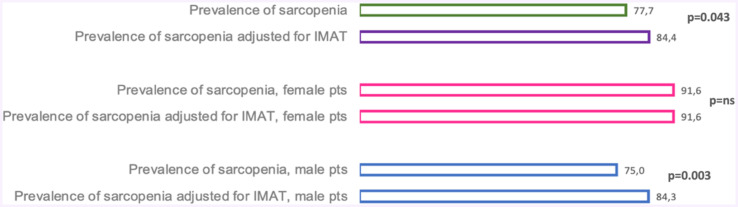
Results: For the study, the enrolled population was divided according to the sarcopenia diagnosis: no sarcopenic patients had higher transferrin (p = 0.03), total proteins (p = 0.04), and azotemia pre-dialysis (p = 0.05) values. On the contrary, atherogenic indices were lower in no sarcopenic patients. Moreover, we observed an indirect correlation between the SI and parathyroid hormone (PTH) (p = 0.00138, R 2 = 0.54). Finally, we calculated the prevalence of sarcopenia and sarcopenia adjusted for IMAT. We showed a different prevalence between sarcopenia diagnosed with a standard index and an index adjusted for IMAT (p = 0.043). In conclusion, we believe that the most important result obtained is the indirect correlation between SI and PTH. These data corroborate the theories, in which PTH seems to play a central role in the cachexia genesis. Moreover, the SI adjusted for IMAT seems to be a more reliable parameter for the early identification of subjects at risk of developing US, allowing timely implementation of targeted therapeutic strategies.
Keywords: body composition analysis; dialysis patients; intramuscular adipose tissue; parathyroid hormone; sarcopenia index; uremic sarcopenia.
Copyright © 2024 Noce, Ceravolo, Gualtieri, Marrone, Romano, Shoshi, Di Lauro and De Lorenzo.
Conflict of interest statement
The authors declare that the research was conducted in the absence of any commercial or financial relationships that could be construed as a potential conflict of interest. AN, PG, GM and ADL, declared that they were an editorial board member of Frontiers, at the time of submission. This had no impact on the peer review process and the final decision.
Figures


References
-
- Bahat G, Ilhan B. Sarcopenia and the cardiometabolic syndrome: a narrative review. Eur Geriatr Med. (2016) 7:220–3. doi: 10.1016/j.eurger.2015.12.012 - DOI
LinkOut - more resources
Full Text Sources
