


Comparison of online adaptive and non-adaptive magnetic resonance image-guided radiation therapy in prostate cancer using dose accumulation
- PMID: 39554802
- PMCID: PMC11564916
- DOI: 10.1016/j.phro.2024.100662
Comparison of online adaptive and non-adaptive magnetic resonance image-guided radiation therapy in prostate cancer using dose accumulation
Abstract
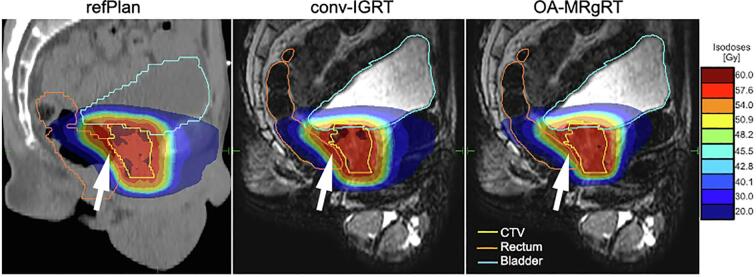
Background and purpose: Conventional image-guided radiotherapy (conv-IGRT) is standard in prostate cancer (PC) but does not account for inter-fraction anatomical changes. Online-adaptive magnetic resonance-guided RT (OA-MRgRT) may improve organ-at-risk (OARs) sparing and clinical target volume (CTV) coverage. The aim of this study was to analyze accumulated OAR and target doses in PC after OA-MRgRT and conv-IGRT in comparison to pre-treatment reference planning (refPlan).
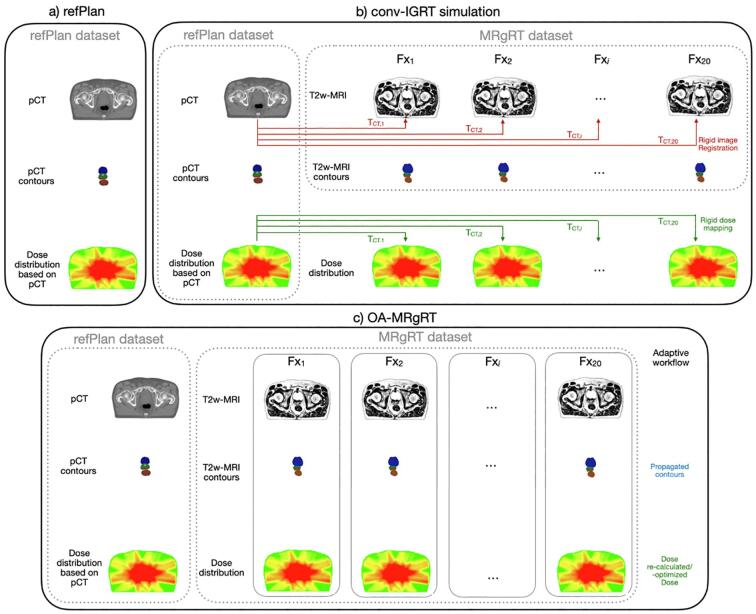
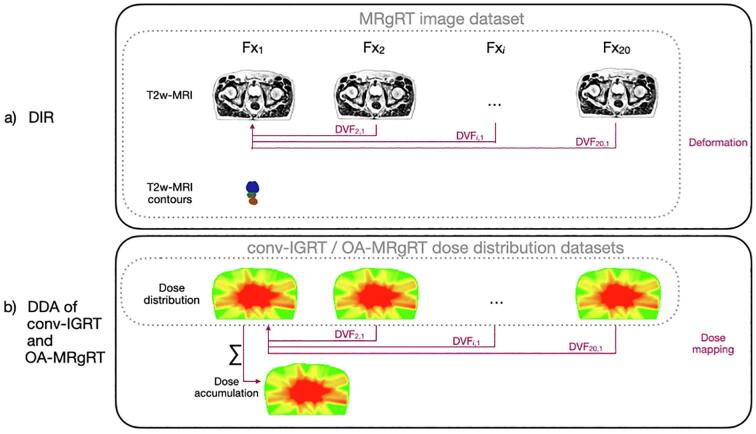
Material and methods: Ten patients with PC, previously treated with OA-MRgRT at the 1.5 T MR-Linac (20x3Gy), were included. Accumulated OA-MRgRT doses were determined by deformably registering all fraction's MR-images. Conv-IGRT was simulated through rigid registration of the planning computed tomography with each fraction's MR-image for dose mapping/accumulation. Dose-volume parameters (DVPs), including CTV D50% and D98%, rectum, bladder, urethra, Dmax and V56Gy for OA-MRgRT, conv-IGRT and refPlan were compared using the Wilcoxon signed-rank test. Clinical relevance of accumulated dose differences was analyzed using a normal-tissue complication-probability model.
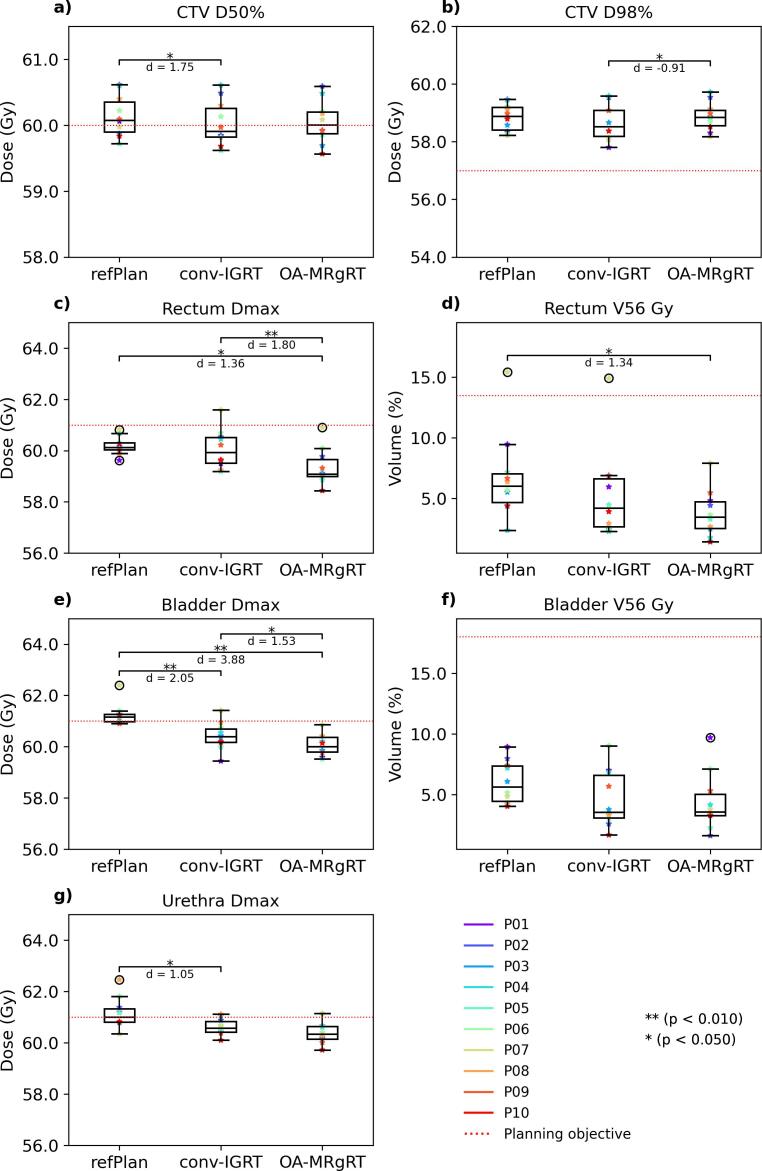
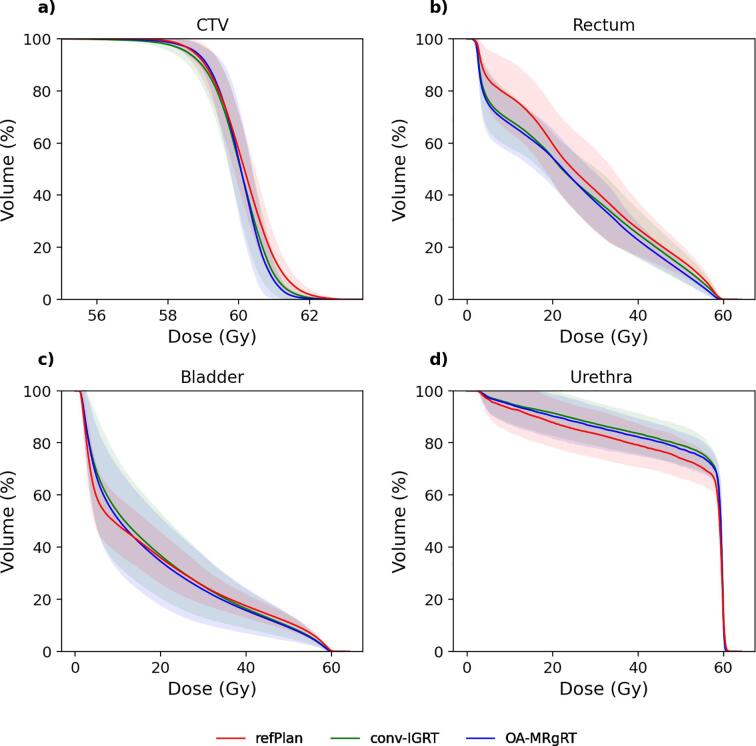
Results: CTV-DVPs were comparable, whereas OA-MRgRT yielded decreased median OAR-DVPs compared to conv-IGRT, except for bladder V56Gy. OA-MRgRT demonstrated significantly lower median rectum Dmax over conv-IGRT (59.1/59.9 Gy, p = 0.006) and refPlan (60.1 Gy, p = 0.012). Similarly, OA-MRgRT yielded reduced median bladder Dmax compared to conv-IGRT (60.0/60.4 Gy, p = 0.006), and refPlan (61.2 Gy, p = 0.002). Overall, accumulated dose differences were small and did not translate into clinically relevant effects.
Conclusion: Deformably accumulated OA-MRgRT using 20x3Gy in PC showed significant but small dosimetric differences comparted to conv-IGRT. Feasibility of a dose accumulation methodology was demonstrated, which may be relevant for evaluating future hypo-fractionated OA-MRgRT approaches.
Keywords: Deformable image registration; Dose accumulation; MR-Linac; MR-guided Radiotherapy; Prostate Cancer.
© 2024 The Author(s).
Conflict of interest statement
The authors declare the following financial interests/personal relationships which may be considered as potential competing interests: The author Daniela Thorwarth is an Editor-in-Chief for Physics and Imaging in Radiation Oncology and was not involved in the editorial review or the decision to publish this article. MM and DT report institutional collaborations including financial and non-financial support by Elekta AB, Philips, TheraPanacea, Dr. Sennewald, Brainlab and PTW Freiburg. MM, ACM, CG, DT and DZ acknowledge funding through the German Research Council (DFG), grants no. MU 4603/1-1 (PAK997/1). MM acknowledges funding through the German Research Council (DFG), grants no. ZI 736/2-1. All other authors do not declare financial interests/personal relationships.
Figures
References
-
- Li G., Li Y., Wang J., Gao X., Zhong Q., He L., et al. Guidelines for radiotherapy of prostate cancer (2020 edition) Precis Radiat Oncol. 2021;5:160–182. doi: 10.1002/pro6.1129. - DOI
-
- Wortel R.C., Incrocci L., Pos F.J., Lebesque J.V., Witte M.G., van der Heide U.A., et al. Acute toxicity after image-guided intensity modulated radiation therapy compared to 3D conformal radiation therapy in prostate cancer patients. Int J Radiat Oncol Biol Phys. 2015;91:737–744. doi: 10.1016/j.ijrobp.2014.12.017. - DOI - PubMed
-
- Alam S., Veeraraghavan H., Tringale K., Amoateng E., Subashi E., Wu A.J., et al. Inter- and intrafraction motion assessment and accumulated dose quantification of upper gastrointestinal organs during magnetic resonance-guided ablative radiation therapy of pancreas patients. Phys Imaging Radiat Oncol. 2022;21:54–61. doi: 10.1016/j.phro.2022.02.007. - DOI - PMC - PubMed
LinkOut - more resources
Full Text Sources
