


Benefits and Risks of AI in Health Care: Narrative Review
- PMID: 39556817
- PMCID: PMC11612599
- DOI: 10.2196/53616
Benefits and Risks of AI in Health Care: Narrative Review
Abstract
Background: The integration of artificial intelligence (AI) into health care has the potential to transform the industry, but it also raises ethical, regulatory, and safety concerns. This review paper provides an in-depth examination of the benefits and risks associated with AI in health care, with a focus on issues like biases, transparency, data privacy, and safety.
Objective: This study aims to evaluate the advantages and drawbacks of incorporating AI in health care. This assessment centers on the potential biases in AI algorithms, transparency challenges, data privacy issues, and safety risks in health care settings.
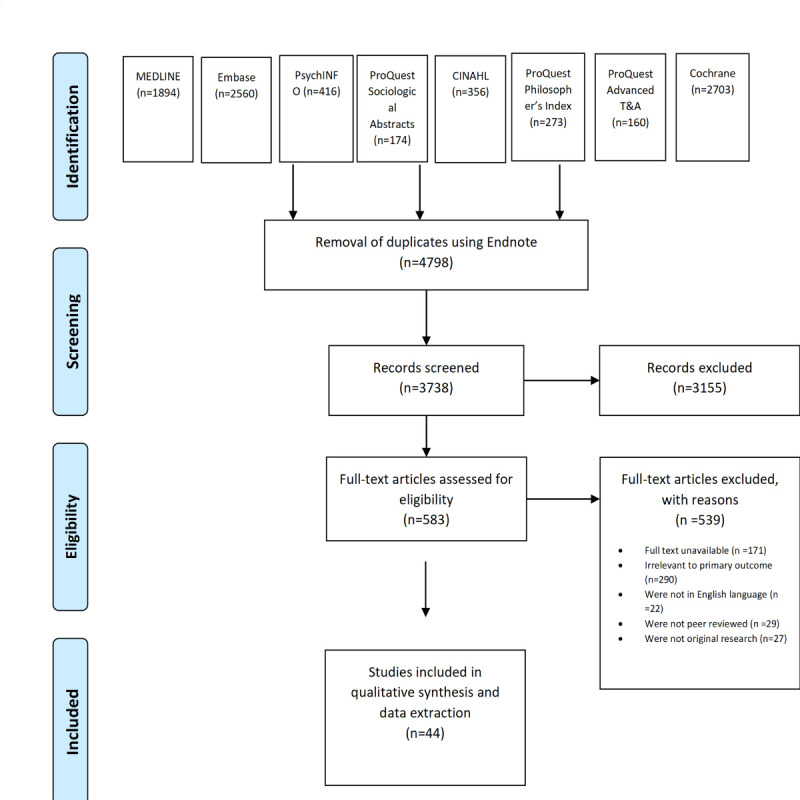
Methods: Studies included in this review were selected based on their relevance to AI applications in health care, focusing on ethical, regulatory, and safety considerations. Inclusion criteria encompassed peer-reviewed articles, reviews, and relevant research papers published in English. Exclusion criteria included non-peer-reviewed articles, editorials, and studies not directly related to AI in health care. A comprehensive literature search was conducted across 8 databases: OVID MEDLINE, OVID Embase, OVID PsycINFO, EBSCO CINAHL Plus with Full Text, ProQuest Sociological Abstracts, ProQuest Philosopher's Index, ProQuest Advanced Technologies & Aerospace, and Wiley Cochrane Library. The search was last updated on June 23, 2023. Results were synthesized using qualitative methods to identify key themes and findings related to the benefits and risks of AI in health care.
Results: The literature search yielded 8796 articles. After removing duplicates and applying the inclusion and exclusion criteria, 44 studies were included in the qualitative synthesis. This review highlights the significant promise that AI holds in health care, such as enhancing health care delivery by providing more accurate diagnoses, personalized treatment plans, and efficient resource allocation. However, persistent concerns remain, including biases ingrained in AI algorithms, a lack of transparency in decision-making, potential compromises of patient data privacy, and safety risks associated with AI implementation in clinical settings.
Conclusions: In conclusion, while AI presents the opportunity for a health care revolution, it is imperative to address the ethical, regulatory, and safety challenges linked to its integration. Proactive measures are required to ensure that AI technologies are developed and deployed responsibly, striking a balance between innovation and the safeguarding of patient well-being.
Keywords: AI; accuracy; artificial intelligence; benefit; biases; data privacy; ethics; health care; risk; safety; safety risks; transparency.
©Margaret Chustecki. Originally published in the Interactive Journal of Medical Research (https://www.i-jmr.org/), 18.11.2024.
Conflict of interest statement
Conflicts of Interest: None declared.
Figures
References
-
- Ghafur S, van Dael J, Leis M, Darzi A, Sheikh A. Public perceptions on data sharing: key insights from the UK and the USA. Lancet Digit Health. 2020;2(9):e444–e446. doi: 10.1016/S2589-7500(20)30161-8. https://linkinghub.elsevier.com/retrieve/pii/S2589-7500(20)30161-8 S2589-7500(20)30161-8 - DOI - PMC - PubMed
-
- Davenport T, Kalakota R. The potential for artificial intelligence in healthcare. Future Healthc J. 2019;6(2):94–98. doi: 10.7861/futurehosp.6-2-94. https://linkinghub.elsevier.com/retrieve/pii/S2514-6645(24)01059-2 S2514-6645(24)01059-2 - DOI - PMC - PubMed
-
- Lee SI, Celik S, Logsdon BA, Lundberg SM, Martins TJ, Oehler VG, Estey EH, Miller CP, Chien S, Dai J, Saxena A, Blau CA, Becker PS. A machine learning approach to integrate big data for precision medicine in acute myeloid leukemia. Nat Commun. 2018;9(1):42. doi: 10.1038/s41467-017-02465-5. https://doi.org/10.1038/s41467-017-02465-5 10.1038/s41467-017-02465-5 - DOI - DOI - PMC - PubMed
-
- Sordo M. Open Clinical Knowledge Management for Medical Care. Boston, MA: Margarita Sordo; 2002. Introduction to Neural Networks in Healthcare.
-
- Fakoor R, Ladhak F, Nazi A, Huber M. Using deep learning to enhance cancer diagnosis and classification. The 30th International Conference on Machine Learning (ICML 2013), WHEALTH Workshop; June 16-21, 2023; Atlanta, GA. 2013. https://www.researchgate.net/publication/281857285_Using_deep_learning_t...
Publication types
LinkOut - more resources
Full Text Sources
