


Sleep Disorders Five Years After Acute Provoked Neonatal Seizures
- PMID: 39557387
- PMCID: PMC12377511
- DOI: 10.1016/j.jpeds.2024.114412
Sleep Disorders Five Years After Acute Provoked Neonatal Seizures
Abstract
Objective: To evaluate whether abnormal sleep is associated with adverse outcomes for children who survived acute provoked neonatal seizures, and their parents.
Study design: This 9-center study prospectively followed newborns with acute provoked seizures. When children reached age 5 years, parents completed the Children's Sleep Habits Questionnaire (CSHQ), the Pediatric Sleep Questionnaire-Sleep Related Breathing Disorders (PSQ-SRBD) subscale, the Vineland Adaptive Behavior Scales-3, and the Hospital Anxiety Depression Scale. Children were also assessed with the Wechsler Preschool and Primary Scale of Intelligence-IV (WPPSI-IV). Spearman correlations and multivariable analyses were used to evaluate risk factors for sleep problems.
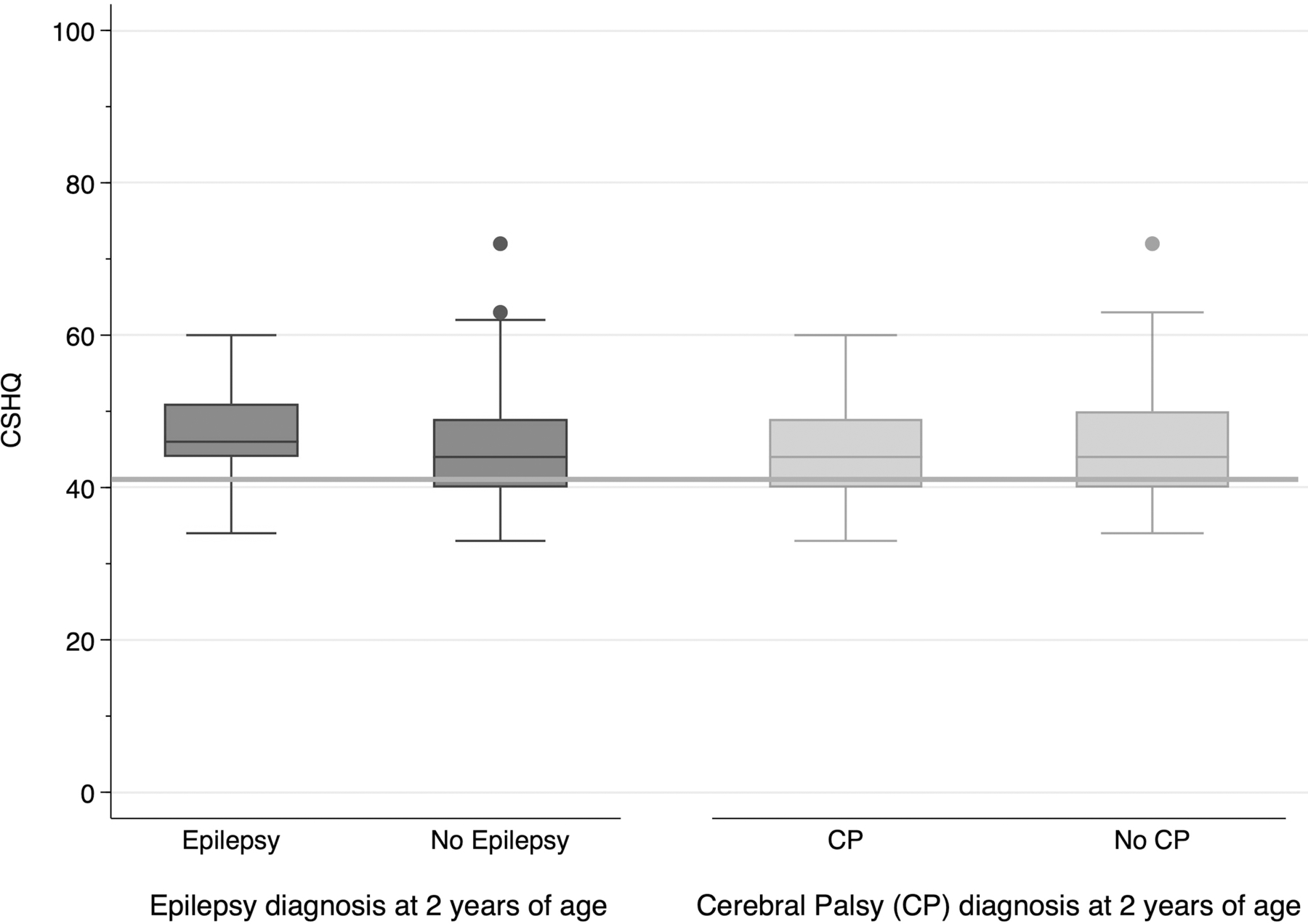
Results: The mean CSHQ score was 45 ± 7; 77 of 118 children (65%) had an abnormal score (above the healthy sleep threshold of 41). On the PSQ-SRBD, 32 of 119 children (27%) screened positive for sleep-disordered breathing (SDB). SDB symptoms were more common among children with cerebral palsy (42% with vs 22% without; P = .03) and epilepsy (54% with vs 24% without; P = .02). Children with lower scores on the Vineland-3 (rho = -0.25; P = .01) and WPPSI-IV (rho = -0.31; P = .004) at 5 years of age were more likely to have symptoms of SDB. Worse CSHQ and PSQ-SRBD scores were associated with higher parental anxiety (rho = 0.28 [P = .002] and rho = 0.34 [P = .0002], respectively) and depression scores on the Hospital Anxiety Depression Scale (rho = 0.16 [P = .08] and rho = 0.17 [P = .07], respectively).
Conclusions: Two-thirds of early school-aged survivors of acute provoked neonatal seizures had parent-reported sleep abnormalities and one-quarter screened positive for SDB. Early screening and effective treatment for sleep disorders could be an innovative, practice-changing approach to improve outcomes after neonatal seizures.
Copyright © 2024 The Authors. Published by Elsevier Inc. All rights reserved.
Conflict of interest statement
Declaration of Competing Interest Renée Shellhaas reports financial support for this study was provided by National Institute of Neurological Disorders and Stroke and the Patient-Centered Outcomes Research Institute. Renée Shellhaas reports a relationship with Pediatric Epilepsy Research Foundation that includes: board membership and employment. Renée Shellhaas reports a relationship with The Epilepsy Study Consortium that includes: consulting or advisory. Renée Shellhaas reports a relationship with UptoDate Inc that includes: royalties for authorship of topics related to neonatal seizures. All other authors declare that they have no known competing financial interests or personal relationships that could have appeared to influence the work reported in this paper.
Figures

References
-
- Glass HC, Grinspan ZM, Shellhaas RA. Outcomes after acute symptomatic seizures in neonates. Semin Fetal Neonatal Med 2018;23(3):218–22. - PubMed
-
- Owens JA, Spirito A, McGuinn M, Nobile C. Sleep habits and sleep disturbance in elementary school-aged children. J Dev Behav Pediatr 2000;21(1):27–36. - PubMed
-
- Sadeh A, Mindell JA, Luedtke K, Wiegand B. Sleep and sleep ecology in the first 3 years: a web-based study. J Sleep Res 2009;18(1):60–73. - PubMed
-
- Chervin RD, Ruzicka DL, Archbold KH, Dillon JE. Snoring predicts hyperactivity four years later. Sleep. 2005;28(7):885–90. - PubMed
Publication types
MeSH terms
Grants and funding
LinkOut - more resources
Full Text Sources
Medical
