


Diagnostic accuracy analysis of SARC-F, its modified versions and the Quality of Life in Sarcopenia questionnaire in screening for sarcopenia in nursing home residents
- PMID: 39557609
- PMCID: PMC11995832
- DOI: 10.1111/ggi.15020
Diagnostic accuracy analysis of SARC-F, its modified versions and the Quality of Life in Sarcopenia questionnaire in screening for sarcopenia in nursing home residents
Abstract
Aim: Sarcopenia, which is among the most important geriatric syndromes, is also a public health challenge. This study evaluated the performance of the SARC-F, its modified versions and the Quality of Life in Sarcopenia (SarQoL) in screening for sarcopenia.
Methods: In the diagnostic accuracy study carried out with a total of 195 nursing home residents, sarcopenia was evaluated according to the European Working Group on Sarcopenia in Older Persons 2 algorithm. For SARC-CalFs, the calf circumference standard and its population-specific reference (31 cm, 32/33 cm, respectively) were used, whereas for SARC + elderly and body mass index information, age (>75 years) and body mass index (<21 kg/m2) were used. Screening test performance was evaluated with receiver operating characteristic analysis, and the optimal cut-off points were determined according to the Youden index.
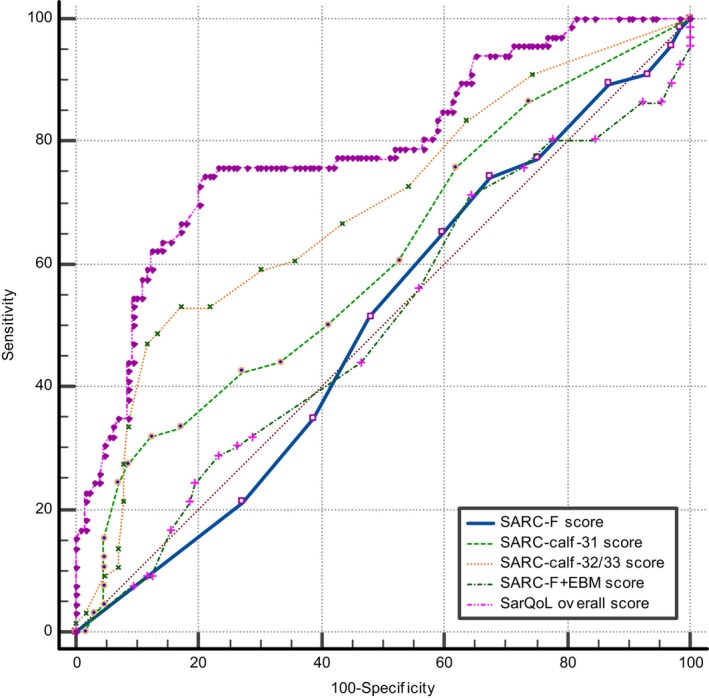
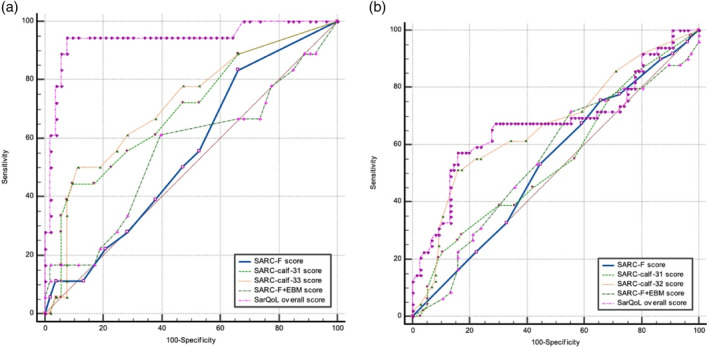
Results: The prevalence of sarcopenia was 33.8%. Although SarQoL and SARC-CalF scores were lower in individuals with sarcopenia, standard SARC-F and SARC-F + elderly and body mass index information scores were not different. SARC-F had the poorest screening performance, whereas the SarQoL scale had the best screening performance (area under the curve 0.502 vs 0.787). SARC-CalF (32/33 cm) had the best performance among the modified versions of SARC-F. The optimal cut-off point for SarQoL was <64.56, and its sensitivity in sarcopenia screening was 74.24% (95% CI 62.0-84.2) and its specificity was 79.07% (95% CI 71.0-85.7). All the modified versions of SARC-CalF had higher sensitivity and area under the curve compared with SARC-F.
Conclusions: SarQoL screening performance might be conducive to providing clinical discrimination in a nursing home sample. Further research is needed for the use of SarQoL as a potential sarcopenia screening strategy. Additionally, SARC-CalFs, especially the population-specific SARC-CalF (32/33 cm), might improve screening performance compared with standard SARC-F. Geriatr Gerontol Int 2024; 24: 1335-1342.
Keywords: SARC‐F; SarQoL; diagnostic accuracy for screening; sarcopenia.
© 2024 Japan Geriatrics Society.
Figures
References
-
- Rosenberg IH. Summary comments. Am J Clin Nutr 1989; 50: 1231–1233.
-
- Yuan S, Larsson SC. Epidemiology of sarcopenia: prevalence, risk factors, and consequences. Metabolism 2023; 144: 155533. - PubMed
MeSH terms
LinkOut - more resources
Full Text Sources
Medical
