. 2024 Nov 18;14(1):28534.
doi: 10.1038/s41598-024-78692-w.

Performance of the MOLES and TFSOM-DIM scores in classifying choroidal nevi and melanoma

Affiliations

Performance of the MOLES and TFSOM-DIM scores in classifying choroidal nevi and melanoma

David Jahnke et al. Sci Rep. .

Abstract

Choroidal nevi are common benign melanocytic lesions often incidentally found during routine ophthalmic examinations. Patients with choroidal nevi are frequently referred to ocular oncology centers to differentiate these from choroidal melanoma and to exclude a malignant transformation which rarely occurs. However, this causes a high workload for referral centers and may delay diagnosis and treatment of patients with potentially severe conditions. To overcome this, the MOLES score was previously developed which may empower non-specialists to differentiate choroidal nevi from melanoma. In this retrospective study, the performance of the MOLES score was assessed in 695 patients with choroidal nevi and 53 with choroidal melanoma. With a specificity of 96% (choroidal nevi) and a sensitivity of 100% (melanoma) the MOLES score was highly successful in differentiating choroidal nevi from melanoma and may offer great potential to optimize monitoring and referral decisions, and for teleophthalmology applications. Furthermore, the TFSOM-DIM score using risk factors for determining tumor progression was applied and showed a good correlation with MOLES. A complementary use of MOLES and TFSOM-DIM may be beneficial for clinical routine: MOLES for screening by non-experts with limited diagnostic tools and TFSOM-DIM in a referral setting to counsel also regarding potential transformation.

Keywords: Choroidal melanoma; Choroidal nevus; Retinal imaging, ocular oncology, imaging.


Conflict of interest statement

Declarations Competing interests The authors declare no competing interests.

Figures

Fig. 1
Fig. 1
Examples for nevi assessed using MOLES. (A-C): “Common nevus” (MOLES 00000) with a basal diameter of 2DD. (D-F): “Low risk nevus“ (MOLES 00100) with a basal diameter of 3DD. (G- I): “High risk nevus” (MOLES 00200) with a basal diameter of 4.5DD and prominence on OCT. From left to right: fundus photography, fundus autofluorescence, OCT imaging.
Fig. 2
Fig. 2
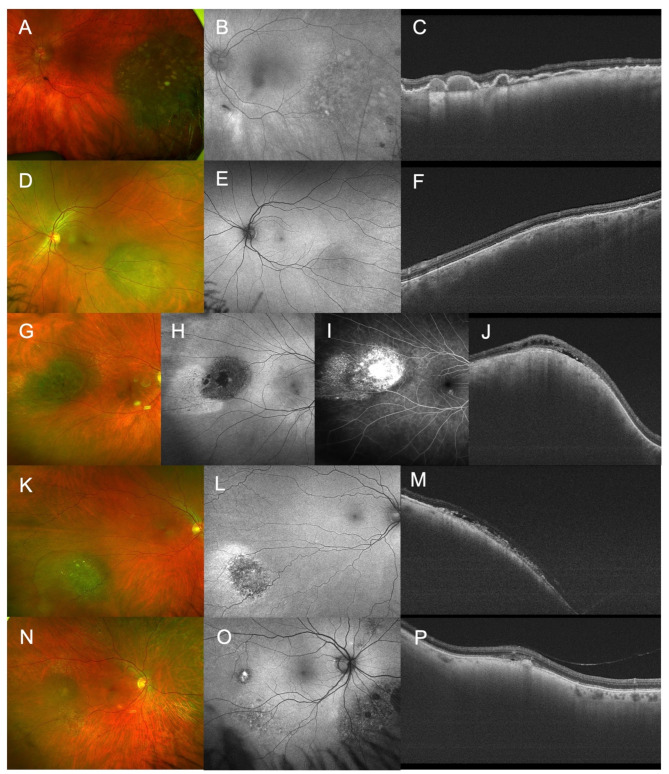
Examples of high-risk nevi labelled as probable melanoma. (A-F): Fundus photography, fundus autofluorescence and OCT of giant nevi with a basal diameter > 5 (MOLES 00220). (G-J): Fundus photography, fundus autofluorescence, fluorescence angiography and OCT of a large nevus with orange dusting and SRF (MOLES 01101). (K-M): Fundus photography, fundus autofluorescence and OCT of a large nevus with orange dusting and SRF (MOLES 01201). (N-P): Fundus photography, fundus autofluorescence and OCT of a small nevus with orange clumps and trace SRF (MOLES 02001).
Fig. 3
Fig. 3
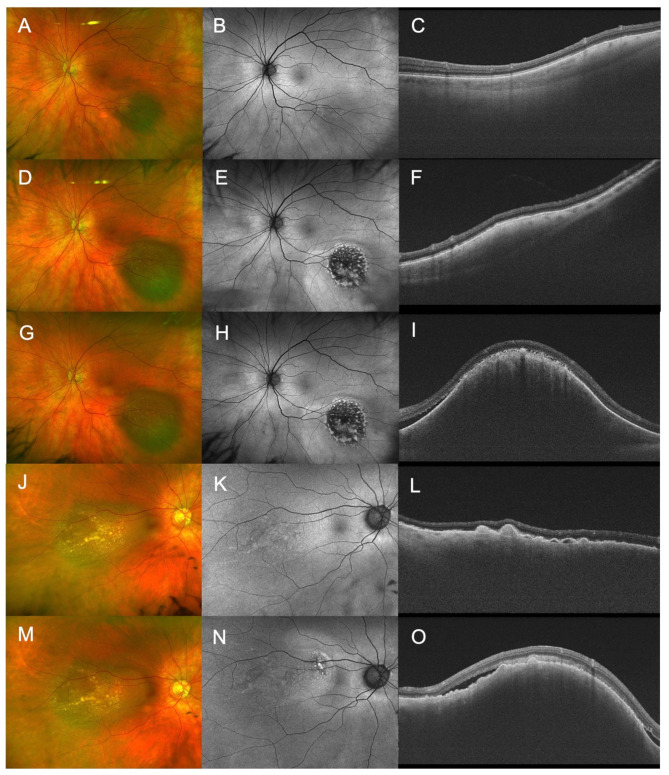
Two cases of malignant transformation. (A-C): Multimodal imaging of a choroidal nevus (MOLES 00100) which transformed to a choroidal tumor; (D-F) one year after first presentation growth in basal diameter and orange clumping were observed (MOLES 02220); (G-I) further growth in thickness and SRF were observed before treatment with proton therapy (MOLES 02221). (J-L): Imaging of a large choroidal nevus (MOLES 00200) which progressed within 6 months and showed at follow up (M-O) confluent orange pigment and SRF (MOLES 02201). From left to right: fundus photography, fundus autofluorescence, OCT imaging.

References

    1. Singh, A. D., Kalyani, P. & Topham, A. Estimating the risk of malignant transformation of a choroidal nevus. Ophthalmology. 112 (10), 1784–1789 (2005). - PubMed
    1. Sumich, P., Mitchell, P. & Wang, J. J. Choroidal nevi in a white population: the Blue mountains Eye Study. Arch. Ophthalmol.116 (5), 645–650 (1998). - PubMed
    1. Kaliki, S. & Shields, C. L. Uveal melanoma: relatively rare but deadly cancer. Eye (Lond). 31 (2), 241–257 (2017). - PMC - PubMed
    1. Damato, B. Time to treatment of uveal melanoma in the United Kingdom. Eye (Lond). 15 (Pt 2), 155–158 (2001). - PubMed
    1. Damato, E. M. & Damato, B. E. Detection and time to treatment of uveal melanoma in the United Kingdom: an evaluation of 2,384 patients. Ophthalmology. 119 (8), 1582–1589 (2012). - PubMed

LinkOut - more resources