. 2024 Nov 18;17(1):472.
doi: 10.1186/s13071-024-06562-5.

Ascorbate peroxidase modulation confirms key role in Leishmania infantum oxidative defence

Affiliations

Ascorbate peroxidase modulation confirms key role in Leishmania infantum oxidative defence

Isabella Fernandes Martins Santos et al. Parasit Vectors. .

Abstract

Background: Ascorbate peroxidase (APX) has emerged as a promising target for chemotherapy because of its absence in humans and crucial role in the antioxidant defence of trypanosomatids. APXs, which are class I haeme-containing enzymes, reduces hydrogen peroxide using ascorbate to produce water and monodehydroascorbate, thereby preventing cell damage caused by H2O2.

Methods: We aimed to create an APX-knockout L. infantum line using CRISPR/Cas9. Despite unsuccessful attempts at full knockouts, we achieved deletion of chromosomal copies post-APX episomal insertion, yielding LiΔchrAPX::LbAPX parasites. We performed phenotypic characterization to assess the impact of these genetic modifications, which included the determination of APX transcript expression levels using quantitative PCR, drug sensitivity, infectivity, and parasite survival in macrophages.

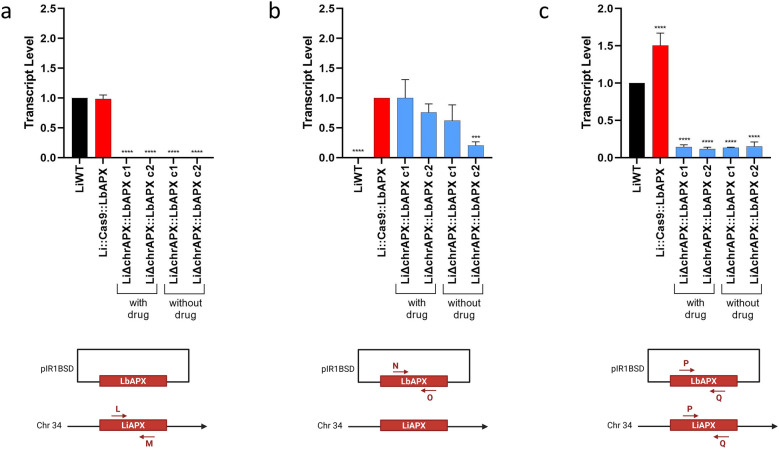
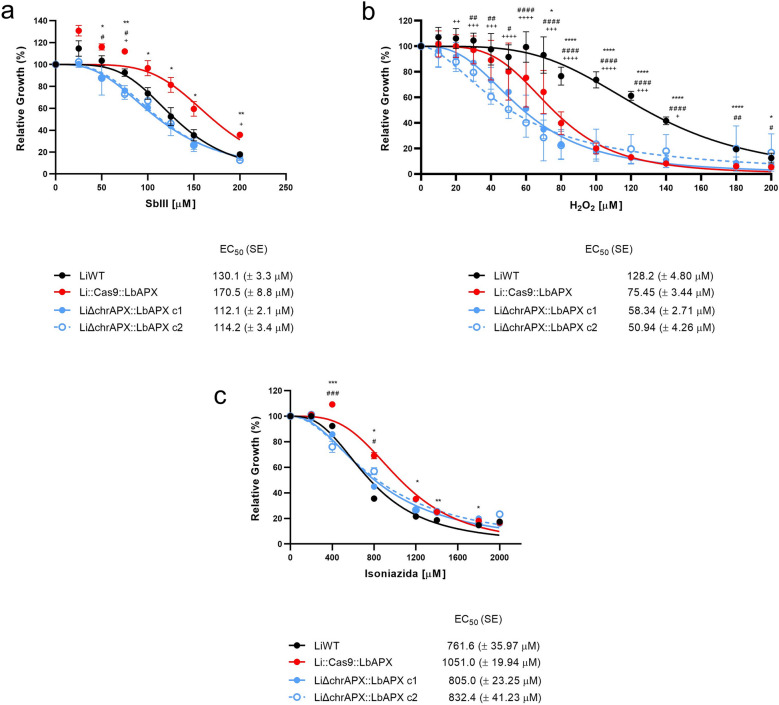
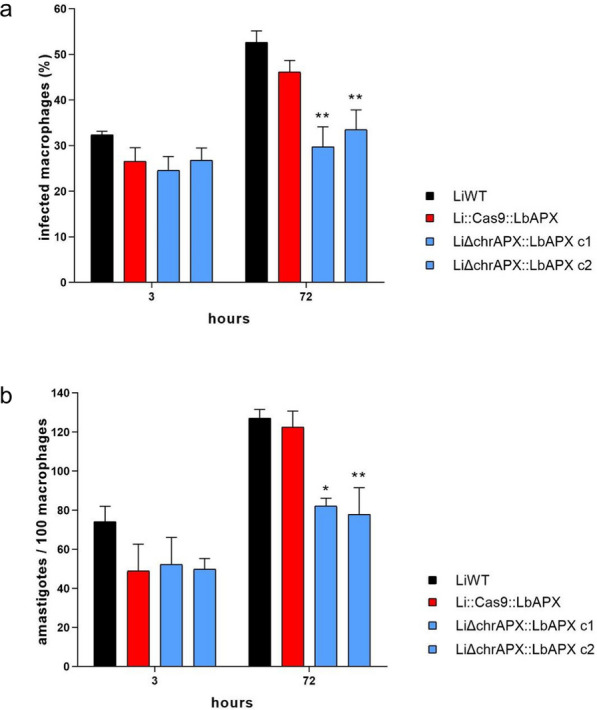
Results: Quantitative polymerase chain reaction (PCR) analysis revealed a 10- to 13-fold reduction in APX transcript expression in LiΔchrAPX::LbAPX compared with wild-type (LiWT) and APX-overexpressing (Li::Cas9::LbAPX) parasites, respectively. The episomes in those knockdown parasites remained stable even after 20 drug-free passages in vitro. Li::Cas9::LbAPX parasites showed increased resistance to trivalent antimony (SbIII) and isoniazid, reduced tolerance to H2O2, and unchanged macrophage infectivity compared with LiWT. In contrast, LiΔchrAPX::LbAPX parasites were more sensitive to SbIII and isoniazid, exhibited greater susceptibility to H2O2-induced oxidative stress, and 72 h post-infection, showed fewer infected macrophages and intracellular amastigotes compared with LiWT parasites.

Conclusions: Our findings hint at the indispensability of APX in L. infantum and raise the possibility of its potential as a therapeutic target for leishmaniasis.

Keywords: Leishmania infantum; Antioxidant defence; Ascorbate peroxidase; CRISPR/Cas9; Drug resistance.


Conflict of interest statement

Declarations Ethics approval and consent to participate Not applicable. Consent for publication Not applicable. Competing interests The authors declare no competing interests.

Figures

Fig. 1
Fig. 1
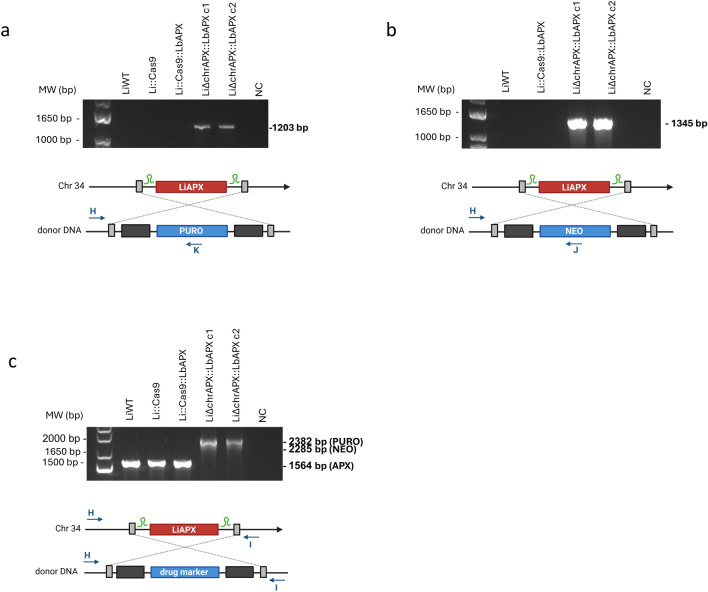
Knockout of APX endogenous gene in L. infantum expressing L. braziliensis APX epissomally. First, knockout was assessed by PCR using genomic DNA from wild-type and mutant parasites. The correct integration of the a PURO and b NEO resistance markers were evaluated by PCR using a primer that anneals in the 5′ UTR region of APX and another primer that anneals in the resistance marker sequence. c Integration of donor DNAs using primers that hybridize to the 5′ and 3′ UTR regions of both wild-type and mutant parasites. Please note that the schematic representations of the molecules are not to scale, with sizes and distances adjusted for clarity rather than accuracy. MW molecular weight standard, bp base pairs, NC: negative control, WT wild type
Fig. 2
Fig. 2
Transcription levels of APX were assessed by RT-qPCR in wild-type parasites and mutants. a Transcription levels of LiAPX gene in wild-type and mutant parasites, assessed using a pair of primers that only amplify LiAPX; b Transcription levels of the LbAPX gene wild-type and mutant parasites, assessed using a pair of primers that only amplify LbAPX; c Transcription levels of both LiAPX and LbAPX in wild-type and mutant parasites, assessed using a pair of primers that recognize both sequences. The transcription level was determined quantitatively to the number of copies of the constitutive DNA polymerase gene by real-time quantitative PCR using the 2-ΔΔCT comparative method. One-way ANOVA with Dunnett post hoc test was used to compare the control parasites and mutants. We used LiWT as the control for a and c and Li::Cas9::LbAPX as the control for b; *p < 0.05, **p < 0.01, ***p < 0.001, and ****p < 0.0001. The sgRNA is depicted in green and indicates the site of the double-strand break within the target sequence. Please note that the schematic representations of the molecules are not to scale, with sizes and distances adjusted for clarity rather than accuracy
Fig. 3
Fig. 3
Drug susceptibility. WT and mutant parasites were cultured in the presence of different concentrations of a SbIII (25–200 μM), b hydrogen peroxide (10–200 μM) and c isoniazid (200–2000 μM). Parasite growth was determined after 48 h of incubation with or without the drug. Data plotted in the dose–response curve represent the mean with standard deviations of three independent experiments performed in triplicate. The EC50 was determined using a non-linear regression–variable slope model with the ‘log (inhibitor) versus response’ equation in GraphPad Prism. Two-way ANOVA with Dunnett post hoc test was used to compare WT parasites and mutants for each drug concentration; *p < 0.05, **p < 0.01, ***p < 0.001, and ****p < 0.0001 for LiWT vs. Li::Cas9::LbAPX; #p < 0.05, ##p < 0.01, ###p < 0.001, and ####p < 0.0001 for LiWT versus LiΔchrAPX::LbAPX c1; and + p < 0.05, + + p < 0.01, + + + p < 0.001, and + + + + p < 0.0001 for LiWT versus LiΔchrAPX::LbAPX c2
Fig. 4
Fig. 4
Analysis of the infectivity of mutant parasites in THP-1 macrophages. To evaluate the fitness of the mutant parasites, THP-1 macrophages were infected with LiWT and mutants in a ratio of 1:10 (ten parasites for each macrophage). a Percentage of infected macrophages at different incubation periods. b Number of intracellular amastigotes per 100 macrophages at different incubation periods. The data are based on the average of three independent experiments performed in triplicate. Two-way ANOVA with Bonferroni post hoc test was used to compare LiWT with each mutant parasite at each time point; *p < 0.05, **p < 0.01, ***p < 0.001 and ****p < 0.0001

References

    1. WHO. Leishmaniasis. https://www.who.int/news-room/fact-sheets/detail/leishmaniasis. Accessed 2 July 2024.
    1. Alvar J, Vélez ID, Bern C, Herrero M, Desjeux P, Cano J, et al. Leishmaniasis worldwide and global estimates of its incidence. PLoS ONE. 2012;7:e35671. - DOI - PMC - PubMed
    1. Muraca G, Berti IR, Sbaraglini ML, Fávaro WJ, Durán N, Castro GR, et al. Trypanosomatid-caused conditions: state of the art of therapeutics and potential applications of lipid-based nanocarriers. Front Chem. 2020;8:601151. - DOI - PMC - PubMed
    1. Ponte-Sucre A, Gamarro F, Dujardin JC, Barrett MP, López-Vélez R, García-Hernández R, et al. Drug resistance and treatment failure in leishmaniasis: a 21st century challenge. PLoS Negl Trop Dis. 2017;11:e0006052. - DOI - PMC - PubMed
    1. Raven EL. Understanding functional diversity and substrate specificity in haem peroxidases: what can we learn from ascorbate peroxidase? Nat Prod Rep. 2003;20:367–81. - DOI - PubMed

MeSH terms

LinkOut - more resources