


Psychological factors contributing to the creation and dissemination of fake news among social media users: a systematic review
- PMID: 39558439
- PMCID: PMC11575416
- DOI: 10.1186/s40359-024-02129-2
Psychological factors contributing to the creation and dissemination of fake news among social media users: a systematic review
Abstract
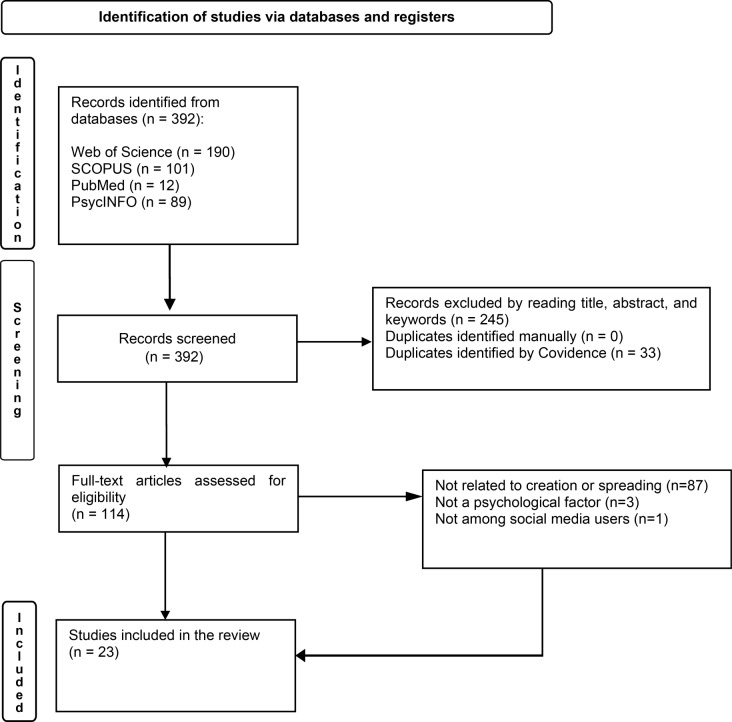
The proliferation of fake news on social media platforms has become a significant concern, influencing public opinion, political decisions, and societal trust. While much research has focused on the technological and algorithmic factors behind the spread of misinformation, less attention has been given to the psychological drivers that contribute to the creation and dissemination of fake news. Cognitive biases, emotional appeals, and social identity motivations are believed to play a crucial role in shaping user behaviour on social media, yet there is limited systematic understanding of how these psychological factors intersect with online information sharing. Existing studies tend to focus on individual aspects of fake news consumption, such as susceptibility to misinformation or partisan biases, leaving a gap in understanding the broader psychological mechanisms behind both the creation and dissemination of fake news. This systematic review aims to fill this gap by synthesizing current research on the psychological factors that influence social media users' involvement in dissemination and creation of fake news. Twenty-three studies were identified from 2014 to 2024 following the PRISMA guidelines. We have identified five themes through critical review and synthesis of the literature which are personal factors, ignorance, social factors, biological process, and cognitive process. These themes help to explain the psychological factors contributing to the creation and dissemination of fake news among social media users. Based on the findings, it is evident that diverse psychological factors influence the dissemination and creation of fake news, which must be studied to design better strategies to minimize this issue.
Keywords: Creation; Dissemination; Fake news; Psychological factors; Social media users.
© 2024. The Author(s).
Conflict of interest statement
Figures
References
-
- Shin J, Jian L, Driscoll K, Bar F. The diffusion of misinformation on social media: temporal pattern, message, and source. Comput Hum Behav. 2018;83:278–87. 10.1016/j.chb.2018.02.008.
-
- Guo L, Zhang Y. Information flow within and across online media platforms: an agenda-setting analysis of rumor diffusion on news websites, Weibo, and WeChat in China. Journalism Stud. 2020;21(15):2176–95. 10.1080/1461670X.2020.1827012.
-
- Lazer DM, Baum MA, Benkler Y, Berinsky AJ, Greenhill KM, Menczer F, Metzger MJ, Nyhan B, Pennycook G, Rothschild D, Schudson M. The science of fake news. Science. 2018;359(6380):1094–6. 10.1371/journal.pone.0239666. - PubMed
-
- Ruchansky N, Seo S, Liu Y, Csi. A hybrid deep model for fake news detection. InProceedings of the 2017 ACM on Conference on Information and Knowledge Management 2017 (pp. 797–806). 10.1145/3132847.3132877
-
- Pennycook G, Rand DG. The Implied Truth Effect: attaching warnings to a subset of fake news stories increases perceived accuracy of stories without warnings. Manage Sci. 2018;66(11):4944–57. 10.1287/mnsc.2019.3478.
Publication types
MeSH terms
Grants and funding
LinkOut - more resources
Full Text Sources
Miscellaneous
