


Decoding the pathological and genomic profile of epithelial ovarian cancer
- PMID: 39562613
- PMCID: PMC11577113
- DOI: 10.1038/s41598-024-80030-z
Decoding the pathological and genomic profile of epithelial ovarian cancer
Abstract
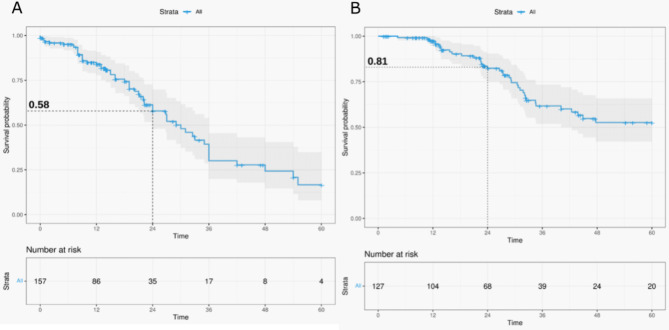
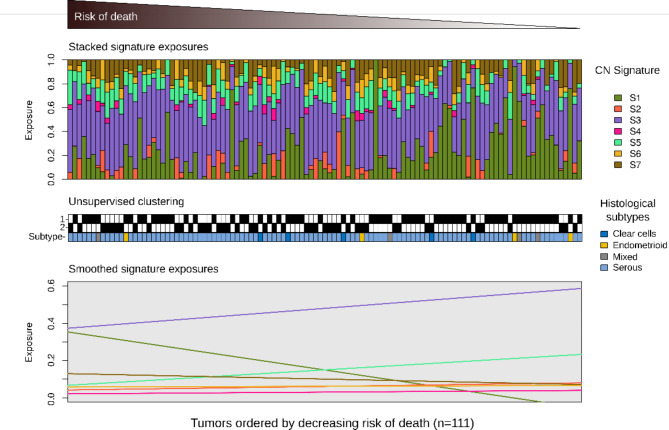
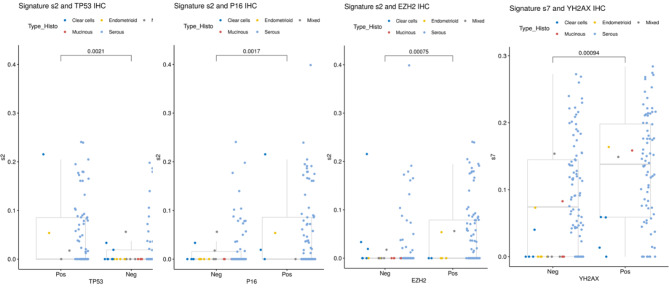
Ovarian cancer (OC) is one of the most common cancers in women, with a high mortality rate. Most of published studies have been focused on Caucasian populations, with the need to explore biological features and clinical outcomes of patients from other ethnicities. We described clinical outcome (progression-free survival and overall survival) and biomarkers associated with survival in a cohort of patients with OC from Tunisia. Using immunohistochemistry, we assessed the expression of 14 proteins known to be altered in OC in a cohort of 198 patients. We explored the correlation between protein expression and copy number alteration (CNA) profiles. FIGO stage, menopausal status and mismatch repair deficiency were associated with survival. ERBB2 amplification was correlated with high ERBB2 expression (OR = 69.32, p = 4.03 E-09), and high PDL1 expression was associated to CD274 amplification (OR = 4.97, p = 5.79 E-2). We identified a correlation between survival and exposure to two CNA signatures (MAPK pathway and BRCA-related homologous recombination deficiency). Moreover, Gama-H2AX protein expression was correlated with exposure to a genomic signature associated with homologous recombination deficiency. We observed that OC clinical and pathological characteristics of these patients from Tunisia were similar to those of Caucasian patients. We identified frequent CNA in this population that need to be confirmed in other sets from Africa.
Keywords: Copy number alterations; Ovarian cancer; Survival.; Tissue micro-array.
© 2024. The Author(s).
Conflict of interest statement
Figures

References
-
- Bray, F. et al. Global cancer statistics 2018: GLOBOCAN estimates of incidence and mortality worldwide for 36 cancers in 185 countries. CA Cancer J. Clin.68, 394–424. 10.3322/caac.21492 (2018). - PubMed
-
- Devouassoux-Shisheboran, M., Genestie, C. & Ray-Coquard, I. Dualistic classification of epithelial ovarian cancer: is it clinically relevant?. Bull. Cancer (Paris). 103, 252–258. 10.1016/j.bulcan.2015.12.005 (2016). - PubMed
-
- RJ, K., ML, C. & CS, H. RH Y. WHO Classification of Tumours of Female Reproductive Organs. n.d.
-
- González-Martín, A. et al. Niraparib in patients with newly diagnosed advanced Ovarian cancer. N Engl. J. Med.381, 2391–2402. 10.1056/NEJMoa1910962 (2019). - PubMed
MeSH terms
Substances
Grants and funding
- 46434ZJ/Projet de recherche mixte franco-tunisien Comité Mixte de Coopération Universitaire (CMCU) PHC Utique
- 46434ZJ/Projet de recherche mixte franco-tunisien Comité Mixte de Coopération Universitaire (CMCU) PHC Utique
- 46434ZJ/Projet de recherche mixte franco-tunisien Comité Mixte de Coopération Universitaire (CMCU) PHC Utique
- 46434ZJ/Projet de recherche mixte franco-tunisien Comité Mixte de Coopération Universitaire (CMCU) PHC Utique
- 46434ZJ/Projet de recherche mixte franco-tunisien Comité Mixte de Coopération Universitaire (CMCU) PHC Utique
LinkOut - more resources
Full Text Sources
Medical
Research Materials
Miscellaneous
