


Iron deficiency anemia and its association with cognitive function among adolescents in the Ashanti Region - Ghana
- PMID: 39563322
- PMCID: PMC11575446
- DOI: 10.1186/s12889-024-20640-4
Iron deficiency anemia and its association with cognitive function among adolescents in the Ashanti Region - Ghana
Abstract
Background: Iron deficiency anemia (IDA) remains a global health concern, and has been associated with cognitive decline. However, very few studies have explored the association between IDA and cognitive function among Ghanaians. We assessed the association between IDA and cognitive function among adolescents in the Ashanti region, Ghana.
Methods: This cross-sectional study involved 250 adolescents from Kumasi, Ghana. Sociodemographic and dietary data were obtained using a well-structured questionnaire. Blood samples were drawn for estimation of ferritin and complete blood count. The Test of Non-verbal Intelligence (TONI-4) was used to assess cognitive function. Binary logistic regression was used to determine the predictors of cognitive function.
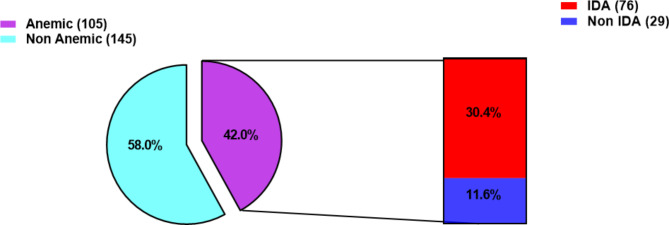
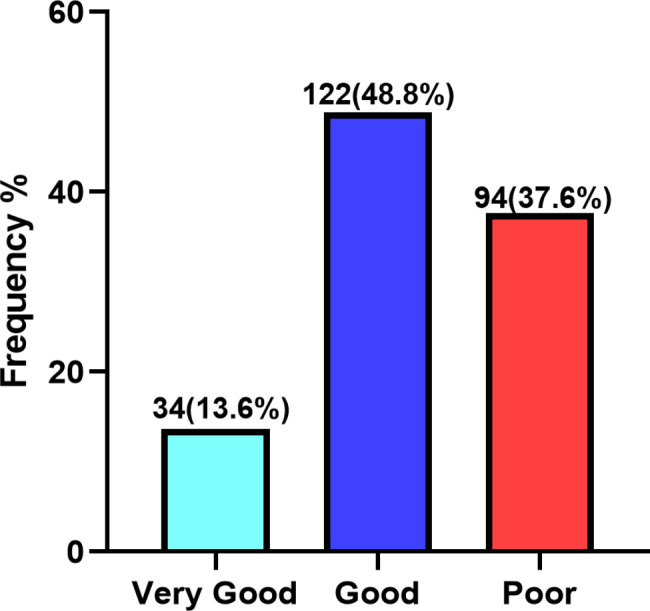
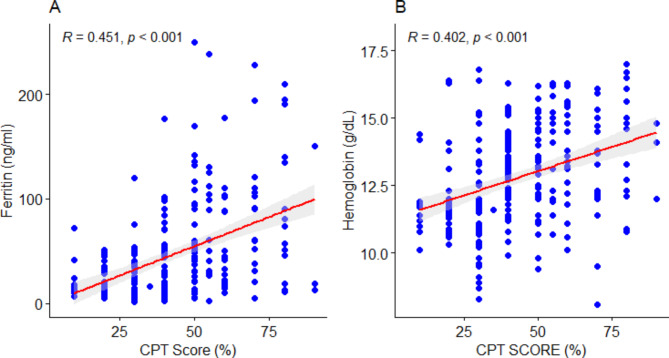
Results: The prevalence of IDA was 30.4%, which was higher among adolescents with poor cognitive performance test scores (CPTS) (71%). Being female [aOR = 0.32, 95% CI (0.10-0.99), p = 0.0480)], father having junior high education [aOR = 0.08, 95% CI (0.02-0.45), p = 0.0040)], being in a category B school [aOR = 0.26, 95% CI (0.09-0.81), p = 0.0200)] and C [aOR = 0.08, 95% CI (0.02-0.40), p = 0.0020)] and non-fruit consumption [aOR = 0.18, 95% CI (0.06-0.52), p = 0.0010)], were significantly associated with lower likelihood of having very good cognitive function. Moreover, ferritin (r = 0.451, p < 0.001) and hemoglobin (r = 0.402, p < 0.001) demonstrated a moderate positive correlation with CPTS.
Conclusion: The prevalence of IDA is high in our study population and was linked with poor cognitive function. Adolescents with IDA had low cognitive performance test scores. High levels of hemoglobin and ferritin showed a moderate correlation with higher cognitive performance. These findings suggest that adolescents' cognitive function may be moderately influenced by IDA, highlighting the potential impact of iron status on cognitive outcomes.
Keywords: Adolescents; Cognitive function; Iron deficiency; anemia.
© 2024. The Author(s).
Conflict of interest statement
Figures

References
-
- Organization WH. Prevention of iron deficiency anaemia in adolescents. WHO Regional Office for South-East Asia; 2011.
MeSH terms
LinkOut - more resources
Full Text Sources
