. 2024 Nov 19;21(1):301.
doi: 10.1186/s12974-024-03295-1.

IL-37 suppresses CNS autoimmunity by increasing the frequency of Treg cells and reducing CD4 + T cell-derived IL-10 production

Affiliations

IL-37 suppresses CNS autoimmunity by increasing the frequency of Treg cells and reducing CD4 + T cell-derived IL-10 production

Reza Yazdani et al. J Neuroinflammation. .

Abstract

Background: Interleukin-37 (IL-37) has anti-inflammatory properties in innate and adaptive immunity. Patients with multiple sclerosis (MS), an autoimmune inflammatory demyelinating disease of the central nervous system (CNS), have increased serum levels of IL-37. However, it is unknown whether IL-37 has an inhibitory effect on ongoing autoimmune neuroinflammation, thus offering a potential MS therapy.

Aim: Here, we examined the effect of IL-37 in an experimental autoimmune encephalomyelitis (EAE) model after disease onset to determine if it was protective.

Findings: IL-37-treated mice developed a less severe disease than control mice, with reduced demyelination as determined by increased expression of myelin basic protein. IL-37 suppressed inflammation by decreasing infiltration of CD4 + T cells into the CNS and increasing the frequency of regulatory T cells, while IL-10 expression by CD4 + T cells decreased over time in the CNS.

Conclusion: Our findings confirm the immunomodulatory role of IL-37 in CNS inflammation during ongoing disease, thus indicating the potential of IL-37 as an inhibitory reagent for MS therapy.

Keywords: Experimental autoimmune encephalomyelitis (EAE); IL-10; IL-37; Inflammation; Multiple sclerosis.


Conflict of interest statement

Declarations Competing interests The authors declare no competing interests.

Figures

Fig. 1
Fig. 1
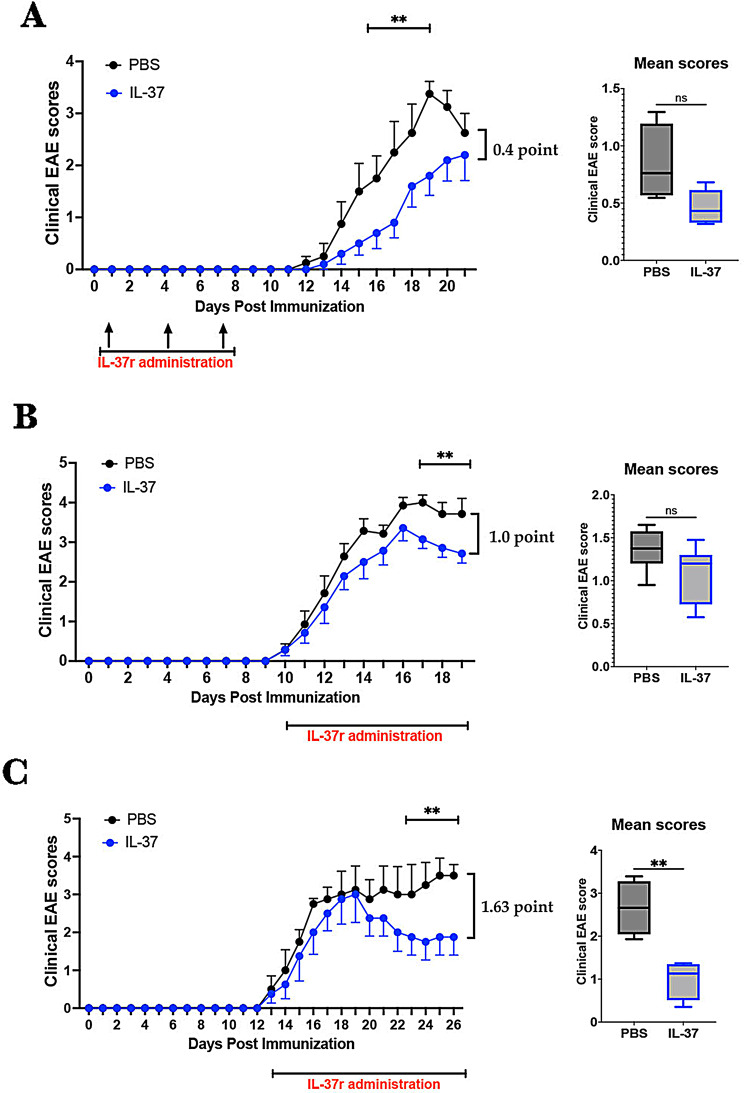
IL-37 treatment ameliorated EAE at both priming and ongoing phases. (A) C57BL/6 mice were immunized to induce EAE and treated i.p. with IL-37 (1 µg/ dose; n = 5) and PBS (n = 4) at days 1, 4, and 7 p.i. The clinical scores were evaluated daily for 21 days p.i. Mean clinical scores for IL-37-treated and PBS-treated groups were calculated as the sum of daily scores for each mouse divided by the number of days per group. (B-C) EAE mice were treated i.p. with 1 µg of rhIL-37b/ day when they showed the first symptoms of EAE. PBS was administered i.p. to the control group in the same way. Clinical scores were followed for 20 days p.i. (peak; n = 7 per group) (B) and 26 days p.i. (chronic; n = 4 per group) (C), and mean clinical scores were compared between IL-37-treated mice and control. Clinical scores were analyzed by multiple unpaired t-tests. Mean clinical scores were analyzed by Student’s t-test. Data shown as mean ± SEM. Values of p < 0.05 (*), p < 0.01 (**) and p < 0.001 (***) were considered significant. Ns: not significant
Fig. 2
Fig. 2
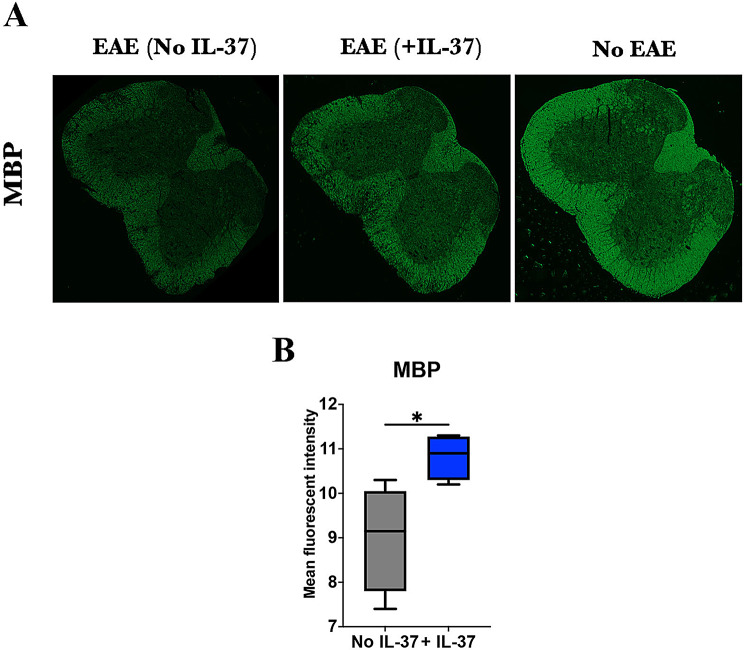
IL-37 enhanced MBP expression. (A) The lumbar section of the spinal cord was harvested from EAE mice treated with PBS (left) or rhIL-37b (middle) at the peak of disease (n = 4 mice in each group). Naïve mice (right) are illustrated as a control to show healthy spinal cord. (B) Mean fluorescent intensity of MBP expression in both groups was measured using FIJI software. Unpaired t-test was performed to analyze these two groups. Data shown as mean ± SEM. Values of p < 0.05 (*), p < 0.01 (**) and p < 0.001 (***) were considered significant. Ns: not significant
Fig. 3
Fig. 3
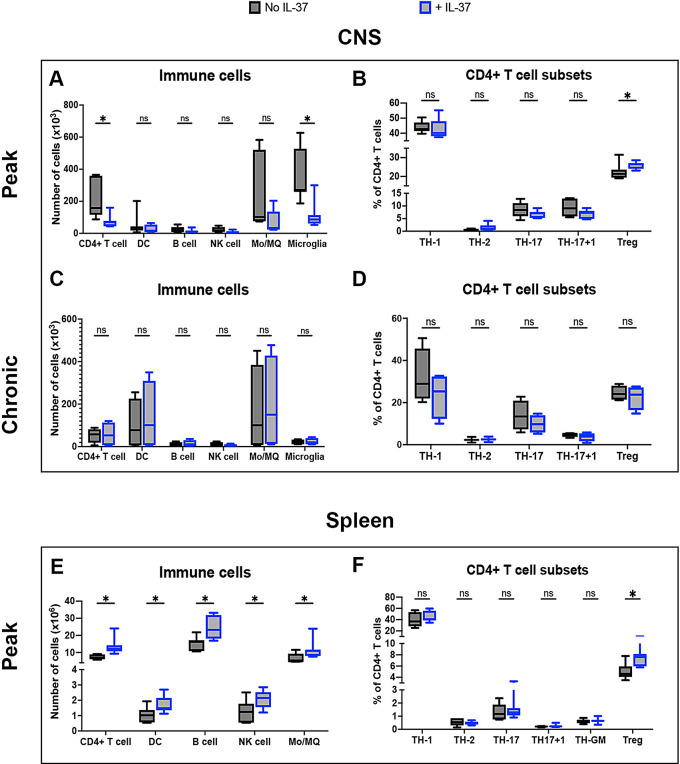
IL-37 reduced infiltration of immune cells into the CNS. Numbers of infiltrated immune cells in the CNS of IL-37- and PBS-treated mice at the peak (A) and chronic phase (C) of EAE. Proportions of TH subsets among CD4 + T cells isolated from the CNS of IL-37- and PBS-treated mice at peak (B) and chronic phase (D) of EAE. The number of immune cells (E) and CD4 + T cell subsets (D) in the spleen of IL-37- and PBS-treated mice at the peak of disease. Unpaired t-test (n = 7 per group in peak; n = 4 per group in chronic) was used to analyze the two groups. Data shown as mean ± SEM. Values of p < 0.05 (*), p < 0.01 (**) and p < 0.001 (***) were considered significant. Ns: not significant
Fig. 4
Fig. 4
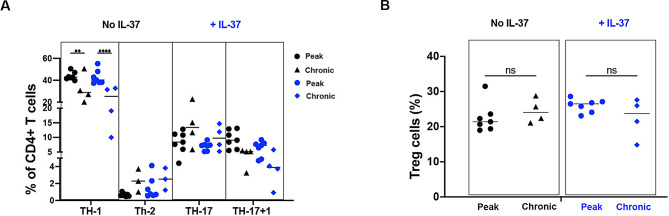
IL-37 reduces proportion of TH-1 cells at chronic phase during CNS inflammation. (A) The frequencies of CD4 + T cells at EAE peak compared to chronic phase in IL-37-treated (blue) and PBS-treated mice (black). (B) The frequencies Treg cells at peak compared to chronic phase of EAE disease in IL-37-treated (blue) and PBS-treated mice (black). Analyses between these two groups were carried out by unpaired t-tests (n = 7 per group in peak; n = 4 per group in chronic). Data shown as mean ± SEM. Values of p < 0.05 (*), p < 0.01 (**) and p < 0.001 (***) were considered significant. Ns: not significant
Fig. 5
Fig. 5
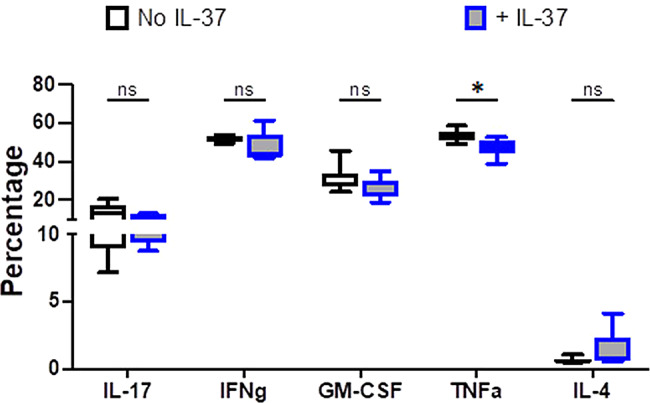
Production of inflammatory and anti-inflammatory cytokines in total CD4 + T cells of the CNS following IL-37 treatment. The frequencies of cytokine-producing CD4 + T cells in the CNS of IL-37- and PBS-treated mice at the peak of disease. Analyses between these two groups were carried out by unpaired t-tests (n = 7 per group). Data shown as mean ± SEM. Values of p < 0.05 (*), p < 0.01 (**) and p < 0.001 (***) were considered significant. Ns: not significant
Fig. 6
Fig. 6
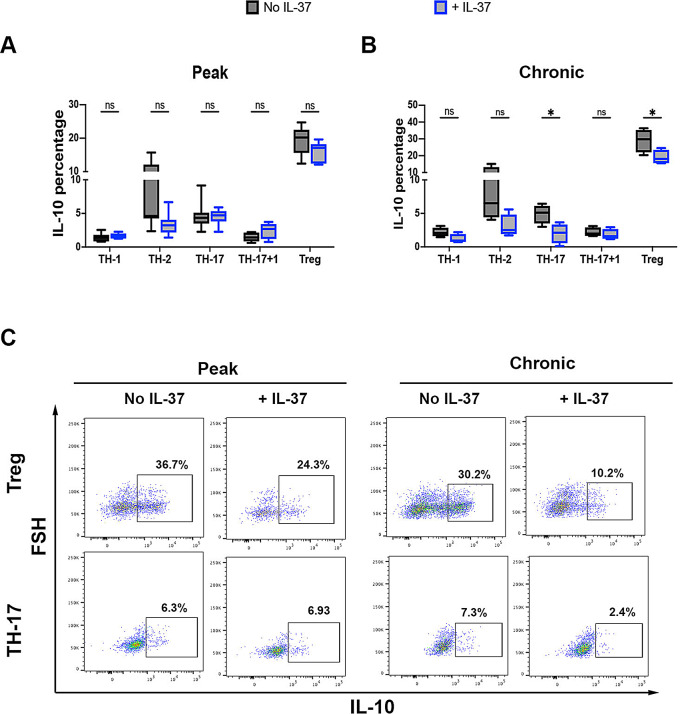
EAE suppression by IL-37 is mediated by reducing IL-10 producing CD4 + T cells of the CNS. The frequencies of IL-10 expression in different CD4 + T cell subsets from the CNS of IL-37-treated and PBS-treated EAE mice at the peak of disease (A) and chronic phase (B). Analyses between these two groups were carried out by unpaired t-tests (n = 7 per group in peak; n = 4 per group in chronic phase). (C) Representative flow cytometry dot-plots showing IL-10 expression in Treg and TH-17 cells from the CNS of PBS-treated and IL-37-treated EAE mice at disease peak and chronic phase. Data shown as mean ± SEM. Values of p < 0.05 (*), p < 0.01 (**) and p < 0.001 (***) were considered significant. Ns: not significant
Fig. 7
Fig. 7
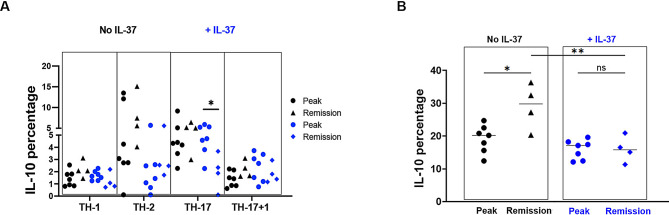
IL-37 reduced frequency of IL-10 producing Treg cells during CNS inflammation. (A) The frequencies of IL-10 producing CD4 + T cells at EAE peak compared to chronic phase in IL-37-treated (blue) and PBS-treated mice (black). (B) The frequencies IL-10 producing Treg cells at peak compared to chronic of EAE disease in IL-37-treated (blue) and PBS-treated mice (black). Analyses between these two groups were carried out by unpaired t-tests (n = 7 per group in peak; n = 4 per group in chronic). Data shown as mean ± SEM. Values of p < 0.05 (*), p < 0.01 (**) and p < 0.001 (***) were considered significant. Ns: not significant

References

    1. Nold MF, Nold-Petry CA, Zepp JA, Palmer BE, Bufler P, Dinarello CA. IL-37 is a fundamental inhibitor of innate immunity. Nat Immunol. 2010;11(11):1014–22. - PMC - PubMed
    1. Tete S, Tripodi D, Rosati M, Conti F, Maccauro G, Saggini A, et al. IL-37 (IL-1F7) the newest anti-inflammatory cytokine which suppresses immune responses and inflammation. Int J Immunopathol Pharmacol. 2012;25(1):31–8. - PubMed
    1. Li S, Amo-Aparicio J, Neff CP, Tengesdal IW, Azam T, Palmer BE, et al. Role for nuclear interleukin-37 in the suppression of innate immunity. Proc Natl Acad Sci U S A. 2019;116(10):4456–61. - PMC - PubMed
    1. Cavalli G, Dinarello CA. Suppression of inflammation and acquired immunity by IL-37. Immunol Rev. 2018;281(1):179–90. - PubMed
    1. Wang L, Quan Y, Yue Y, Heng X, Che F. Interleukin-37: a crucial cytokine with multiple roles in disease and potentially clinical therapy. Oncol Lett. 2018;15(4):4711–9. - PMC - PubMed

MeSH terms

LinkOut - more resources