


Predicting patient reported outcome measures: a scoping review for the artificial intelligence-guided patient preference predictor
- PMID: 39564457
- PMCID: PMC11573790
- DOI: 10.3389/frai.2024.1477447
Predicting patient reported outcome measures: a scoping review for the artificial intelligence-guided patient preference predictor
Abstract
Background: The algorithmic patient preference predictor (PPP) has been proposed to aid in decision making for incapacitated patients in the absence of advanced directives. Ethical and legal challenges aside, multiple practical barriers exist for building a personalized PPP. Here, we examine previous work using machine learning to predict patient reported outcome measures (PROMs) for capacitated patients undergoing diverse procedures, therapies, and life events. Demonstrating robust performance in predicting PROMs for capacitated patients could suggest opportunities for developing a model tailored to incapacitated ones.
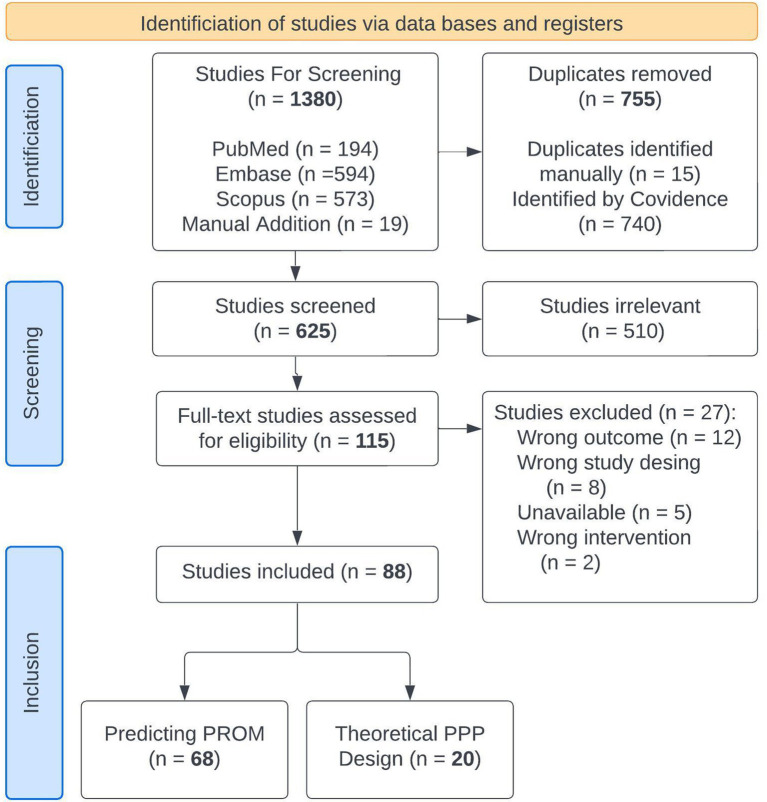
Methods: We performed a scoping review of PubMed, Embase, and Scopus using the PRISMA-ScR guidelines to capture studies using machine learning to predict PROMs following a medical event alongside qualitative studies exploring a theoretical PPP.
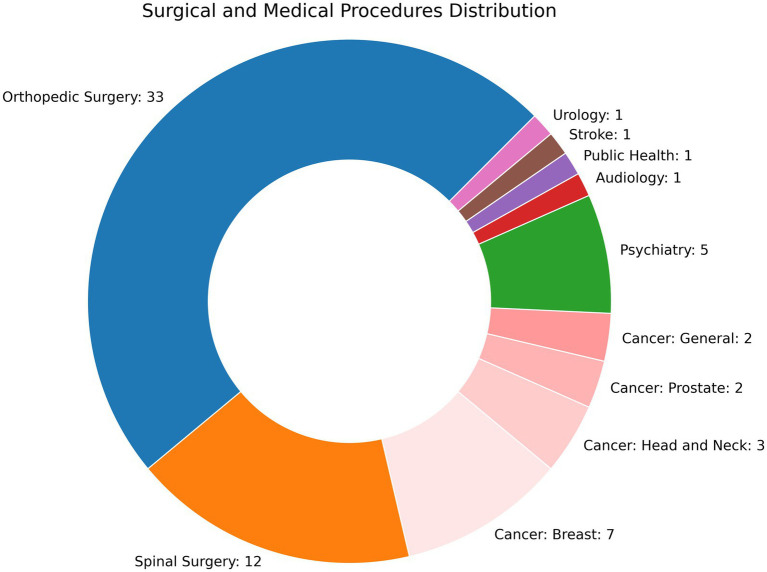
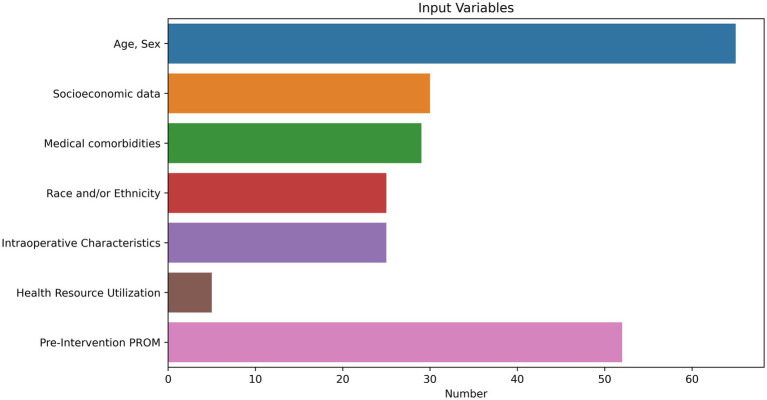
Results: Sixty-eight studies used machine learning to evaluate PROMs; an additional 20 studies focused on a theoretical PPP. For PROMs, orthopedic surgeries (n = 33) and spinal surgeries (n = 12) were the most common medical event. Studies used demographic (n = 30), pre-event PROMs (n = 52), comorbidities (n = 29), social determinants of health (n = 30), and intraoperative variables (n = 124) as predictors. Thirty-four different PROMs were used as the target outcome. Evaluation metrics varied by task, but performance was overall poor to moderate for the best reported scores. In models that used feature importance, pre-event PROMs were the most predictive of post-event PROMs. Fairness assessments were rare (n = 6). These findings reinforce the necessity of the integrating patient values and preferences, beyond demographic factors, to improve the development of personalized PPP models for incapacitated patients.
Conclusion: The primary objective of a PPP is to estimate patient-reported quality of life following an intervention. Use of machine learning to predict PROMs for capacitated patients introduces challenges and opportunities for building a personalized PPP for incapacitated patients without advanced directives.
Keywords: clinical decision support; fairness; machine learn; palliative care; patient reported outcome.
Copyright © 2024 Balch, Chatham, Hong, Manganiello, Baskaran, Bihorac, Shickel, Moseley and Loftus.
Conflict of interest statement
The authors declare that the research was conducted in the absence of any commercial or financial relationships that could be construed as a potential conflict of interest.
Figures
Similar articles
-
Comparison of Two Modern Survival Prediction Tools, SORG-MLA and METSSS, in Patients With Symptomatic Long-bone Metastases Who Underwent Local Treatment With Surgery Followed by Radiotherapy and With Radiotherapy Alone.Clin Orthop Relat Res. 2024 Dec 1;482(12):2193-2208. doi: 10.1097/CORR.0000000000003185. Epub 2024 Jul 23. Clin Orthop Relat Res. 2024. PMID: 39051924
-
Are Current Survival Prediction Tools Useful When Treating Subsequent Skeletal-related Events From Bone Metastases?Clin Orthop Relat Res. 2024 Sep 1;482(9):1710-1721. doi: 10.1097/CORR.0000000000003030. Epub 2024 Mar 22. Clin Orthop Relat Res. 2024. PMID: 38517402
-
Does the Presence of Missing Data Affect the Performance of the SORG Machine-learning Algorithm for Patients With Spinal Metastasis? Development of an Internet Application Algorithm.Clin Orthop Relat Res. 2024 Jan 1;482(1):143-157. doi: 10.1097/CORR.0000000000002706. Epub 2023 Jun 12. Clin Orthop Relat Res. 2024. PMID: 37306629 Free PMC article.
-
Routine use of patient reported outcome measures (PROMs) for improving treatment of common mental health disorders in adults.Cochrane Database Syst Rev. 2016 Jul 13;7(7):CD011119. doi: 10.1002/14651858.CD011119.pub2. Cochrane Database Syst Rev. 2016. PMID: 27409972 Free PMC article.
-
Drugs for preventing postoperative nausea and vomiting in adults after general anaesthesia: a network meta-analysis.Cochrane Database Syst Rev. 2020 Oct 19;10(10):CD012859. doi: 10.1002/14651858.CD012859.pub2. Cochrane Database Syst Rev. 2020. PMID: 33075160 Free PMC article.
Cited by
-
Ethical Challenges and Opportunities of AI in End-of-Life Palliative Care: Integrative Review.Interact J Med Res. 2025 May 14;14:e73517. doi: 10.2196/73517. Interact J Med Res. 2025. PMID: 40302210 Free PMC article. Review.
-
Bioethical Considerations of Deploying Artificial Intelligence in Clinical Orthopedic Settings: A Narrative Review.HSS J. 2025 May 30:15563316251340303. doi: 10.1177/15563316251340303. Online ahead of print. HSS J. 2025. PMID: 40458232 Free PMC article. Review.
References
-
- Agochukwu-Mmonu N., Murali A., Wittmann D., Denton B., Dunn R. L., Montie J., et al. . (2022). Development and validation of dynamic multivariate prediction models of sexual function recovery in patients with prostate Cancer undergoing radical prostatectomy: results from the MUSIC statewide collaborative. Eur. Urol. Open Sci. 40, 1–8. doi: 10.1016/j.euros.2022.03.009, PMID: - DOI - PMC - PubMed
-
- Alaiti R. K., Vallio C. S., Assunção J. H., Andrade e Silva F. B., Gracitelli M. E. C., Neto A. A. F., et al. . (2023). Using machine learning to predict nonachievement of clinically significant outcomes after rotator cuff repair. Orthop. J. Sports Med. 11:6180. doi: 10.1177/23259671231206180 - DOI - PMC - PubMed
-
- Assistant P., et al. . Predicting consumer behaviour with artificial intelligence. (2023).
Publication types
Grants and funding
LinkOut - more resources
Full Text Sources
