. 2024 Nov 5:6:1458811.
doi: 10.3389/fdgth.2024.1458811. eCollection 2024.

AI's pivotal impact on redefining stakeholder roles and their interactions in medical education and health care

Affiliations

AI's pivotal impact on redefining stakeholder roles and their interactions in medical education and health care

Jayne S Reuben et al. Front Digit Health. .

Abstract

Artificial Intelligence (AI) has the potential to revolutionize medical training, diagnostics, treatment planning, and healthcare delivery while also bringing challenges such as data privacy, the risk of technological overreliance, and the preservation of critical thinking. This manuscript explores the impact of AI and Machine Learning (ML) on healthcare interactions, focusing on faculty, students, clinicians, and patients. AI and ML's early inclusion in the medical curriculum will support student-centered learning; however, all stakeholders will require specialized training to bridge the gap between medical practice and technological innovation. This underscores the importance of education in the ethical and responsible use of AI and emphasizing collaboration to maximize its benefits. This manuscript calls for a re-evaluation of interpersonal relationships within healthcare to improve the overall quality of care and safeguard the welfare of all stakeholders by leveraging AI's strengths and managing its risks.

Keywords: Artificial Intelligence (AI); clinical decision support systems; ethics; healthcare; machine learning; medical education; strategies and guidelines.


Conflict of interest statement

The authors declare that the writing was conducted in the absence of any commercial or financial relationships that could be construed as a potential conflict of interest.

Figures
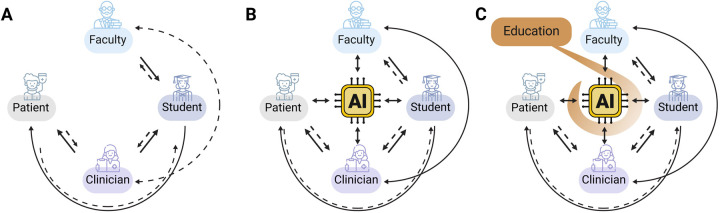
Figure 1
Figure 1
Changes in key health system players’ interrelationships in the era of AI. The arrows symbolize the dynamic interactions between the four stakeholders, with the AI positioned at the center as a new participant. Solid lines represent a higher level of information access and input; dashed lines represent a relatively lower level of access and input. (A) Before the availability of AI technologies, communication primarily followed a bidirectional pattern with patients being relatively passive recipients of information and instructions. Students constructed knowledge and gained competencies under the guidance of faculty members and clinicians, progressively developing their expertise in problem-solving and patient treatment. The health system's responsibility was primarily centered on clinicians and patients, with faculty involvement in preclinical education. Faculty and clinician professionals collaborated to reduce the gap between education and clinical practice. (B) With the availability of AI technologies to patients, students, and experts, medical knowledge is now more accessible to all stakeholders. This shifts communication interrelationships towards a more multi-directional approach, breaking down language and competency barriers and making AI a collaborative partner in decision-making. (C) Incorporation of AI education and training plays a crucial role in guiding all players for the effective and responsible use of AI, maintaining the desired level of expertise to minimize misinterpretations and medical errors.

References

    1. Alowais SA, Alghamdi SS, Alsuhebany N, Alqahtani T, Alshaya AI, Almohareb SN, et al. Revolutionizing healthcare: the role of artificial intelligence in clinical practice. BMC Med Educ. (2023) 23:689. 10.1186/s12909-023-04698-z - DOI - PMC - PubMed
    1. Wu S-H, Tong W-J, Li M-D, Hu H-T, Lu X-Z, Huang Z-R, et al. Collaborative enhancement of consistency and accuracy in US diagnosis of thyroid nodules using large language models. Radiology. (2024) 310:e232255. 10.1148/radiol.232255 - DOI - PubMed
    1. Esteva A, Chou K, Yeung S, Naik N, Madani A, Mottaghi A, et al. Deep learning-enabled medical computer vision. NPJ Digit Med. (2021) 4:5. 10.1038/s41746-020-00376-2 - DOI - PMC - PubMed
    1. Thirunavukarasu AJ, Ting DSJ, Elangovan K, Gutierrez L, Tan TF, Ting DSW. Large language models in medicine. Nat Med. (2023) 29:1930–40. 10.1038/s41591-023-02448-8 - DOI - PubMed
    1. Tayebi Arasteh S, Han T, Lotfinia M, Kuhl C, Kather JN, Truhn D, et al. Large language models streamline automated machine learning for clinical studies. Nat Commun. (2024) 15:1603. 10.1038/s41467-024-45879-8 - DOI - PMC - PubMed

LinkOut - more resources
