. 2024 Nov 6:15:1484321.
doi: 10.3389/fimmu.2024.1484321. eCollection 2024.

Impairment of regulatory T cell stability in axial spondyloarthritis: role of EZH2 and pSTAT5

Affiliations

Impairment of regulatory T cell stability in axial spondyloarthritis: role of EZH2 and pSTAT5

Majda Lyna Mebrek et al. Front Immunol. .

Abstract

Background and objectives: Axial spondyloarthritis (axSpA) is a chronic inflammatory disease involving the spine, peripheral joints, and entheses. Functional impairment of regulatory T cells (Treg) is linked to inflammatory diseases, but limited data is available regarding Treg involvement in axSpA. Treg stability refers to their ability to maintain their functions and characteristics in pro-inflammatory environments. EZH2 and phosphorylated STAT5 (pSTAT5) play a critical role in maintaining Treg stability. We aimed to characterize Treg stability in patients with axSpA.

Methods: Peripheral blood mononuclear cells (PBMCs) from axSpA patients, either naïve from targeted therapy or treated by TNF inhibitors (TNFi), and from healthy donors (HD), were freshly isolated. Expression of stability (EZH2, pSTAT5) and suppressive (TNFR2 and CD39) markers by Treg was analyzed by flow cytometry.

Results: EZH2 expression by Treg was decreased in axSpA patients as compared to HD (p<0.01). Mechanistic study showed that inhibition of EZH2 attenuated Treg differentiation and suppressive phenotype in vitro. EZH2 was predominantly expressed by highly suppressive TNFR2+ and CD39+ Treg. Additionally, axSpA patients also exhibited a reduced frequency of pSTAT5+ Treg compared to HD (p<0.05), and pSTAT5+ Treg frequency increased at 3 months of TNFi treatment compared to baseline (p<0.05). This last result suggested a restoration of Treg stability upon TNFi treatment.

Conclusion: By highlighting a deficient expression of EZH2 and pSTAT5 by Treg, we revealed an impaired Treg stability in axSpA. Deciphering the pathways influenced by these molecules is necessary to assess the potential therapeutic benefits of restoring Treg stability in axSpA.

Keywords: EZH2; PSTAT5; TNF inhibitors; regulatory T cells; spondyloarthritis.


Conflict of interest statement

The authors declare that the research was conducted in the absence of any commercial or financial relationships that could be construed as a potential conflict of interest.

Figures
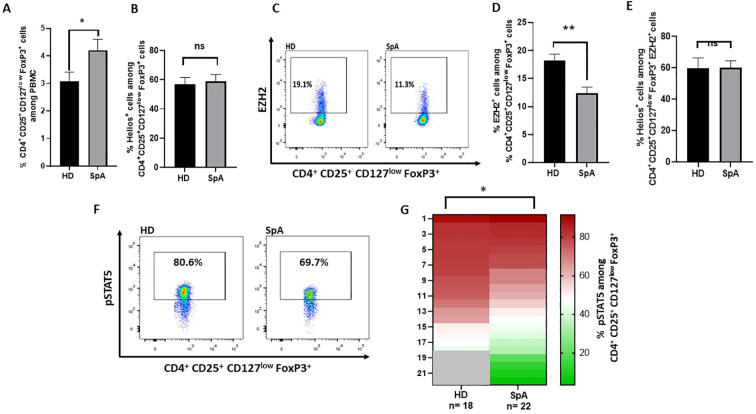
Figure 1
Figure 1
EZH2, pSTAT5 and Helios expression in Treg from axSpA patients and healthy donors (HD). (A-F) Flow cytometry experiments were performed using peripheral blood mononuclear cells (PBMC) from axSpA patients and from healthy donors (HD). (A) Frequency of Treg (CD4 + CD25 + CD127low FoxP3 + ) from axSpA patients (n=16) and HD (n=16). (B) Frequency of Helios + cells among Treg (CD4 + CD25 + CD127low FoxP3 + ) from axSpA patients (n=16) (cohort 1) and HD (n=16). (C) Representative dot plot of EZH2 expression among CD4 + CD25 + CD127low FoxP3 + cells in axSpA patients and HD. (D) Frequency of EZH2 + cells among Treg (CD4 + CD25 + CD127low FoxP3 + ) from axSpA patients (cohort 1) (n=16) and HD (n=17). (E) Frequency of Helios + cells among EZH2+ Treg (CD4 + CD25 + CD127low FoxP3 + ) from axSpA patients (cohort 1) (n=16) and HD (n=17). (F) Representative dot plot of pSTAT5 + Treg (CD4 + CD25 + CD127low FoxP3 +) frequency among the indicated individuals. (G) Heatmap showing the frequency of pSTAT5 + cells among Treg (CD4 + CD25 + CD127low FoxP3 + ) from axSpA patients naïve of targeted therapy (cohort 2) (n=22) and HD (n=18). Data are expressed as mean ± SEM. Unpaired t-test were used for statistical analysis. *p< 0.05; **p<0.01. ns, non significant.
Figure 2
Figure 2
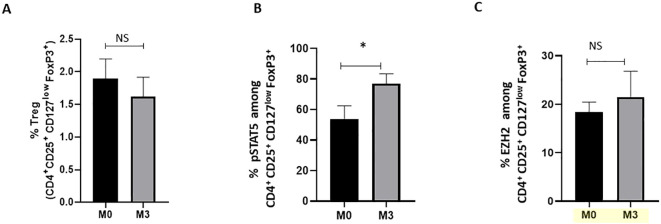
Impact of TNFi treatments on pSTAT5 and EZH2 expression in Treg from axSpA patients. Flow cytometry was used to analyse cells at baseline (M0) and 3 months (M3) after TNFi (adalimumab (n=6), infliximab (n=1), etanercept (n=3), certolizumab (n=1)) of axSpA patients (n=11) (cohort 3). (A) Percentage of CD4 + FoxP3 + Treg in peripheral blood. (B, C) Frequency of pSTAT5 + and EZH2 + cells among CD4 + CD25 + FoxP3 + CD127low Treg from axSpA patients at M0 and M3, respectively. Data are expressed as mean ± SEM. A Wilcoxon matched-pairs signed-rank test was used for statistical analysis. *p≤ 0.05. ns, non significant.

References

    1. Rodolfi S, Davidson C, Vecellio M. Regulatory T cells in spondyloarthropathies: genetic evidence, functional role, and therapeutic possibilities. Front Immunol. (2024) 14:1303640. doi: 10.3389/fimmu.2023.1303640 - DOI - PMC - PubMed
    1. Miao J, Zhu P. Functional defects of Treg cells: new targets in rheumatic diseases, including ankylosing spondylitis. Curr Rheumatol Rep. (2018) 20:30. doi: 10.1007/s11926-018-0729-1 - DOI - PubMed
    1. Sumida TS, Cheru NT, Hafler DA. The regulation and differentiation of regulatory T cells and their dysfunction in autoimmune diseases. Nat Rev Immunol. (2024) 24:503–17. doi: 10.1038/s41577-024-00994-x - DOI - PMC - PubMed
    1. Qiu R, Zhou L, Ma Y, Zhou L, Liang T, Shi L, et al. Regulatory T cell plasticity and stability and autoimmune diseases. Clin Rev Allergy Immunol. (2020) 58:52−70. doi: 10.1007/s12016-018-8721-0 - DOI - PubMed
    1. Lam AJ, Uday P, Gillies JK, Levings MK. Helios is a marker, not a driver, of human Treg stability. Eur J Immunol. (2022) 52:75−84. doi: 10.1002/eji.202149318 - DOI - PubMed

Substances

LinkOut - more resources