


Accommodative behaviour and retinal defocus in highly myopic eyes fitted with a dual focus myopia control contact lens
- PMID: 39569764
- PMCID: PMC11629841
- DOI: 10.1111/opo.13420
Accommodative behaviour and retinal defocus in highly myopic eyes fitted with a dual focus myopia control contact lens
Abstract
Purpose: To evaluate the myopic and hyperopic defocus delivered to the retina by a dual focus (DF) myopia control contact lens when myopia exceeds 6.00 D.
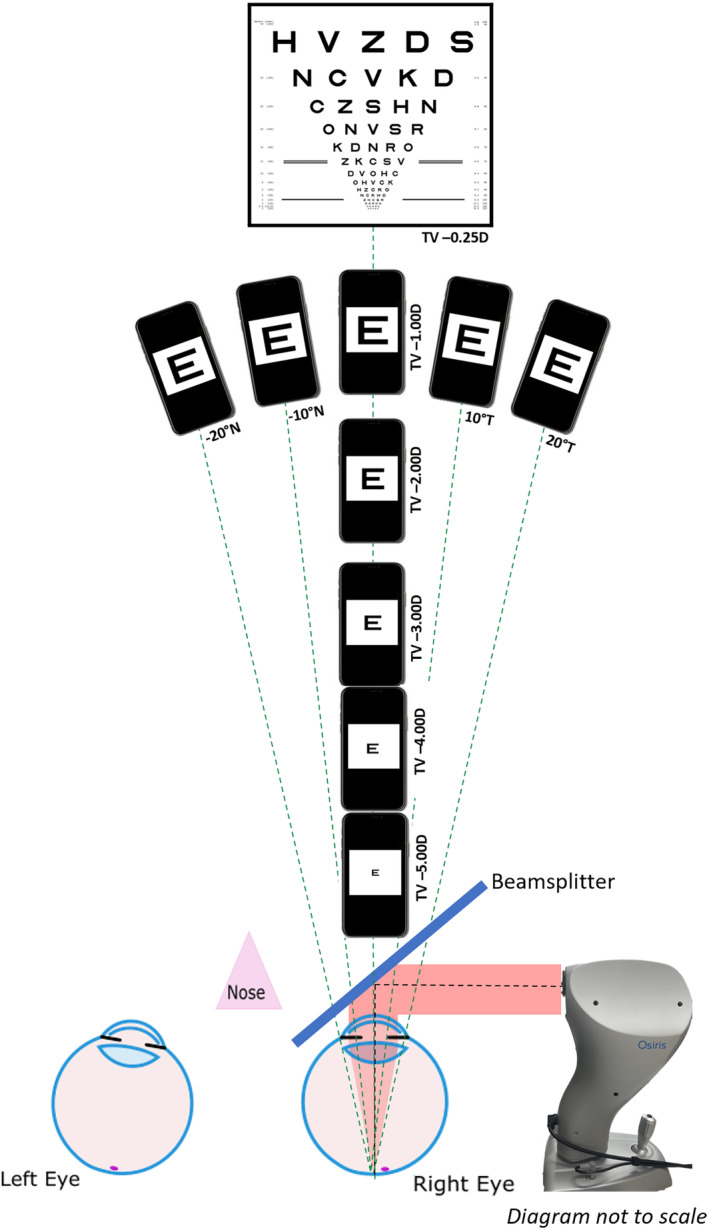
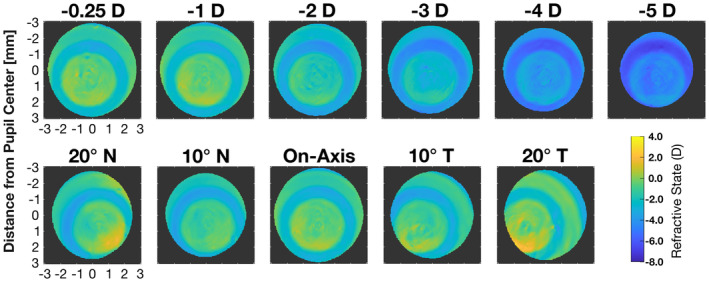
Methods: Individuals with high myopia were fitted bilaterally with high-powered DF lenses containing power profiles matching a Coopervision MiSight 1 day contact lens (omafilcon A) and a Coopervision Proclear 1 day single vision (SV) lens. Wavefront measurements along the primary line of sight and across the central ±20° of the horizontal retina were acquired using a pyramidal aberrometer, while subjects accommodated to high-contrast letter stimuli (6/12 equivalent) at six target vergences (-0.25 and -1.00 to -5.00 D). Linear mixed-effects regression models explored the relationship between the spherical equivalent refractive error (SERE) and induced defocus.
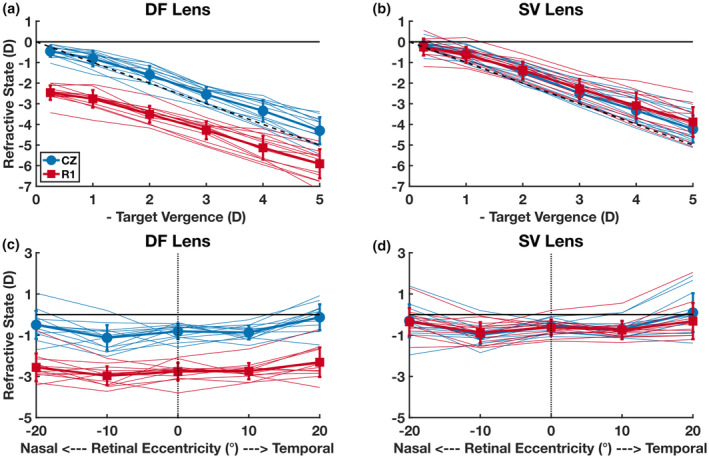
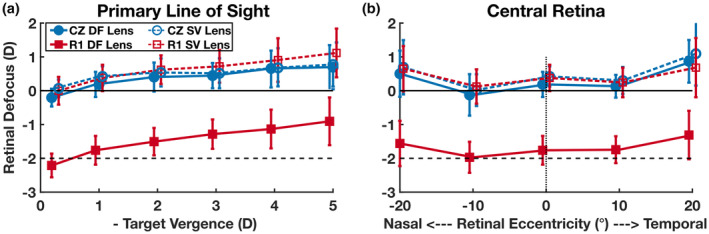
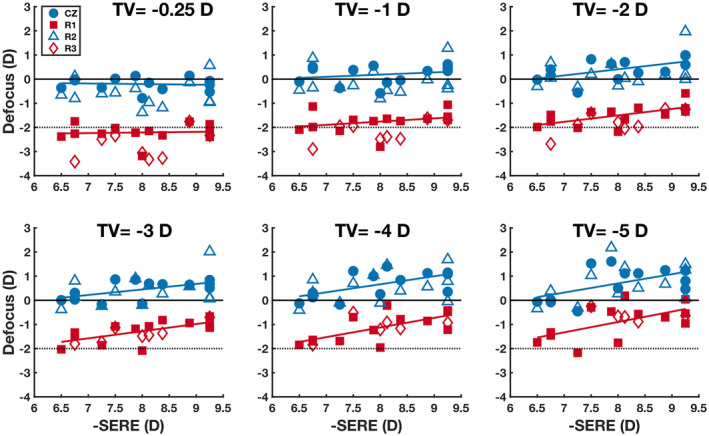
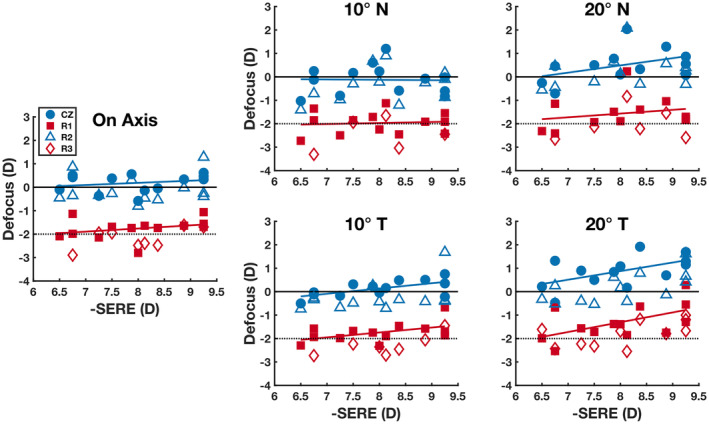
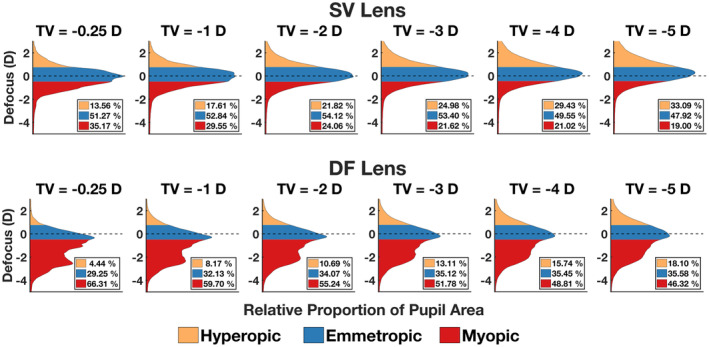
Results: Thirteen teenagers and young adults (ages 13-32 years, mean [standard deviation, SD] age = 22.8 [4.9] years) with high myopia (SERE -6.50 to -9.25 D) were tested. The treatment optic zone of the DF lens shifted retinal defocus by the expected -2.00 D, with a mean (SD) difference (DF-SV) of -2.21 (0.18) D for the inner treatment ring. Inclusion of the treatment optic had no significant impact on accommodative accuracy (p = 0.51). Accommodative lags were larger at the nearer viewing distances, with lag increasing by approximately 0.30 D for every additional dioptre of SERE. Measured retinal defocus within the annular treatment zone was approximately -2.00 D at the foveal centre, 10° nasal and temporal and 20° nasal and reduced to -1.90 (0.57) D at 20° temporal.
Conclusions: Relative to eyes with lower levels of myopia, the increased accommodative lags and more prolate retinas of highly myopic eyes reduced the myopic retinal defocus from the DF myopia control lens, while the treatment optical zones generated the combined effect of reducing hyperopic and introducing myopic retinal defocus relative to an SV correction.
Keywords: accommodative behaviour; contact lenses; dual focus contact lenses; high myopia; myopia control; retinal defocus.
© 2024 The Author(s). Ophthalmic and Physiological Optics published by John Wiley & Sons Ltd on behalf of College of Optometrists.
Conflict of interest statement
DM: none; JG: none; MR: consultant: CooperVision Inc., SightGlass Vision; NM: none; PC: employee, CooperVision Inc.; AB: employee, CooperVision Inc. PK: research: Alcon, CooperVision Inc., EssilorLuxottica, Hoya, Johnson and Johnson Vision, SightGlass Vision; PK: consultant EssilorLuxottica, SightGlass Vision.
Figures
References
-
- Jung SK, Lee JH, Kakizaki H, Jee D. Prevalence of myopia and its association with body stature and educational level in 19‐year‐old male conscripts in Seoul, South Korea. Invest Ophthalmol Vis Sci. 2012;53:5579–5583. - PubMed
-
- Sun J, Zhou J, Zhao P, Lian J, Zhu H, Zhou Y, et al. High prevalence of myopia and high myopia in 5060 Chinese university students in Shanghai. Invest Ophthalmol Vis Sci. 2012;53:7504–7509. - PubMed
-
- Holden BA, Fricke TR, Wilson DA, Jong M, Naidoo KS, Sankaridurg P, et al. Global prevalence of myopia and high myopia and temporal trends from 2000 through 2050. Ophthalmology. 2016;123:1036–1042. - PubMed
-
- Willis JR, Vitale S, Morse L, Parke DW 2nd, Rich WL, Lum F, et al. The prevalence of myopic choroidal neovascularization in the United States: analysis of the IRIS(®) data registry and NHANES. Ophthalmology. 2016;123:1771–1782. - PubMed
-
- Lin LL, Shih YF, Hsiao CK, Chen CJ. Prevalence of myopia in Taiwanese schoolchildren: 1983 to 2000. Ann Acad Med Singapore. 2004;33:27–33. - PubMed
MeSH terms
Grants and funding
LinkOut - more resources
Full Text Sources
Miscellaneous
