


The clinical and microbiological efficacy of a zinc-citrate/hydroxyapatite/potassium-citrate containing toothpaste: a double-blind randomized controlled clinical trial
- PMID: 39572408
- PMCID: PMC11582097
- DOI: 10.1007/s00784-024-06052-z
The clinical and microbiological efficacy of a zinc-citrate/hydroxyapatite/potassium-citrate containing toothpaste: a double-blind randomized controlled clinical trial
Abstract
Objectives: To evaluate the antibacterial efficacy of two fluoride-containing (1450 ppm F) toothpastes with or without zinc-citrate (ZCT), hydroxyapatite (HAP) and potassium-citrate (KCit); to assess and compare their clinical effects in terms of tooth sensitivity, plaque accumulation and gingivitis, as well as patients' satisfaction.
Materials and methods: Healthy, adult patients were selected and randomly assigned to two groups (n = 50): Experimental: ZCT-, HAP-, KCit- and fluoride-containing toothpaste; Control: fluoride-containing toothpaste. Salivary counts of Streptococcus mutans (S. mutans), plaque and gingival index, as well as clinically diagnosed sensitivity were recorded at baseline, and after 4 weeks. A custom-made questionnaire was used to assess patients' self-reported sensitivity (baseline and after 4 weeks) and overall satisfaction with the tested toothpastes. Data were statistically analyzed (α = 0.05).
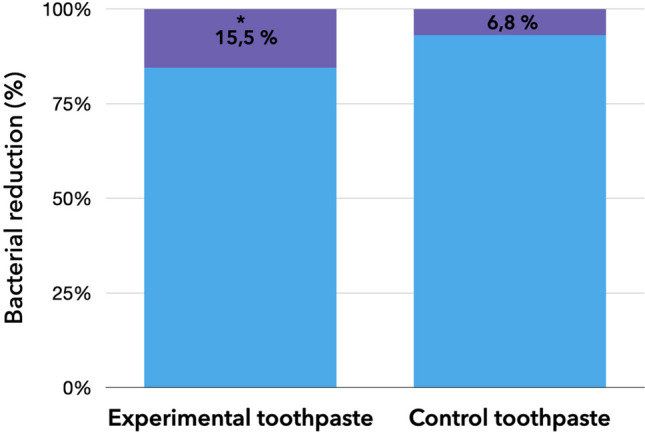
Results: After 4 weeks, a statistically significant salivary reduction of S. mutans was observed in both groups (p = 0.001). Furthermore, the percentage of S. mutans decrease was significantly higher in Experimental group (p = 0.014). There were no statistically significant differences between the groups in terms of plaque and gingival index (p > 0.05). After 4 weeks, the self-reported tooth sensitivity was lower in Experimental group (p < 0.001).
Conclusions: Both toothpastes showed good antimicrobial effect after 4 weeks; however, the toothpaste containing ZCT, HAP, KCit and fluoride was found to be more effective in reducing the salivary counts of S. mutans than the product containing fluoride alone.
Clinical relevance: Toothpaste containing ZCT, HAP, KCit and fluoride can be recommended for patients at risk for developing caries and may also be beneficial for individuals experiencing dental sensitivity.
Keywords: Antimicrobial; Dentin sensitivity; Fluoride; Hydroxyapatite; Randomized clinical trial; Toothpaste; Zinc citrate.
© 2024. The Author(s).
Conflict of interest statement
Declarations. Ethical approval: The study protocol was reviewed and approved by the University of Bologna Ethics Committee (793/2022/SPER/AUSLBO). Informed consent: A written informed consent was obtained from patients before their enrollment in the study. Competing interests: The authors declare no competing interests.
Figures


References
-
- Dye BA, Hsu K-LC, Afful J (2015) Prevalence and measurement of dental caries in young children. Pediatr Dent 37:200–216 - PubMed
-
- Borg-Bartolo R, Roccuzzo A, Mourelle PM, Schimmel M, Gambetta-Tessini K, Chaurasia A et al (2022) Global prevalence of edentulism and dental caries in middle-aged and elderly persons. A systematic review and meta-analysis. J Dent 127:104335. 10.1016/j.jdent.2022.104335 - PubMed
-
- Dos Anjos AMC, de Lima MDM, Muniz FWMG, Lima CCB, de Deus LFA, Rösing CK et al (2023) Is there an association between dental caries and genetics? systematic review and meta-analysis of studies with twins. J Dent 135:104586 - PubMed
-
- Wen P, Chen M, Zhong Y, Dong Q, Wong H (2022) Global burden and inequality of dental caries, 1990 to 2019. J Dent Res 101:392–399 - PubMed
Publication types
MeSH terms
Substances
LinkOut - more resources
Full Text Sources
