


Self-measurement of blood pressure at home using a cuff device for change in blood pressure levels: systematic review and meta-analysis
- PMID: 39572787
- PMCID: PMC11794135
- DOI: 10.1038/s41440-024-01981-4
Self-measurement of blood pressure at home using a cuff device for change in blood pressure levels: systematic review and meta-analysis
Abstract
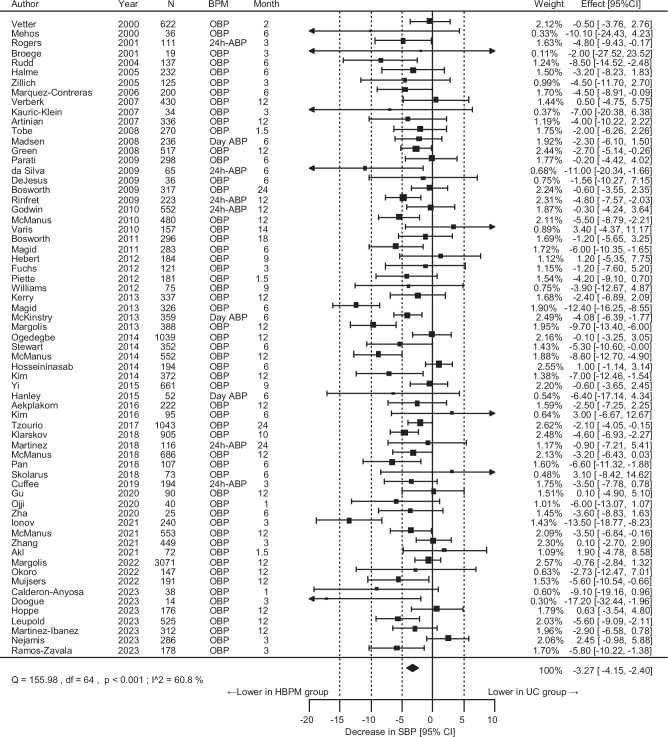
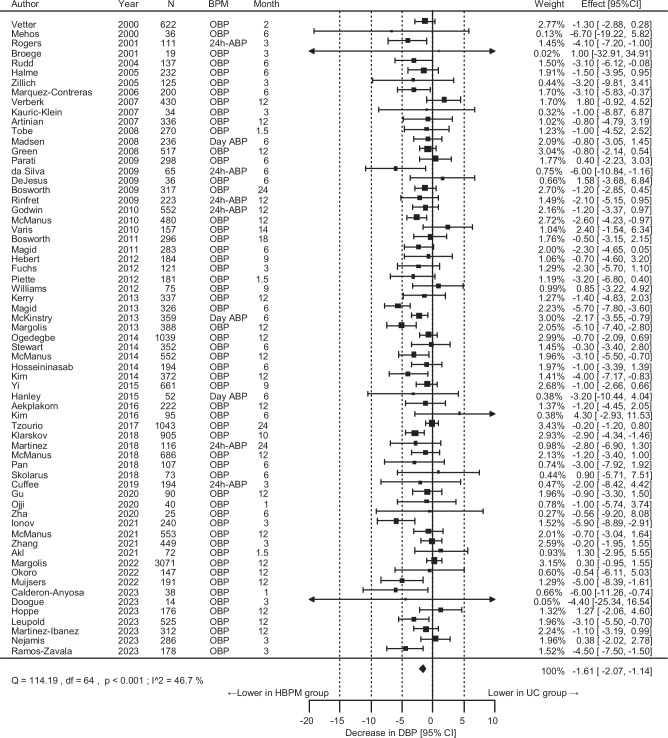
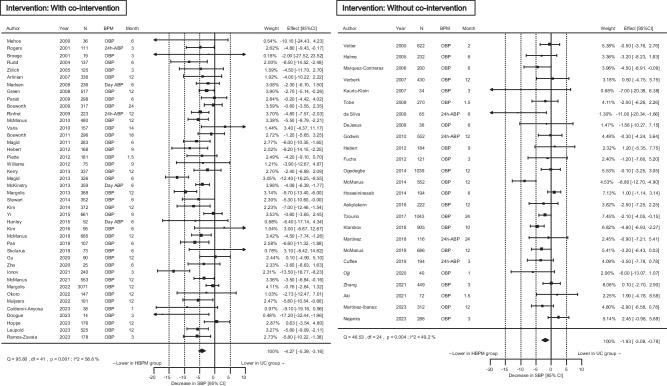
The effect of self-measurement of blood pressure (BP) at home (home BP measurement, HBPM) has been evaluated over the past decade. This meta-analysis included the latest studies to determine whether HBPM reduced BP (PROSPERO ID: CRD42023442225). PubMed, Cochrane Library Database, and IchuShi-Web were searched for randomized controlled trials after the year 2000 which demonstrated the effect of HBPM on BP change compared with usual care (UC). Overall, 65 articles (n = 21,053; 63 based on patients with hypertension) were included. The systolic/diastolic BP reduction was significantly greater in the HBPM than in the UC group by 3.27/1.61 mmHg (95% confidence intervals: 2.40-4.15/1.14-2.07) at the end of the intervention, and I2 values ≥ 46.7% suggested moderate-to-high heterogeneity. The funnel plots exhibited no notable publication bias (Egger's test p ≥ 0.16). HBPM with co-interventions (such as telemonitoring) showed a stronger BP-lowering effect than without co-interventions while the effect of HBPM on BP change remained significant in the absence of co-interventions. HBPM was not associated with systolic BP changes when we combined the four studies that used a wrist cuff device for HBPM. The number of antihypertensive medications increased by 0.17 medications in the HBPM group compared with that in the UC group. There were no significant differences in body mass index changes or risk of severe adverse outcomes between the groups. Our results demonstrated a beneficial effect of HBPM in reducing BP, particularly when used in conjunction with telemonitoring or additional medical support and when employing upper-arm cuff devices.
Keywords: Ambulatory; Blood pressure monitoring; Meta-analysis; Randomized controlled trial; Systematic review; Telemedicine.
© 2024. The Author(s).
Conflict of interest statement
Compliance with ethical standards. Conflict of interest: TO received honoraria (lecture fee) and a joint research grant from Omron Healthcare Co., Ltd.
Figures

Comment in
-
Does self-measurement of sleep blood pressure at home exert a favorable effect on blood pressure control?Hypertens Res. 2025 Feb;48(2):822-823. doi: 10.1038/s41440-024-02041-7. Epub 2024 Dec 4. Hypertens Res. 2025. PMID: 39633001 No abstract available.
References
-
- Umemura S, Arima H, Arima S, Asayama K, Dohi Y, Hirooka Y, et al. The Japanese Society of Hypertension Guidelines for the Management of Hypertension (JSH 2019). Hypertens Res. 2019;42:1235–481. - PubMed
-
- Whelton PK, Carey RM, Aronow WS, Casey DE Jr, Collins KJ, Dennison Himmelfarb C, et al. 2017 ACC/AHA/AAPA/ABC/ACPM/AGS/APhA/ASH/ASPC/NMA/PCNA guideline for the prevention, detection, evaluation, and management of high blood pressure in adults: a report of the American College of Cardiology/American Heart Association Task Force on Clinical Practice Guidelines. Hypertension 2018;71:e13–e115. - PubMed
-
- Satoh M, Asayama K, Kikuya M, Inoue R, Metoki H, Hosaka M, et al. Long-term stroke risk due to partial white-coat or masked hypertension based on home and ambulatory blood pressure measurements: the Ohasama study. Hypertension. 2016;67:48–55. - PubMed
-
- Mancia G, Kreutz R, Brunstrom M, Burnier M, Grassi G, Januszewicz A, et al. 2023 ESH Guidelines for the management of arterial hypertension The Task Force for the management of arterial hypertension of the European Society of Hypertension: endorsed by the International Society of Hypertension (ISH) and the European Renal Association (ERA). J Hypertens. 2023;41:1874–2071. - PubMed
Publication types
MeSH terms
LinkOut - more resources
Full Text Sources
Medical
Miscellaneous
