


Occupational risks of COVID-19: a case-cohort study using health insurance claims data in Germany
- PMID: 39574031
- PMCID: PMC11580653
- DOI: 10.1186/s12889-024-20706-3
Occupational risks of COVID-19: a case-cohort study using health insurance claims data in Germany
Abstract
Background: Studies on occupation and COVID-19 infection that cover a range of occupational groups and adjust for important confounders are lacking. This study aimed to estimate occupational risks of hospitalization with COVID-19 by taking into account sociodemographic factors and previous comorbidities.
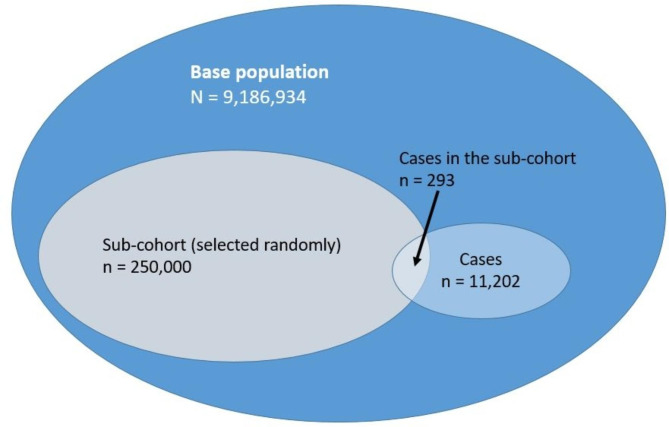
Methods: We applied a case-cohort design using workers insured with one of Germany's largest statutory health insurers as a data source for occupational and demographical information as well as for information on comorbidities. Cox regression models with denominator weights for cases and controls assessed relative risks of hospitalization with COVID-19 in 2020.
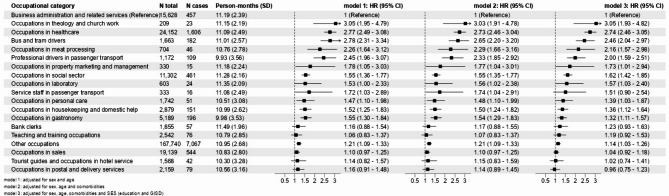
Results: The study consisted of 11,202 COVID-19 cases and 249,707 non-cases. After adjusting for age, sex, number of pre-existing comorbidities, and socioeconomic status, we found at least doubled risks for occupations in theology and church work (HR = 3.05; 95% CI 1.93-4.82), occupations in healthcare (HR = 2.74; 95% CI 2.46-3.05), for bus and tram divers (HR = 2.46; 95% CI 2.04-2.97), occupations in meat processing (HR = 2.16; 95% CI 1.57-2.98), and professional drivers in passenger transport (e.g. taxi drivers) (HR = 2.00; 95% CI 1.59-2.51). In addition, occupations in property marketing and management, social workers, laboratory workers, occupations in personal care (e.g. hairdressers), occupations in housekeeping and occupations in gastronomy all had statistically significantly increased risks compared to the reference population (administrative workers).
Conclusions: We identified occupations with increased risks for hospitalization with COVID-19. For those having a doubled risk it can be assumed that COVID-19 diseases are predominantly occupationally related. By identifying high-risk occupations in non-healthcare professions, effective measures to prevent infections in the workplace can be developed, also in case of a future pandemic.
Keywords: COVID-19; Hospitalization risk; Occupation; SARS-CoV-2; Work.
© 2024. The Author(s).
Conflict of interest statement
Declarations. Ethics approval: This study was performed in line with the principles of the Declaration of Helsinki. Approval was granted by the Ethics Committee of the Technische Universität Dresden (No. BO-EK-160042022). Consent to participate: This study was performed as an observational study in routinely collected healthcare data after de-personalization according to German legislation on data protection (Bundesdatenschutzgesetz) and social law (Sozialgesetzbuch). The statistical analyses are based on anonymous data and it was neither possible nor adequate to obtained informed consent from study participants. Consent for publication: Not applicable. Competing interests: The authors declare no competing interests.
Figures
References
-
- Gómez-Ochoa SA, Franco OH, Rojas LZ, Raguindin PF, Roa-Díaz ZM, Wyssmann BM et al. COVID-19 in Health-Care Workers: A Living Systematic Review and Meta-Analysis of Prevalence, Risk Factors, Clinical Characteristics, and Outcomes. Am J Epidemiol. 2021;190(1):161 – 75.10.1093/aje/kwaa191. - PMC - PubMed
-
- Bundesanstalt für. Arbeitsschutz und Arbeitsmedizin (BAuA). Liste der Berufskrankheiten. 2021.
MeSH terms
LinkOut - more resources
Full Text Sources
Medical
Miscellaneous
