. 2024 Nov 22;17(1):84.
doi: 10.1186/s13041-024-01160-z.

Intravitreal injection of the Galectin-3 inhibitor TD139 provides neuroprotection in a rat model of ocular hypertensive glaucoma

Affiliations

Intravitreal injection of the Galectin-3 inhibitor TD139 provides neuroprotection in a rat model of ocular hypertensive glaucoma

Anne Rombaut et al. Mol Brain. .

Abstract

Neuroinflammation is a significant contributor to the pathology of glaucoma. Targeting key-mediators in this process is a realistic option to slow disease progression. Galectin-3 is a β-galactoside binding lectin that has been associated with inflammation in both systemic and central nervous system diseases. Elevated Galectin-3 has recently been detected in multiple animal models of glaucoma and inhibiting Galectin-3 using an intravitreal injection of TD139 (a Galectin-3 small molecule inhibitor) is neuroprotective. We queried whether this neuroprotective effect was translatable to another animal model and species. TD139 was intravitreally injected, in a rat ocular hypertensive model of glaucoma, 3 days after the induction of ocular hypertension (at peak intraocular pressure). Retinal ganglion cell survival and glial morphological markers were quantified. The degeneration of retinal ganglion cells was prevented by TD139 injection, but gross glial markers remained unaffected. These data confirm that the intravitreal injection of TD139 is neuroprotective in a rat ocular hypertensive model of glaucoma, while suggesting that the inhibition of Galectin-3 is not sufficient to alter the gross inflammatory outcome.

Keywords: Astrocytes; Galectin-3; Glaucoma; Microglia; Neurodegeneration; Neuroinflammation; Neuroprotection; Retina; Retinal ganglion cells; TD139.


Conflict of interest statement

Declarations. Ethics approval and consent to participate: All experimental procedures were undertaken following the Association for Research for Vision and Ophthalmology Statement for the Use of Animals in Ophthalmic and Research. Individual study protocols were approved by Stockholm’s Committee for Ethical Animal Research (10389 − 2018, 14053 − 2020, 3909 − 2023). Consent for publication: Not applicable. Competing interests: The authors declare that they have no competing interests.

Figures
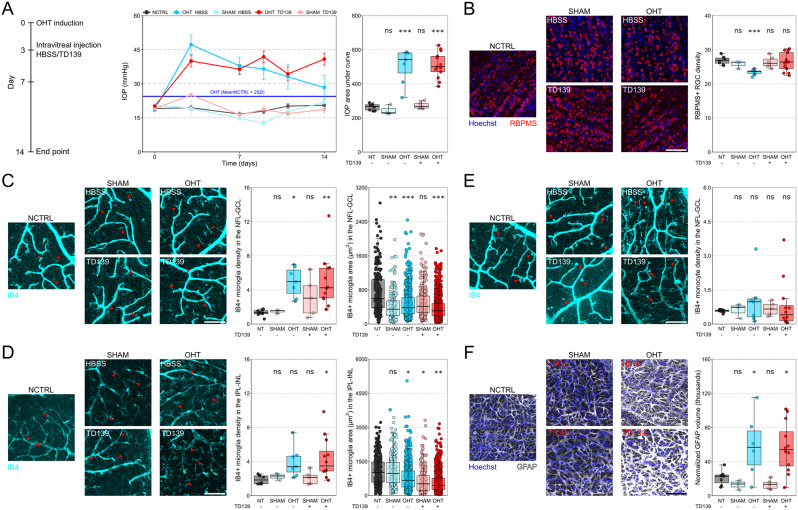
Fig. 1
Fig. 1
Intravitreal injection of TD139 results in neuroprotection but does not limit gross inflammation. A) Rats received TD139 (or vehicle) intravitreally 3 days after the induction of OHT. The IOP profile over time and area under the curve was comparable for OHT-HBSS and OHT-TD139. B) The density of RGCs (RBPMS+) was significantly lower for the OHT-HBSS group compared to the normotensive control (NCTRL) group, which was prevented by TD139 injection. C) In the NFL-GCL, the density of microglia (IB4+; examples denoted by red arrows) was significantly higher for the OHT-HBSS and OHT-TD139 group compared to the NCTRL group, and microglia surface area was significantly lower for all groups except for the SHAM-TD139 group compared to the NCTRL group. D) In the IPL-INL, microglia (IB4+; examples denoted by red arrows) density was significantly higher for the OHT-TD139 group compared to the NCTRL group, and microglia surface area was significantly lower for all groups except for the SHAM-HBSS group compared to the NCTRL group. E) The monocyte (IB4+; examples denoted by red arrows) density in the NFL-GCL did not change significantly for any of the groups compared to the NCTRL group. F) Astrocyte (GFAP+) volume in the NFL was significantly higher for the OHT-HBSS and OHT-TD139 group compared to the NCTRL group. ns = P > 0.05, * = P < 0.05, ** = P < 0.01, *** = P < 0.001. For B-F, scale bar = 100 μm. For B, C-D (left panels), and E-F data are normalized to 0.01 mm2 of retinal surface area. Conditions were: NCTRL (naïve normotensive controls; no bead injection, no intravitreal injection; n = 8 retina), SHAM-HBSS (sham controls; bead injection without OHT, intravitreal injection of vehicle; n = 3 retina), SHAM-TD139 (drug controls; bead injection without OHT, intravitreal injection of TD139; n = 6 retina), OHT-HBSS (OHT controls; bead injection resulting in OHT, intravitreal injection of vehicle; n = 7 retina), and OHT-TD139 (OHT drug treated; AC injection resulting in OHT, intravitreal injection of TD139; n = 13 retina)

References

    1. Giri PM, Banerjee A, Ghosal A, Layek B. Neuroinflammation in neurodegenerative disorders: current knowledge and therapeutic implications. Int J Mol Sci. 2024;25(7). - PMC - PubMed
    1. Quaranta L, Bruttini C, Micheletti E, Konstas AGP, Michelessi M, Oddone F, et al. Glaucoma and neuroinflammation: an overview. Surv Ophthalmol. 2021;66(5):693–713. - PubMed
    1. Hara A, Niwa M, Noguchi K, Kanayama T, Niwa A, Matsuo M et al. Galectin-3 as a next-generation biomarker for detecting early stage of various diseases. Biomolecules. 2020;10(3). - PMC - PubMed
    1. Lozinski BM, Ta K, Dong Y. Emerging role of galectin 3 in neuroinflammation and neurodegeneration. Neural Regen Res. 2024;19(9):2004–9. - PMC - PubMed
    1. Ge MM, Chen N, Zhou YQ, Yang H, Tian YK, Ye DW. Galectin-3 in microglia-mediated neuroinflammation: implications for Central Nervous System diseases. Curr Neuropharmacol. 2022;20(11):2066–80. - PMC - PubMed

MeSH terms

LinkOut - more resources
