Review
. 2024 Nov 21;23(1):261.
doi: 10.1186/s12943-024-02165-x.

Metabolic reprogramming and therapeutic resistance in primary and metastatic breast cancer

Affiliations
Review

Metabolic reprogramming and therapeutic resistance in primary and metastatic breast cancer

Shan Liu et al. Mol Cancer. .

Abstract

Metabolic alterations, a hallmark of cancer, enable tumor cells to adapt to their environment by modulating glucose, lipid, and amino acid metabolism, which fuels rapid growth and contributes to treatment resistance. In primary breast cancer, metabolic shifts such as the Warburg effect and enhanced lipid synthesis are closely linked to chemotherapy failure. Similarly, metastatic lesions often display distinct metabolic profiles that not only sustain tumor growth but also confer resistance to targeted therapies and immunotherapies. The review emphasizes two major aspects: the mechanisms driving metabolic resistance in both primary and metastatic breast cancer, and how the unique metabolic environments in metastatic sites further complicate treatment. By targeting distinct metabolic vulnerabilities at both the primary and metastatic stages, new strategies could improve the efficacy of existing therapies and provide better outcomes for breast cancer patients.


Conflict of interest statement

Declarations. Competing interests: The authors declare no competing interests.

Figures

Fig. 1
Fig. 1
Metabolic Reprogramming and Drug Resistance in Breast Cancer. Metabolic reprogramming drives drug resistance in breast cancer cells. Glycolysis converts glucose into lactate, which is exported by MCTs, creating a barrier that limits drug penetration. Pyruvate enters the TCA cycle in the mitochondria, producing energy molecules like NADH and FADH2 that support cell survival. Amino acid metabolism, particularly involving glutamine and glutamate, supplies crucial intermediates for cellular functions. Lipid metabolism, regulated by the mTOR signaling pathway, influences fatty acid oxidation and maintains energy homeostasis. These metabolic adaptations enable breast cancer cells to withstand therapeutic stress, promoting drug resistance
Fig. 2
Fig. 2
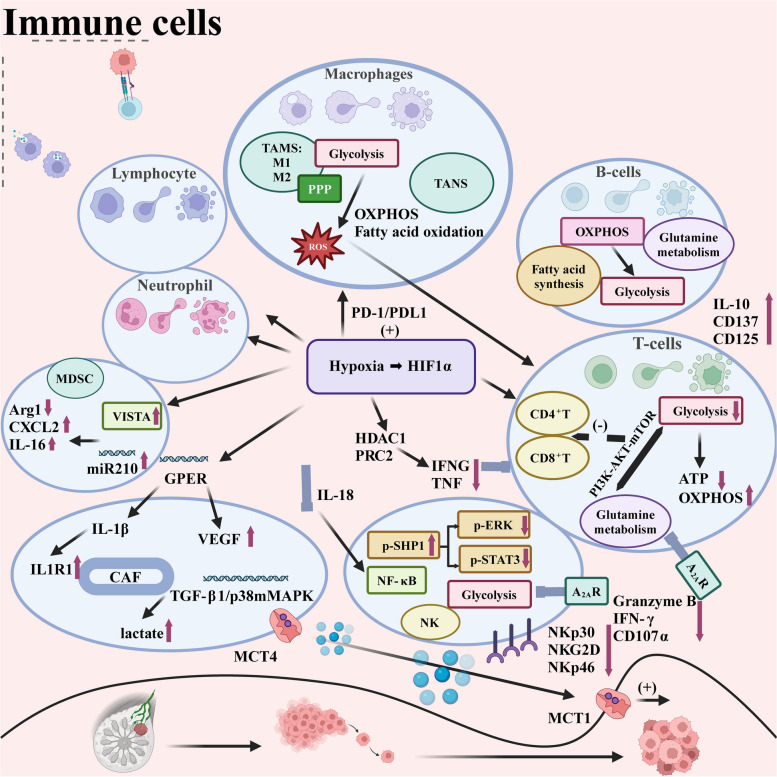
Metabolic Reprogramming of Immune Cells in the Hypoxic Tumor Microenvironment.Under hypoxic conditions, immune cells undergo metabolic shifts that foster immunosuppression and drug resistance. TAMs rely on glycolysis and OXPHOS, generating ROS to mediate immunosuppression. B and T cells display altered glucose and glutamine metabolism, resulting in the upregulation of immunosuppressive factors such as IL-10, CD137, and CD125. TANs and MDSCs, through VISTA and associated pathways, promote immune evasion. CAFs export lactate via MCT4, activating the TGF-β1/p38 MAPK pathway, which reinforces tumor resistance
Fig. 3
Fig. 3
Key Mechanisms of Metabolic and Immune Modulation in the Tumor Microenvironment. A Nerve cells secrete norepinephrine, activating β-adrenergic receptors and triggering the PI3K/AKT/mTOR pathway. This enhances glucose metabolism and lactate production, with mTOR and HIF-1α upregulation intensifying inflammation and metabolic dysfunction, contributing to drug resistance. B In the tumor vascular niche, endothelial cells under hypoxic conditions regulate angiogenesis via VEGFR2, FGFR, and other receptor-mediated pathways. This involves glycolysis, degradation of the basement membrane, endothelial progenitor cell migration, and the formation of abnormal blood vessels, promoting tumor vascularization and resistance to therapy. C Bacterial metabolism, particularly lactate production and microenvironment acidification, modulates the activity of tumor-associated immune cells, such as TAMs, DCs, and T cells. This induces cytokine release and inflammatory responses, further enhancing tumor cell resistance
Fig. 4
Fig. 4
Molecular Mechanisms of Breast Cancer Metastasis, Drug Resistance, and Target Organ Selection.A Breast cancer cells acquire both intrinsic and adaptive drug resistance during metastasis through genetic mutations, clonal selection, and therapy-induced adaptations, complicating treatment strategies. B Tumor-Derived Factors. Direct Factors: VEGF, PlGF, TGF-β, MMP9, and exosomes promote angiogenesis, cell migration, and microenvironment remodeling, facilitating metastatic niche formation in target organs. Indirect Factors: MMP2, HIF-1α, CXCL1/CXCL12, and neutrophils enhance invasiveness and immune evasion, supporting metastasis across multiple organs. C Brain Metastasis: Breakdown of the blood-brain barrier, mediated by CXCL12, VEGF, and exosomes, promotes tumor cell colonization and angiogenesis in the brain. D Lung Metastasis: VEGF, MMP9, and LOX drive angiogenesis, extracellular matrix degradation, and cell adhesion, promoting tumor growth and dissemination in the lungs. E Bone Metastasis: Tumor cells trigger bone destruction via the RANKL-RANK signaling pathway and TGF-β release, creating a vicious cycle that accelerates bone metastasis. F Liver Metastasis: HIF-1α, VEGF, and CXCL12 foster fibrosis, immune modulation, and angiogenesis, facilitating tumor colonization and growth in the liver
Fig. 5
Fig. 5
Metabolic Pathways Driving Breast Cancer Metastasis and Drug Resistance.The upper left panel outlines the metastatic process of circulating tumor cells, emphasizing the role of the TME and the involvement of blood and lymphatic vessels in promoting cancer cell spread. The upper right panel highlights mechanisms that confer drug resistance to circulating tumor cells. The lower panel details the metabolic reprogramming in breast cancer cells, focusing on key pathways such as glucose uptake via GLUT transporters and its conversion to lactate through glycolysis. Glutamine metabolism, facilitated by the ASCT2 transporter, is depicted alongside related processes like one-carbon metabolism, lipid synthesis, nucleotide biosynthesis, and iron metabolism. The regulatory role of mTORC1 is highlighted in these pathways, as well as the link between ferroptosis and iron metabolism, involving molecules like transferrin, ferritin, and TFR1. Essential mitochondrial functions, including the TCA cycle and fatty acid oxidation, are also shown, which support cancer cell survival and proliferation under stress, including resistance to therapies. This figure encapsulates the metabolic adaptations that enable tumor cells to metastasize and resist treatment

References

    1. Siegel RL, Giaquinto AN, Jemal A. Cancer statistics, 2024. CA Cancer J Clin. 2024;74:12–49. - DOI - PubMed
    1. Onkar SS, et al. The great Immune escape: understanding the Divergent Immune response in breast Cancer subtypes. Cancer Discov. 2023;13:23–40. - DOI - PMC - PubMed
    1. Nong S, et al. Metabolic reprogramming in cancer: mechanisms and therapeutics. MedComm (2020). 2023;4:e218. - DOI - PMC - PubMed
    1. Jin MZ, Jin WL. The updated landscape of tumor microenvironment and drug repurposing. Signal Transduct Target Ther. 2020;5:166. - DOI - PMC - PubMed
    1. Xia L, et al. The cancer metabolic reprogramming and immune response. Mol Cancer. 2021;20:28. - DOI - PMC - PubMed

Substances

LinkOut - more resources